
Title

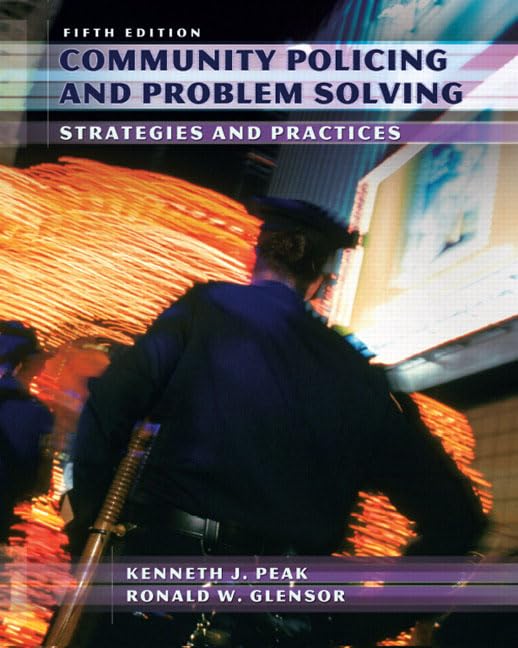
Community Policing and Problem Solving: Strategies and Practices,Used
Sold by Ergodebooks, an authorized reseller.
Returns accepted within 30 days | support@ergodebooks.com
Shipping Information
- Free Standard Shipping — United States only
- Processing Time: 3–5 business days
- Estimated Delivery: 6–10 business days after dispatch
- Double-boxed, fully insured & discreetly packaged
- Tracking number sent via email once dispatched
Returns & Refund
Returns accepted within 30 days of delivery.
Damaged or Defective Item
Free return shipping + replacement or full refund
Wrong Item Received
Free return shipping + replacement or full refund
Change of Mind
Return shipping at customer's expense · 25% restocking fee applies
Payment Option

This book is about policing at its most important and challenging levelsin neighborhoods and in communities across the nation and abroad. Unique in perspective, its focus is on community policing and problem solvingand the processes that are being implemented under COPPS to control and prevent crime, disorder and fear. Extremely applied, this book focuses on daily processes and tactics and how and why agencies are revolutionizing their traditional philosophy and operations. This fifth edition provides updated information on crime in the United States, more emphasis on terrorism and homeland defense, and a new chapter on information technology. Authoritative and practical perspectivecombines the classroom expertise of a seasoned criminal justice educator with the practical experience of an executivelevel police administrator. Communityoriented policing and problem solving (COPPS) focus provides a comprehensive view of how agencies are changing their management style, organizational structures, and operational strategies to attack crime, disorder and fear. Includes topics such as computeraided dispatch, mobile computing, records management, geomapping, CompStat, global positioning systems, use of the Internet, and surveys. Police practictioners with a fundamental knowledge of police history or operations or those working in a government agency outside policing and are interested in learning about community policing and problem solving.
⚠️ WARNING (California Proposition 65):
This product may contain chemicals known to the State of California to cause cancer, birth defects, or other reproductive harm.
For more information, please visit www.P65Warnings.ca.gov.
- Q: What is the main focus of 'Community Policing and Problem Solving: Strategies and Practices'? A: The book primarily focuses on community policing and problem-solving strategies aimed at controlling and preventing crime and disorder in neighborhoods and communities.
- Q: Who is the author of this book? A: The book is authored by Kenneth J. Peak, who combines academic expertise with practical experience in law enforcement.
- Q: What edition is this book? A: This is the fifth edition of the book, which includes updated information and new chapters.
- Q: What are some key topics covered in the book? A: Key topics include community-oriented policing, crime prevention strategies, technology in policing, and changes in police agency operations.
- Q: How many pages does the book contain? A: The book contains a total of 401 pages.
- Q: What type of binding does the book have? A: The book is available in a hardcover binding.
- Q: Is this book suitable for beginners in criminal justice? A: Yes, the book is suitable for police practitioners and individuals with a fundamental knowledge of police history or operations, providing practical insights into community policing.
- Q: When was this book published? A: The book was published on January 1, 2007.
- Q: What kind of perspective does the author provide? A: The author provides an authoritative and practical perspective, combining academic knowledge with real-world law enforcement experience.
- Q: Is this book focused more on theory or practical application? A: The book emphasizes practical application, focusing on daily processes and tactics in community policing.