
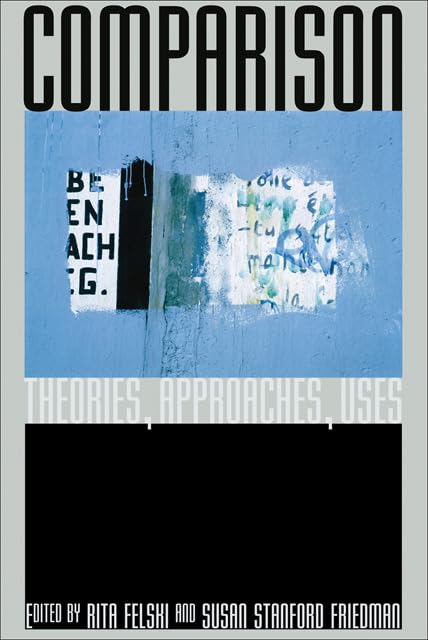
Title
Comparison: Theories, Approaches, Uses,Used
Sold by Ergodebooks, an authorized reseller.
Returns accepted within 30 days | support@ergodebooks.com
Shipping Information
- Free Standard Shipping — United States only
- Processing Time: 3–5 business days
- Estimated Delivery: 6–10 business days after dispatch
- Double-boxed, fully insured & discreetly packaged
- Tracking number sent via email once dispatched
Returns & Refund
Returns accepted within 30 days of delivery.
Damaged or Defective Item
Free return shipping + replacement or full refund
Wrong Item Received
Free return shipping + replacement or full refund
Change of Mind
Return shipping at customer's expense · 25% restocking fee applies
Payment Option

An extended volume of New Literary History that considers the practice of comparison in literary studies and other disciplines within the humanities.Writing and teaching across cultures and disciplines makes the act of comparison inevitable. Comparative theory and methods of comparative literature and cultural anthropology have permeated the humanities as they engage more centrally with the cultural flows and circulation of past and present globalization. How do scholars make ethically and politically responsible comparisons without assuming that their own values and norms are the standard by which other cultures should be measured?Comparison expands upon a special issue of the journal New Literary History, which analyzed theories and methodologies of comparison. Six new essays from senior scholars of transnational and postcolonial studies complement the original ten pieces. The work of Gayatri Chakravorty Spivak, Ella Shohat, Robert Stam, R. Radhakrishnan, Bruce Robbins, Ania Loomba, Haun Saussy, Linda Gordon, Walter D. Mignolo, Shumei Shih, and Pheng Cheah are included with contributions by anthropologists Caroline B. Brettell and Richard Handler. Historical periods discussed range from the early modern to the contemporary and geographical regions that encompass the globe. Ultimately, Comparison argues for the importance of greater selfreflexivity about the politics and methods of comparison in teaching and in research.
⚠️ WARNING (California Proposition 65):
This product may contain chemicals known to the State of California to cause cancer, birth defects, or other reproductive harm.
For more information, please visit www.P65Warnings.ca.gov.
- Q: How many pages does this book have? A: This book has three hundred fifty-two pages. It provides extensive insights into comparative literature and methodologies.
- Q: What is the binding type of this book? A: The binding type is paperback. This makes it flexible and lightweight for ease of handling.
- Q: What are the dimensions of this book? A: The dimensions are six inches in length, zero point eighty-three inches in width, and nine point zero two inches in height. It is designed for easy reading.
- Q: Who is the author of this book? A: The author is Rita Felski. She is well-known for her contributions to literary theory and criticism.
- Q: What category does this book fall under? A: This book falls under the category of Criticism and Theory. It explores various approaches to comparison in literature.
- Q: What is the main focus of this book? A: The main focus is on the practice of comparison in literary studies and other humanities disciplines. It discusses ethical and political responsibilities in comparison.
- Q: Is this book suitable for beginners? A: Yes, this book is suitable for both beginners and advanced scholars. It provides foundational theories as well as complex discussions.
- Q: How can I apply the theories discussed in this book? A: You can apply the theories by incorporating comparative methods in your own research or teaching practices, especially in cultural studies.
- Q: Is this book appropriate for academic research? A: Yes, this book is appropriate for academic research. It includes essays from senior scholars and comprehensive analyses.
- Q: How should I store this book to maintain its condition? A: Store this book in a cool, dry place away from direct sunlight. This will help preserve its pages and binding.
- Q: Can I clean the book if it gets dirty? A: No, it is not recommended to clean the book with water or chemicals. Gently dust it with a soft cloth instead.
- Q: What if the book arrives damaged? A: If the book arrives damaged, you should contact the seller for return instructions. Most sellers offer a replacement or refund.
- Q: Is there a warranty for this book? A: No, books typically do not come with a warranty. However, check with the seller for any specific return policies.
- Q: What if I want to return the book? A: You can return the book if it is within the return period set by the seller. Make sure it is in original condition.
- Q: Are there any notable contributors in this book? A: Yes, notable contributors include Gayatri Chakravorty Spivak and Ella Shohat among others. Their essays enrich the discussion.