If you have any questions, you are always welcome to contact us. We'll get back to you as soon as possible, withing 24 hours on weekdays.
Customer service
All questions about your order, return and delivery must be sent to our customer service team by e-mail at yourstore@yourdomain.com
Sale & Press
If you are interested in selling our products, need more information about our brand or wish to make a collaboration, please contact us at press@yourdomain.com
Help
If you have any questions, you are always welcome to contact us. We'll get back to you as soon as possible, withing 24 hours on weekdays.
Customer service
All questions about your order, return and delivery must be sent to our customer service team by e-mail at yourstore@yourdomain.com
Sale & Press
If you are interested in selling our products, need more information about our brand or wish to make a collaboration, please contact us at press@yourdomain.com
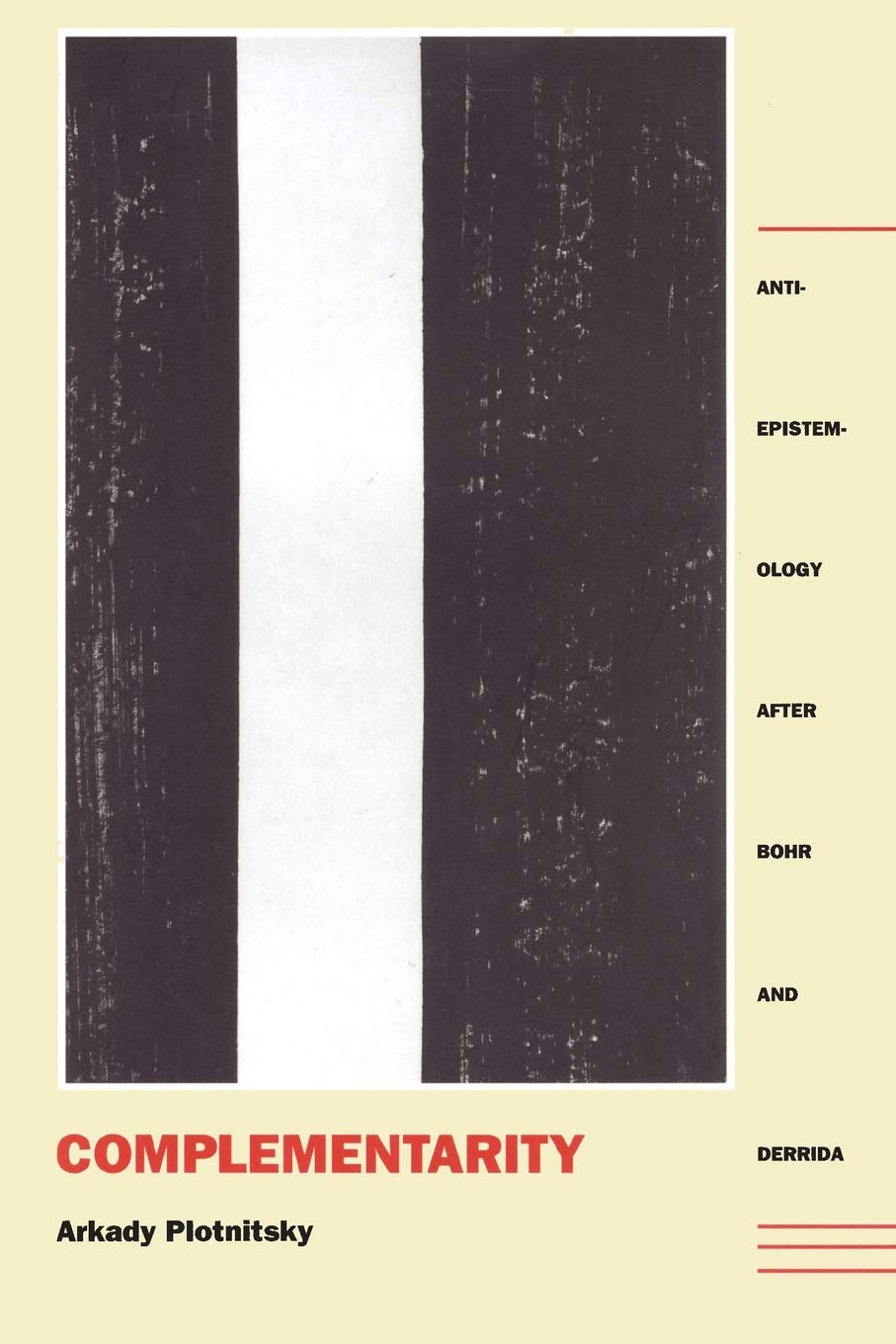
Many commentators have remarked in passing on the resonance between deconstructionist theory and certain ideas of quantum physics. In this book, Arkady Plotnitsky rigorously elaborates the similarities and differences between the two by focusing on the work of Niels Bohr and Jacques Derrida. In detailed considerations of Bohrs notion of complementarity and his debates with Einstein, and in analysis of Derridas work via Georges Batailles concept of general economy, Plotnitsky demonstrates the value of exploring these theories in relation to each other.Bohrs term complementarity describes a situation, unavoidable in quantum physics, in which two theories thought to be mutually exclusive are required to explain a single phenomenon. Light, for example, can only be explained as both wave and particle, but no synthesis of the two is possible. This theoretical transformation is then examined in relation to the ways that Derrida sets his work against or outside of Hegel, also resisting a similar kind of synthesis and enacting a transformation of its own.Though concerned primarily with Bohr and Derrida, Plotnitsky also considers a wide range of antiepistemological endeavors including the work of Nietzsche, Bataille, and the mathematician Kurt Gdel. Under the rubric of complementarity he develops a theoretical framework that raises new possiblilities for students and scholars of literary theory, philosophy, and philosophy of science.
⚠️ WARNING (California Proposition 65):
This product may contain chemicals known to the State of California to cause cancer,
birth defects, or other reproductive harm.
For MAP (Minimum Advertised Price) violations and Intellectual Property (IP) or Trademark concerns, please contact:
support@ergodebooks.com
⚠️ California Proposition 65 Warning: Some products sold on this website may expose you to chemicals known to the State of California to cause cancer, birth defects, or other reproductive harm. For more information, visit www.P65Warnings.ca.gov.