
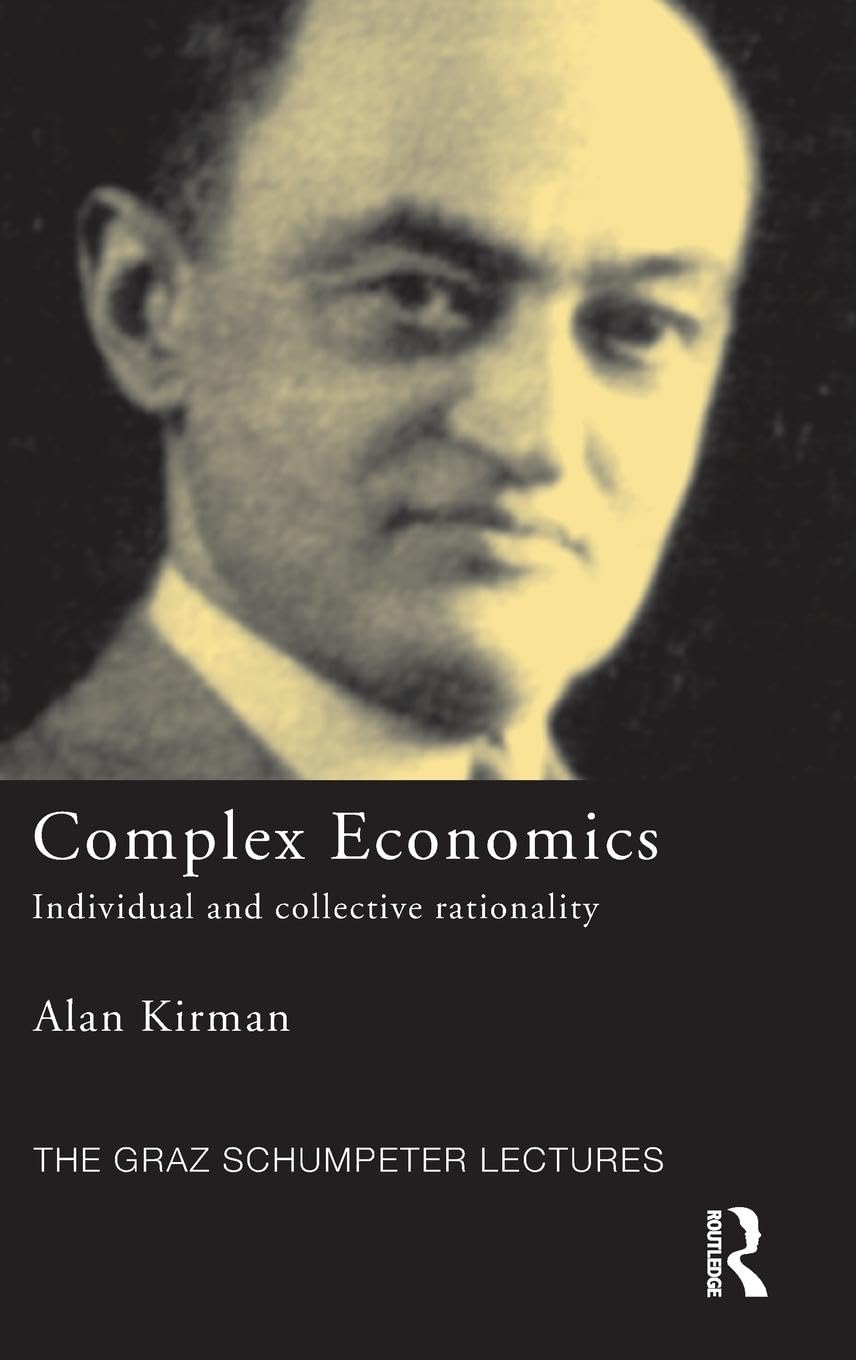
Title
Complex Economics: Individual And Collective Rationality (The Graz Schumpeter Lectures),New
Sold by Ergodebooks, an authorized reseller.
Returns accepted within 30 days | support@ergodebooks.com
Shipping Information
- Free Standard Shipping — United States only
- Processing Time: 3–5 business days
- Estimated Delivery: 6–10 business days after dispatch
- Double-boxed, fully insured & discreetly packaged
- Tracking number sent via email once dispatched
Returns & Refund
Returns accepted within 30 days of delivery.
Damaged or Defective Item
Free return shipping + replacement or full refund
Wrong Item Received
Free return shipping + replacement or full refund
Change of Mind
Return shipping at customer's expense · 25% restocking fee applies
Payment Option

The economic crisis is also a crisis for economic theory. Most analyses of the evolution of the crisis invoke three themes, contagion, networks and trust, yet none of these play a major role in standard macroeconomic models. What is needed is a theory in which these aspects are central. The direct interaction between individuals, firms and banks does not simply produce imperfections in the functioning of the economy but is the very basis of the functioning of a modern economy. This book suggests a way of analysing the economy which takes this point of view.The economy should be considered as a complex adaptive system in which the agents constantly react to, influence and are influenced by, the other individuals in the economy. In such systems which are familiar from statistical physics and biology for example, the behaviour of the aggregate cannot be deduced from the behaviour of the average, or 'representative' individual. Just as the organised activity of an ants nest cannot be understood from the behaviour of a 'representative ant' so macroeconomic phenomena should not be assimilated to those associated with the 'representative agent'. This book provides examples where this can clearly be seen. The examples range from Schellings model of segregation, to contributions to public goods, the evolution of buyer seller relations in fish markets, to financial models based on the foraging behaviour of ants.The message of the book is that coordination rather than efficiency is the central problem in economics. How do the myriads of individual choices and decisions come to be coordinated? How does the economy or a market, 'self organise' and how does this sometimes result in major upheavals, or to use the phrase from physics, 'phase transitions'? The sort of system described in this book is not in equilibrium in the standard sense, it is constantly changing and moving from state to state and its very structure is always being modified. The economy is not a ship sailing on a welldefined trajectory which occasionally gets knocked off course. It is more like the slime described in the book 'emergence', constantly reorganising itself so as to slide collectively in directions which are neither understood nor necessarily desired by its components.
⚠️ WARNING (California Proposition 65):
This product may contain chemicals known to the State of California to cause cancer, birth defects, or other reproductive harm.
For more information, please visit www.P65Warnings.ca.gov.