If you have any questions, you are always welcome to contact us. We'll get back to you as soon as possible, withing 24 hours on weekdays.
Customer service
All questions about your order, return and delivery must be sent to our customer service team by e-mail at yourstore@yourdomain.com
Sale & Press
If you are interested in selling our products, need more information about our brand or wish to make a collaboration, please contact us at press@yourdomain.com
Help
If you have any questions, you are always welcome to contact us. We'll get back to you as soon as possible, withing 24 hours on weekdays.
Customer service
All questions about your order, return and delivery must be sent to our customer service team by e-mail at yourstore@yourdomain.com
Sale & Press
If you are interested in selling our products, need more information about our brand or wish to make a collaboration, please contact us at press@yourdomain.com
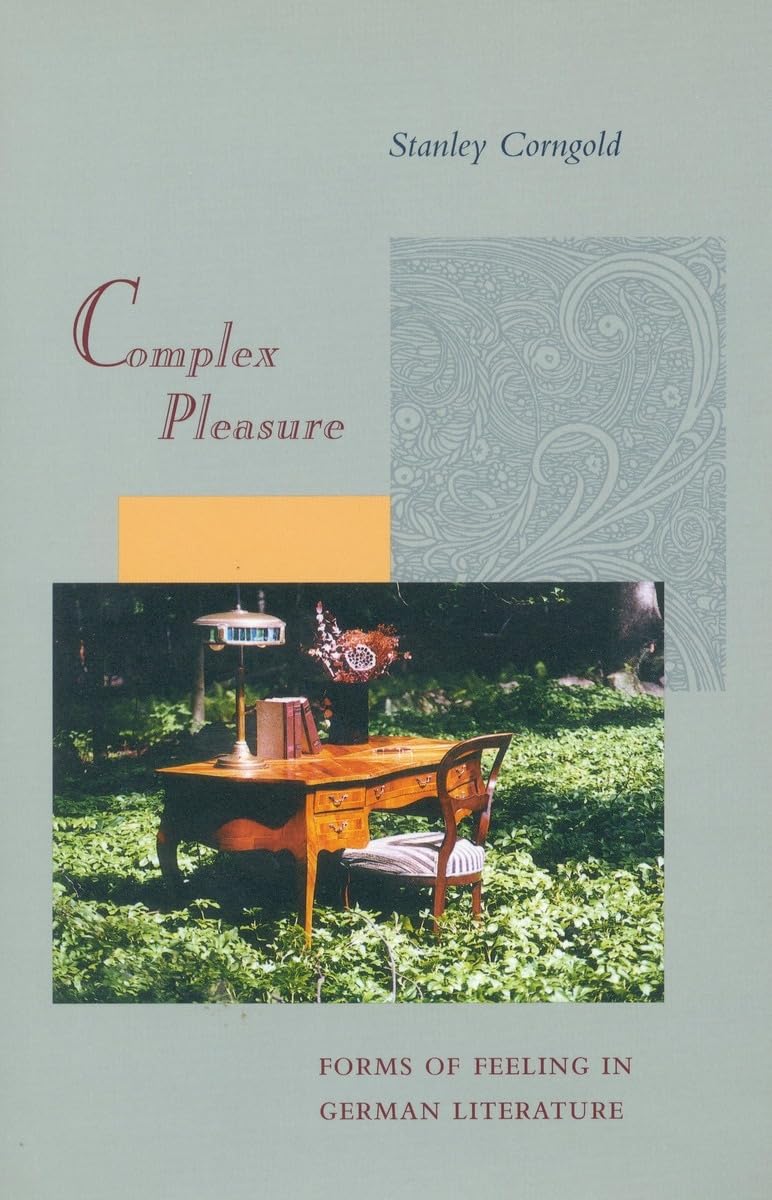
Complex Pleasure deals with questions of literary feeling in eight major German writersLessing, Kant, Hlderlin, Nietzsche, Musil, Kafka, Trakl, and Benjamin. On the basis of close readings of these authors Stanley Corngold makes vivid the following ideas: that where there is literature there is complex pleasure; that this pleasure is complex because it involves the impression of a disclosure; that this thought is foremost in the minds of a number of canonical writers; that important literary works in the German traditionfiction, poetry, critiquecan be illuminated through their treatment of literary feeling; and, finally, that the conceptual terms for these forms of feeling continually vary.The types of feeling treated in Complex Pleasure include wit (the startling perception of likeness) and the disinterested pleasure of aesthetic judgment; Hlderlin's 'swift conceptual grasp,' in which 'the tempo of the process of thought is stressed'; 'artistic imagination,' mood, sadistic enjoyment, rapturous distraction, homonymic dissonance, and courage as a mode of literary experience. At the same time, through the deftness, range, and surprise of its execution, the book itself conveys complex pleasure. The reader will also find fascinating, hitherto untranslated material by Nietzsche ('On Moods') and Kafka (important sections from his journals and from his unfinished novel The Boy Who Sank Out of Sight).
⚠️ WARNING (California Proposition 65):
This product may contain chemicals known to the State of California to cause cancer,
birth defects, or other reproductive harm.
For MAP (Minimum Advertised Price) violations and Intellectual Property (IP) or Trademark concerns, please contact:
support@ergodebooks.com
⚠️ California Proposition 65 Warning: Some products sold on this website may expose you to chemicals known to the State of California to cause cancer, birth defects, or other reproductive harm. For more information, visit www.P65Warnings.ca.gov.