If you have any questions, you are always welcome to contact us. We'll get back to you as soon as possible, withing 24 hours on weekdays.
Customer service
All questions about your order, return and delivery must be sent to our customer service team by e-mail at yourstore@yourdomain.com
Sale & Press
If you are interested in selling our products, need more information about our brand or wish to make a collaboration, please contact us at press@yourdomain.com
Help
If you have any questions, you are always welcome to contact us. We'll get back to you as soon as possible, withing 24 hours on weekdays.
Customer service
All questions about your order, return and delivery must be sent to our customer service team by e-mail at yourstore@yourdomain.com
Sale & Press
If you are interested in selling our products, need more information about our brand or wish to make a collaboration, please contact us at press@yourdomain.com
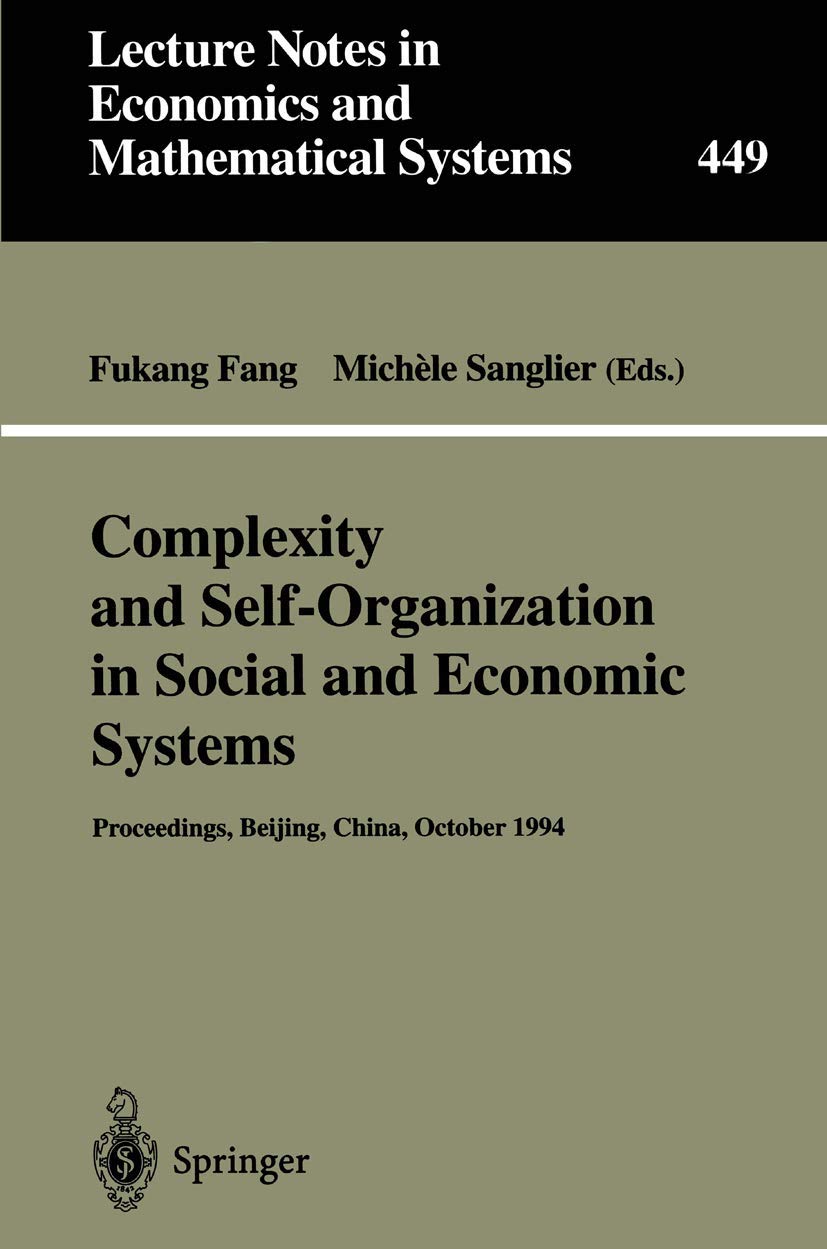
The Instituts Internationaux de Physique et de Chimie fondis par E. Solvay and the Institute of Nonequilibrium systems of Beijing Normal University jointly sponsored a conference on 'The Complexity and Selforganization in Socio economic Systems' on October 1720, 1994 at Beijing, China. The purpose of the conference was to explore the complexity and evolutionary laws of socio economic systems through nonlinear dynamic systems and selforganization theory. The conference was chaired by Professor M. Sanglier and Professor Fang Fukang and was introduced by the Nobel prize winner, Professor I. Prigogine and the vice director of the Chinese National System Reform Committee, Mr. Wu Jie. The conference was held at an important time. On the one hand, the research in the natural sciences about the evolution of complex systems has made great progress, modern scientific theories such as nonlinear dynamic system theory and selforganization theory are becoming more and more mature and a series of methods dealing with these complex systems are being developed which enable us to understand and study non equilibrium, uncertainty and instability. On the other hand, human societies around the world witness a general increase of connectedness, interactivity and an increase of reaction speeds to decisions. In this context, the deterministic, linear way of thinking becomes more and more inadequate and this stimulates the development of non linear science.
⚠️ WARNING (California Proposition 65):
This product may contain chemicals known to the State of California to cause cancer,
birth defects, or other reproductive harm.
For MAP (Minimum Advertised Price) violations and Intellectual Property (IP) or Trademark concerns, please contact:
support@ergodebooks.com
⚠️ California Proposition 65 Warning: Some products sold on this website may expose you to chemicals known to the State of California to cause cancer, birth defects, or other reproductive harm. For more information, visit www.P65Warnings.ca.gov.