
Title
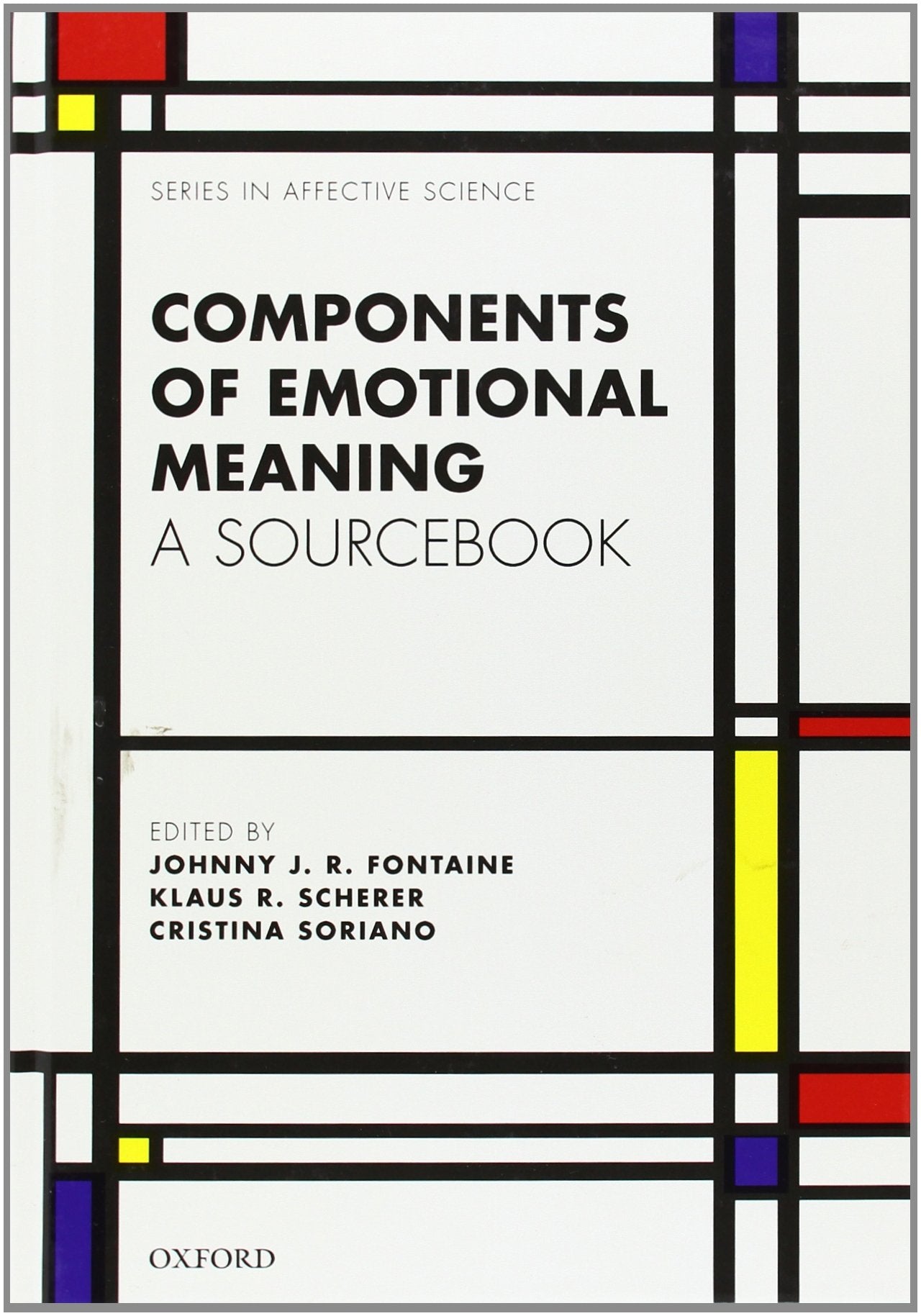
Components of emotional meaning: A sourcebook (Series in Affective Science),Used
Sold by Ergodebooks, an authorized reseller.
Returns accepted within 30 days | support@ergodebooks.com
Shipping Information
- Free Standard Shipping — United States only
- Processing Time: 3–5 business days
- Estimated Delivery: 6–10 business days after dispatch
- Double-boxed, fully insured & discreetly packaged
- Tracking number sent via email once dispatched
Returns & Refund
Returns accepted within 30 days of delivery.
Damaged or Defective Item
Free return shipping + replacement or full refund
Wrong Item Received
Free return shipping + replacement or full refund
Change of Mind
Return shipping at customer's expense · 25% restocking fee applies
Payment Option

Publications on emotion (and the affective sciences in general) have exploded in the last decade. Numerous research teams and individual scholars from many different disciplines have published research papers or books about many different aspects of emotions and their role in behaviour and society. However, One aspect of emotional research that has been somewhat neglected, is the way in which emotional terms translate into other languages. When using terms like anger, sadness, fear, disgust, and joy for socalled basic emotions, as well as terms like shame, guilt, pride, regret and contempt for more complex emotions, it is naturally assumed that the emotion terms used for research in the native language of the researchers and translated into English are completely equivalent in meaning. However, this is not generally the case. In many cases there is no direct one to one relationship between an English term and a term in an alternative language. In fact, there can be significant differences in the way that these seemingly similar emotional terms can be applied across various languages, with important implications for how we review and appraise this work.This book presents an extensive crosscultural and crosslinguistic review of the meaning of emotion words, adopting a novel methodological approach. Based on the Component Process Model, the authors developed a new instrument to assess the meaning of emotion terms. This instrument, the GRID questionnaire, consists of a grid of 24 emotion terms spanning the emotion domain and 142 emotion features that operationalize five emotion components (Appraisals, Bodily reactions, Expressions, Action tendencies, and Feelings). For the operationalization of these five emotion components, very different emotion models from the Western and the culturalcomparative emotion literature were taken into account.'Components of Emotional Meaning' includes contributions from psychological, culturalcomparative, and linguistic perspectives demonstrating how this new instrument can be used to empirically study very different research questions on the meaning of emotion terms. The implications of the results for major theoretical debates on emotion are also discussed.For all researchers in the affective sciences, this book is an important new reference work.
⚠️ WARNING (California Proposition 65):
This product may contain chemicals known to the State of California to cause cancer, birth defects, or other reproductive harm.
For more information, please visit www.P65Warnings.ca.gov.