If you have any questions, you are always welcome to contact us. We'll get back to you as soon as possible, withing 24 hours on weekdays.
Customer service
All questions about your order, return and delivery must be sent to our customer service team by e-mail at yourstore@yourdomain.com
Sale & Press
If you are interested in selling our products, need more information about our brand or wish to make a collaboration, please contact us at press@yourdomain.com
Help
If you have any questions, you are always welcome to contact us. We'll get back to you as soon as possible, withing 24 hours on weekdays.
Customer service
All questions about your order, return and delivery must be sent to our customer service team by e-mail at yourstore@yourdomain.com
Sale & Press
If you are interested in selling our products, need more information about our brand or wish to make a collaboration, please contact us at press@yourdomain.com
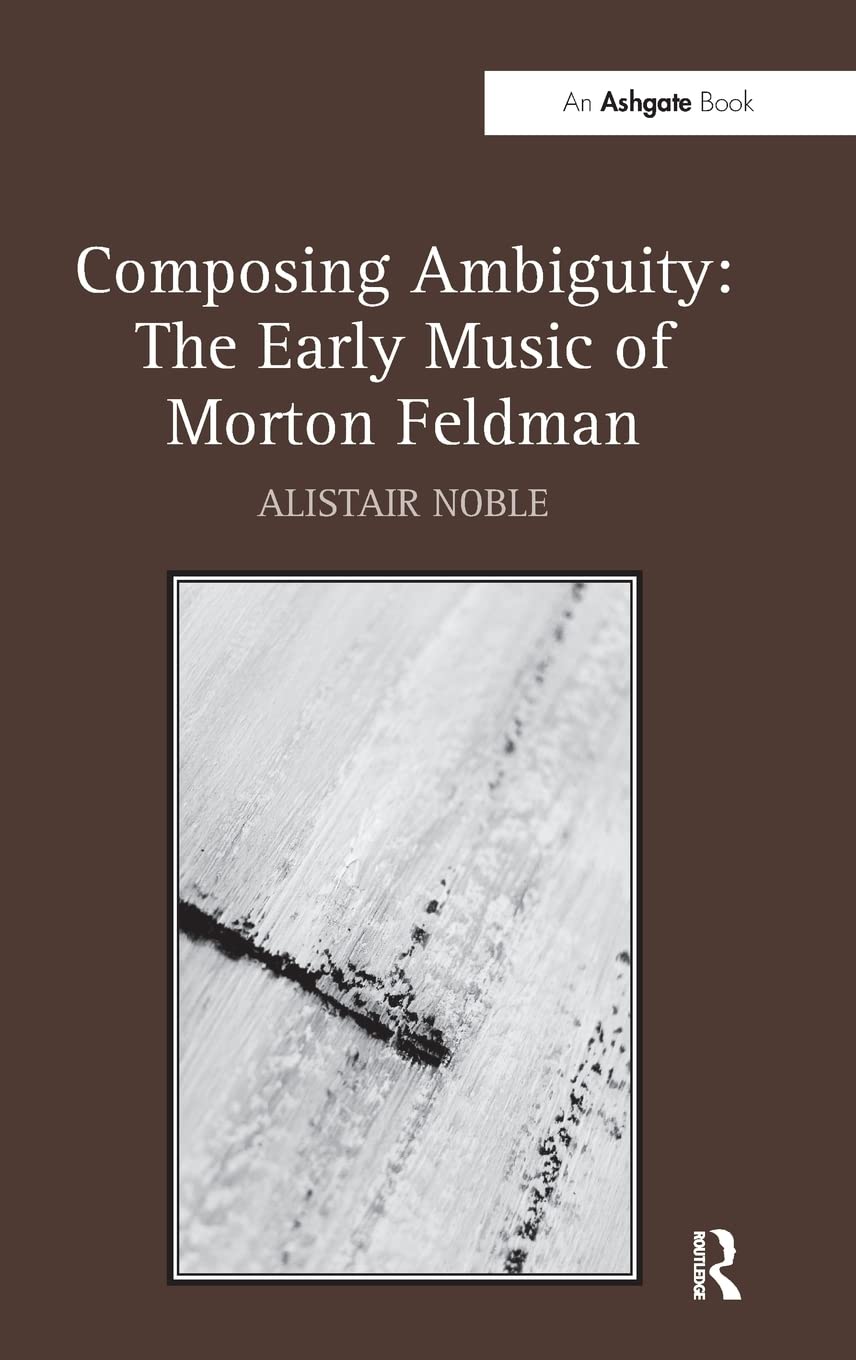
American composer Morton Feldman is increasingly seen to have been one of the key figures in latetwentiethcentury music, with his work exerting a powerful influence into the twentyfirst century. At the same time, much about his music remains enigmatic, largely due to longstanding myths about supposedly intuitive or aleatoric working practices. In Composing Ambiguity, Alistair Noble reveals key aspects of Feldman's musical language as it developed during a crucial period in the early 1950s. Drawing models from primary sources, including Feldman's musical sketches, he shows that Feldman worked deliberately within a twodimensional frame, allowing a focus upon the fundamental materials of sounding pitch in time. Beyond this, Feldman's work is revealed to be essentially concerned with the 12tone chromatic field, and with the delineation of complexes of simple proportions in 'crystalline' forms. Through close reading of several important works from the early 1950s, Noble shows that there is a remarkable consistency of compositional method, despite the varied experimental notations used by Feldman at this time. Not only are there direct relations to be found between staffnotated works and grid scores, but much of the language developed by Feldman in this period was still in use even in his late works of the 1980s.
⚠️ WARNING (California Proposition 65):
This product may contain chemicals known to the State of California to cause cancer,
birth defects, or other reproductive harm.
For MAP (Minimum Advertised Price) violations and Intellectual Property (IP) or Trademark concerns, please contact:
support@ergodebooks.com
⚠️ California Proposition 65 Warning: Some products sold on this website may expose you to chemicals known to the State of California to cause cancer, birth defects, or other reproductive harm. For more information, visit www.P65Warnings.ca.gov.