
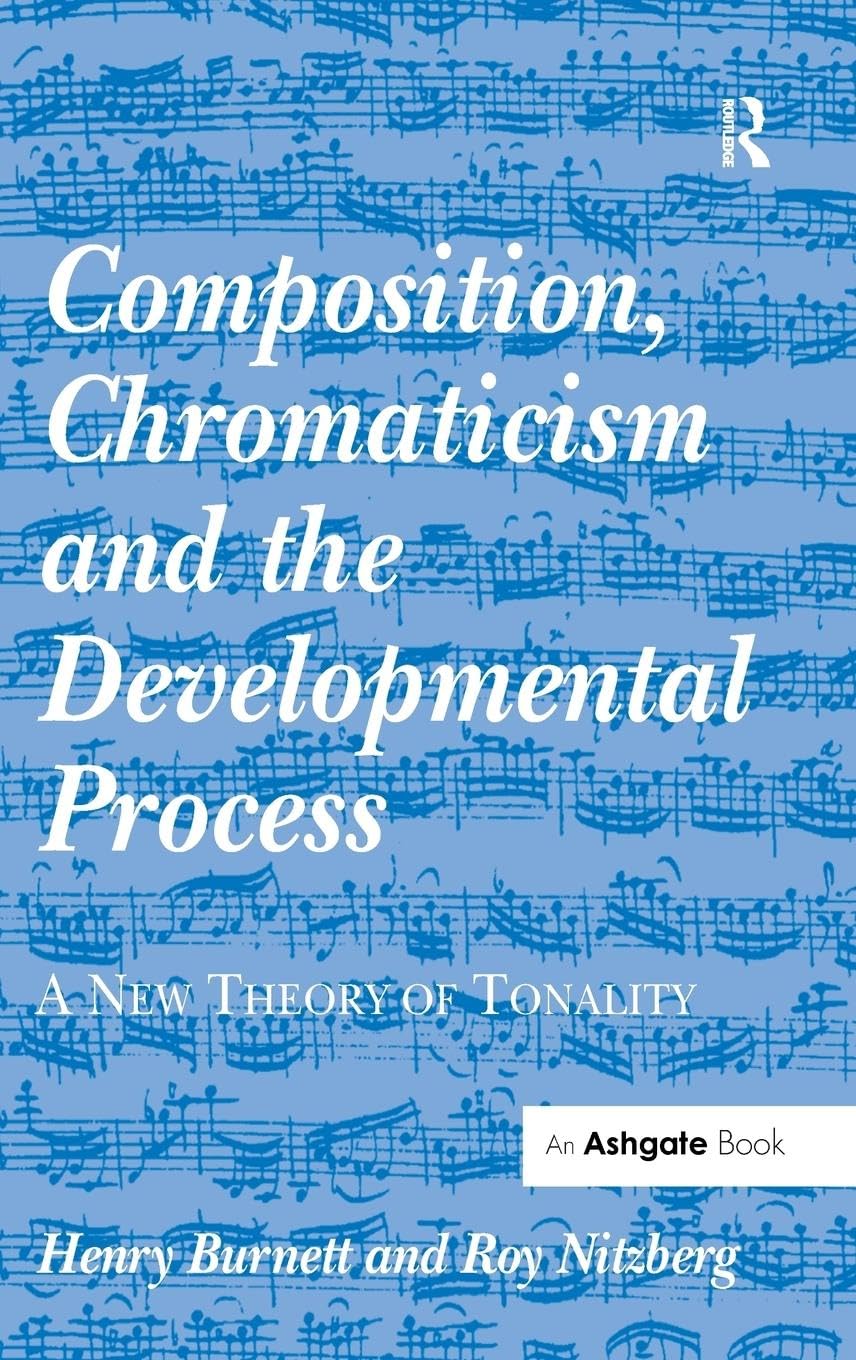
Title
Composition, Chromaticism And The Developmental Process: A New Theory Of Tonality,New
Sold by Ergodebooks, an authorized reseller.
Returns accepted within 30 days | support@ergodebooks.com
Shipping Information
- Free Standard Shipping — United States only
- Processing Time: 3–5 business days
- Estimated Delivery: 6–10 business days after dispatch
- Double-boxed, fully insured & discreetly packaged
- Tracking number sent via email once dispatched
Returns & Refund
Returns accepted within 30 days of delivery.
Damaged or Defective Item
Free return shipping + replacement or full refund
Wrong Item Received
Free return shipping + replacement or full refund
Change of Mind
Return shipping at customer's expense · 25% restocking fee applies
Payment Option

Musicology, Having Been Transmitted As A Compilation Of Disparate Events And Disciplines, Has Long Necessitated A 'Magic Bullet', A 'Unified Field Theory' So To Speak, That Can Interpret The Steady Metamorphosis Of Western Art Music From Late Medieval Modality To Twentiethcentury Atonality Within A Single Theoretical Construct. Without That Magic Bullet, Discussions Of This Kind Are Increasingly Complicated And, To Make Matters Worse, The Validity Of Any Transformational Models And Ideas Of The Natural Evolution Of Styles Is Questioned And Even Frowned Upon Today As Epitomizing A Grotesque Teleological Bigotry. Going Against Current Thinking, Henry Burnett And Roy Nitzberg Claim That The Teleological Approach To Observing Stylistic Change Is Still Valid When Considered From The Purely Compositional Perspective. The Authors Challenge The Traditional Understanding Of Development, And Advance A New Theory Of Elevenpitch Tonality As It Relates To The Corpus Of Western Composition. The Book Plots The Evolution Of Tonality And Its Bearing On Style And The Compositional Process Itself. The Theory Is Not Based On The Diatonic Aspect Of The Various Tonal Systems Exploited By Composers; Rather, The Theory Is Chromatically Based The Chromatically Inflected Octave Being The Source Not Only Of A Highly Ingenious Developmental Dialectic, But Also Encompassing The Momenttomoment Progression Of The Musical Narrative Itself. Even The Most Profound Teachings Of Schenker, And The Often Startlingly Original And Worthwhile Speculations Of Riemann, Tovey, Dahlhaus And Others, Still Provide No Theory Of Development And So Are Ultimately Unable To Unite The Various Tendrils Of The Compositional Organism Into A Unified Whole. Burnett And Nitzberg Move Beyond Existing Theory And Analysis To Base Their Theory From The Standpoint Of Chromatic 'Pitch Fields'. These Fields Are The Specific Chromatic Pitch Choices That A Composer Uses To Inform And Design A Complete Composition, Utilizing Specific Chromatic Inflections To Control A Largescale Working Out Process That Is The Very Essence Of 'Development'. In Short, The Authors Claim That A Chromatic Background That Coexists With A Diatonic Contrapuntal Background May Define The Process Of Compositional Development. These Chromatic And Diatonic Events Are The Two Genus Expressions Of Slowly Unfolding Tonic Octaves.
⚠️ WARNING (California Proposition 65):
This product may contain chemicals known to the State of California to cause cancer, birth defects, or other reproductive harm.
For more information, please visit www.P65Warnings.ca.gov.
- Q: What is the page count of the book? A: This book has four hundred twenty pages. It offers an in-depth exploration of tonality and compositional processes.
- Q: What are the dimensions of the book? A: The book measures six point thirty-eight inches in length, one point fourteen inches in width, and nine point forty-five inches in height. These dimensions make it a standard hardcover size.
- Q: What binding type does the book have? A: The book is bound in hardcover. This ensures durability and longevity for frequent use.
- Q: Is this book suitable for beginners in music theory? A: Yes, this book is suitable for beginners. It introduces complex concepts in a way that is accessible to those new to music theory.
- Q: What genre does this book belong to? A: This book belongs to the History and Criticism genre. It focuses on the evolution of tonality in Western art music.
- Q: How does this book approach the topic of tonality? A: The book presents a new theory of eleven-pitch tonality. It emphasizes a chromatic basis for understanding the development of Western music.
- Q: How do I care for this hardcover book? A: To care for this book, keep it in a dry place and avoid exposure to direct sunlight. This will help preserve its condition.
- Q: Is this book safe for all ages? A: Yes, this book is safe for all ages. However, it is recommended for those interested in musicology and theory.
- Q: Does this book have any special features? A: The book does not list any special features. Its primary focus is on presenting a new theoretical framework for tonality.
- Q: Can I return the book if I’m not satisfied? A: Yes, you can return the book if you’re not satisfied. Check the seller’s return policy for specific details.
- Q: What if the book arrives damaged? A: If the book arrives damaged, contact customer service immediately for assistance. Most retailers will offer a replacement or refund.
- Q: Does this book include references or a bibliography? A: Yes, this book includes references. It is well-researched and provides a bibliography for further reading.
- Q: Is there an ebook version available? A: No, there is no ebook version currently available. This book is only offered in hardcover format.
- Q: What kind of reader is this book intended for? A: This book is intended for readers interested in music theory, musicology, and the history of Western art music.
- Q: Are there any illustrations or charts in the book? A: Yes, the book may include illustrations or charts to support the theoretical concepts discussed. Check the preview for specifics.