If you have any questions, you are always welcome to contact us. We'll get back to you as soon as possible, withing 24 hours on weekdays.
Customer service
All questions about your order, return and delivery must be sent to our customer service team by e-mail at yourstore@yourdomain.com
Sale & Press
If you are interested in selling our products, need more information about our brand or wish to make a collaboration, please contact us at press@yourdomain.com
Help
If you have any questions, you are always welcome to contact us. We'll get back to you as soon as possible, withing 24 hours on weekdays.
Customer service
All questions about your order, return and delivery must be sent to our customer service team by e-mail at yourstore@yourdomain.com
Sale & Press
If you are interested in selling our products, need more information about our brand or wish to make a collaboration, please contact us at press@yourdomain.com
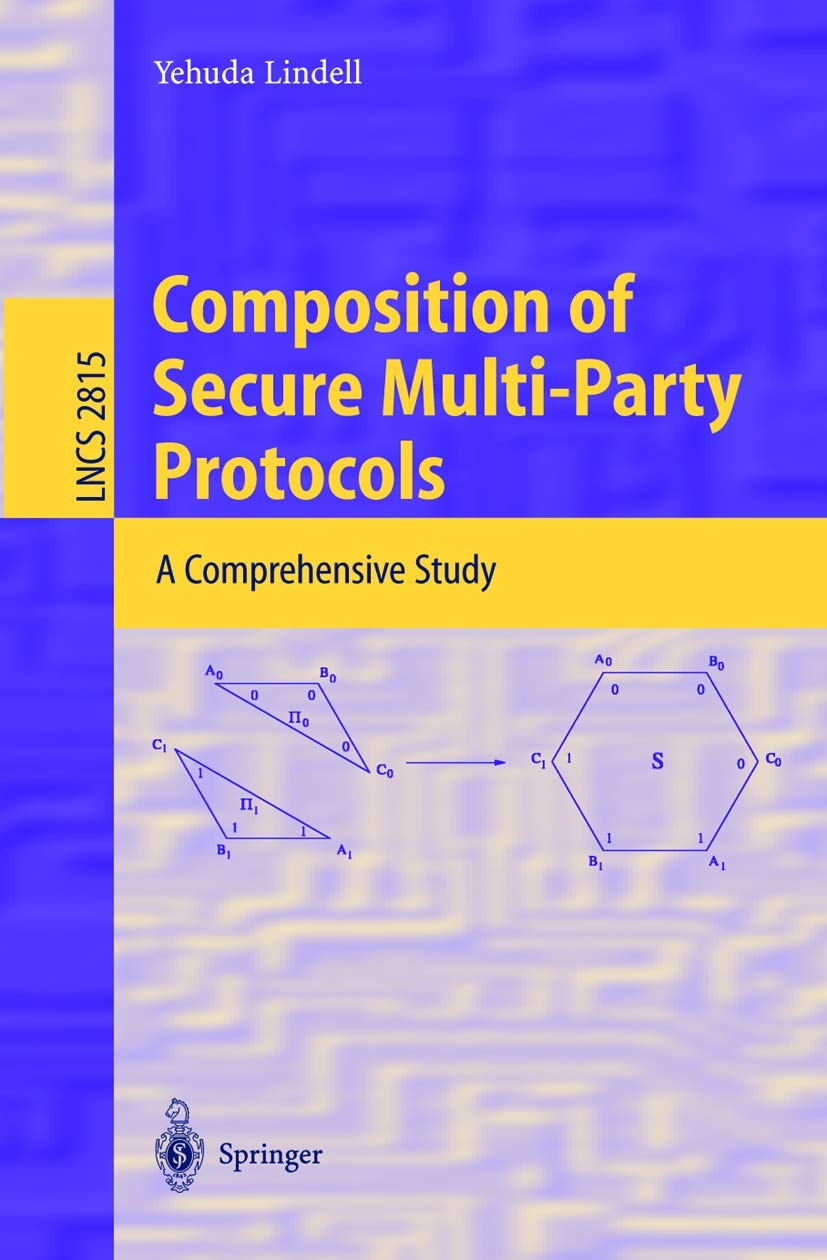
In the setting of multiparty computation, sets of two or more parties with private inputs wish to jointly compute some (predetermined) function of their inputs. General results concerning secure twoparty or multiparty computation were first announced in the 1980s. Put briefly, these results assert that under certain assumptions one can construct protocols for securely computing any desired multiparty functionality. However, this research relates only to a setting where a single protocol execution is carried out. In contrast, in modern networks, many different protocol executions are run at the same time.This book is devoted to the general and systematic study of secure multiparty computation under composition. Despite its emphasis on a theoretically wellfounded treatment of the subject, general techniques for designing secure protocols are developed that may even result in schemes or modules to be incorporated in practical systems. The book clarifies fundamental issues regarding security in a multiexecution environment and gives a comprehensive and unique treatment of the composition of secure multiparty protocols.
⚠️ WARNING (California Proposition 65):
This product may contain chemicals known to the State of California to cause cancer,
birth defects, or other reproductive harm.
For MAP (Minimum Advertised Price) violations and Intellectual Property (IP) or Trademark concerns, please contact:
support@ergodebooks.com
⚠️ California Proposition 65 Warning: Some products sold on this website may expose you to chemicals known to the State of California to cause cancer, birth defects, or other reproductive harm. For more information, visit www.P65Warnings.ca.gov.