
Title
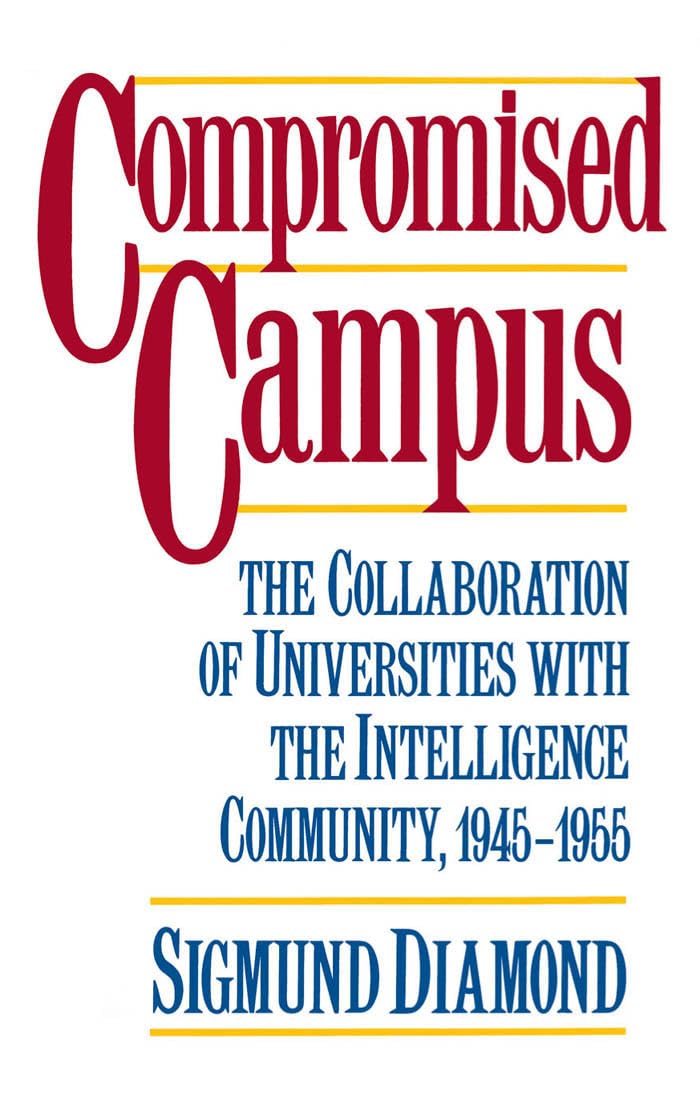
Compromised Campus: The Collaboration of Universities with the Intelligence Community, 19451955,Used
Sold by Ergodebooks, an authorized reseller.
Returns accepted within 30 days | support@ergodebooks.com
Shipping Information
- Free Standard Shipping — United States only
- Processing Time: 3–5 business days
- Estimated Delivery: 6–10 business days after dispatch
- Double-boxed, fully insured & discreetly packaged
- Tracking number sent via email once dispatched
Returns & Refund
Returns accepted within 30 days of delivery.
Damaged or Defective Item
Free return shipping + replacement or full refund
Wrong Item Received
Free return shipping + replacement or full refund
Change of Mind
Return shipping at customer's expense · 25% restocking fee applies
Payment Option

In the early 1950s, a young Harvard professor named Henry Kissinger approached the FBI with alleged evidence of communist subversion among the foreign students of his summer seminar. His evidence was a flyer criticizing the nuclear arms buildup and promoting world peace. At the same time at Yale, young William F. Buckley, Jr., was discovering more than God while writing God and Man at Yale as an undergraduate. He was discovering J. Edgar Hoover. These are just two examples of how ambitious young men used the 'special relationship' developing between the FBI and the universities to advance their fledgling careers. Revelations such as these abound in Sigmund Diamond's Compromised Campus, an eyeopening look at the role American intelligence agencies played at some of America's most prestigious universities.It is often said that in the 1950s, American universities were free of the McCarthyism that pervaded the rest of the nation. Not so, says Diamond. Using previously secret materials newly made available under the Freedom of Information Act, and an impressive amount of information gained from years of research in university and foundation archives, he reveals that despite academia's 'official story' of autonomy from the federal government, in fact university administrators, faculty, and students secretly and actively sought close ties with intelligence agencies. Diamond describes the cooperation of Harvard President James B. Conant with intelligence agencies, the institution and operation of Harvard's Russian Research Center, Yale's shadowy 'liaison agent' H.B. Fisher, who moved from problems of student drinking to cooperation with the FBI in loyaltysecurity matters, and the existence of formal and informal relations with the FBI and other intelligence agencies at major universities throughout the country. He calls attention to the cooperation of university presidentsGriswold of Yale, Dodds of Princeton, Wriston of Brown, Sproul of California, among otherswith the FBI and state governors on the techniques of blacklisting.Diamond shows how this interaction between intelligence agencies and American universities has had serious consequences for America ever sinceon foreign policy, questions of law and constitutional government, the role of secrecy, separation of public and private activities, and the existence and control of government deceit and lawlessness. Dismissed himself from Harvard in the 1950s by McGeorge Bundy (for refusing to talk to the FBI about former associates), Diamond brings a special immediacy to this revealing study.
⚠️ WARNING (California Proposition 65):
This product may contain chemicals known to the State of California to cause cancer, birth defects, or other reproductive harm.
For more information, please visit www.P65Warnings.ca.gov.