If you have any questions, you are always welcome to contact us. We'll get back to you as soon as possible, withing 24 hours on weekdays.
Customer service
All questions about your order, return and delivery must be sent to our customer service team by e-mail at yourstore@yourdomain.com
Sale & Press
If you are interested in selling our products, need more information about our brand or wish to make a collaboration, please contact us at press@yourdomain.com
Help
If you have any questions, you are always welcome to contact us. We'll get back to you as soon as possible, withing 24 hours on weekdays.
Customer service
All questions about your order, return and delivery must be sent to our customer service team by e-mail at yourstore@yourdomain.com
Sale & Press
If you are interested in selling our products, need more information about our brand or wish to make a collaboration, please contact us at press@yourdomain.com
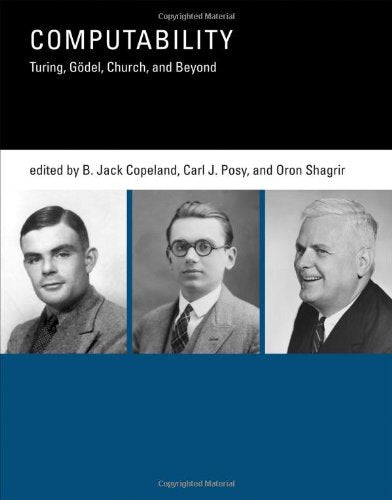
In the 1930s a series of seminal works published by Alan Turing, Kurt Gdel, Alonzo Church, and others established the theoretical basis for computability. This work, advancing precise characterizations of effective, algorithmic computability, was the culmination of intensive investigations into the foundations of mathematics. In the decades since, the theory of computability has moved to the center of discussions in philosophy, computer science, and cognitive science. In this volume, distinguished computer scientists, mathematicians, logicians, and philosophers consider the conceptual foundations of computability in light of our modern understanding. Some chapters focus on the pioneering work by Turing, Gdel, and Church, including the ChurchTuring thesis and Gdel's response to Church's and Turing's proposals. Other chapters cover more recent technical developments, including computability over the reals, Gdel's influence on mathematical logic and on recursion theory and the impact of work by Turing and Emil Post on our theoretical understanding of online and interactive computing; and others relate computability and complexity to issues in the philosophy of mind, the philosophy of science, and the philosophy of mathematics.Contributors:Scott Aaronson, Dorit Aharonov, B. Jack Copeland, Martin Davis, Solomon Feferman, Saul Kripke, Carl J. Posy, Hilary Putnam, Oron Shagrir, Stewart Shapiro, Wilfried Sieg, Robert I. Soare, Umesh V. Vazirani
⚠️ WARNING (California Proposition 65):
This product may contain chemicals known to the State of California to cause cancer,
birth defects, or other reproductive harm.
For MAP (Minimum Advertised Price) violations and Intellectual Property (IP) or Trademark concerns, please contact:
support@ergodebooks.com
⚠️ California Proposition 65 Warning: Some products sold on this website may expose you to chemicals known to the State of California to cause cancer, birth defects, or other reproductive harm. For more information, visit www.P65Warnings.ca.gov.