
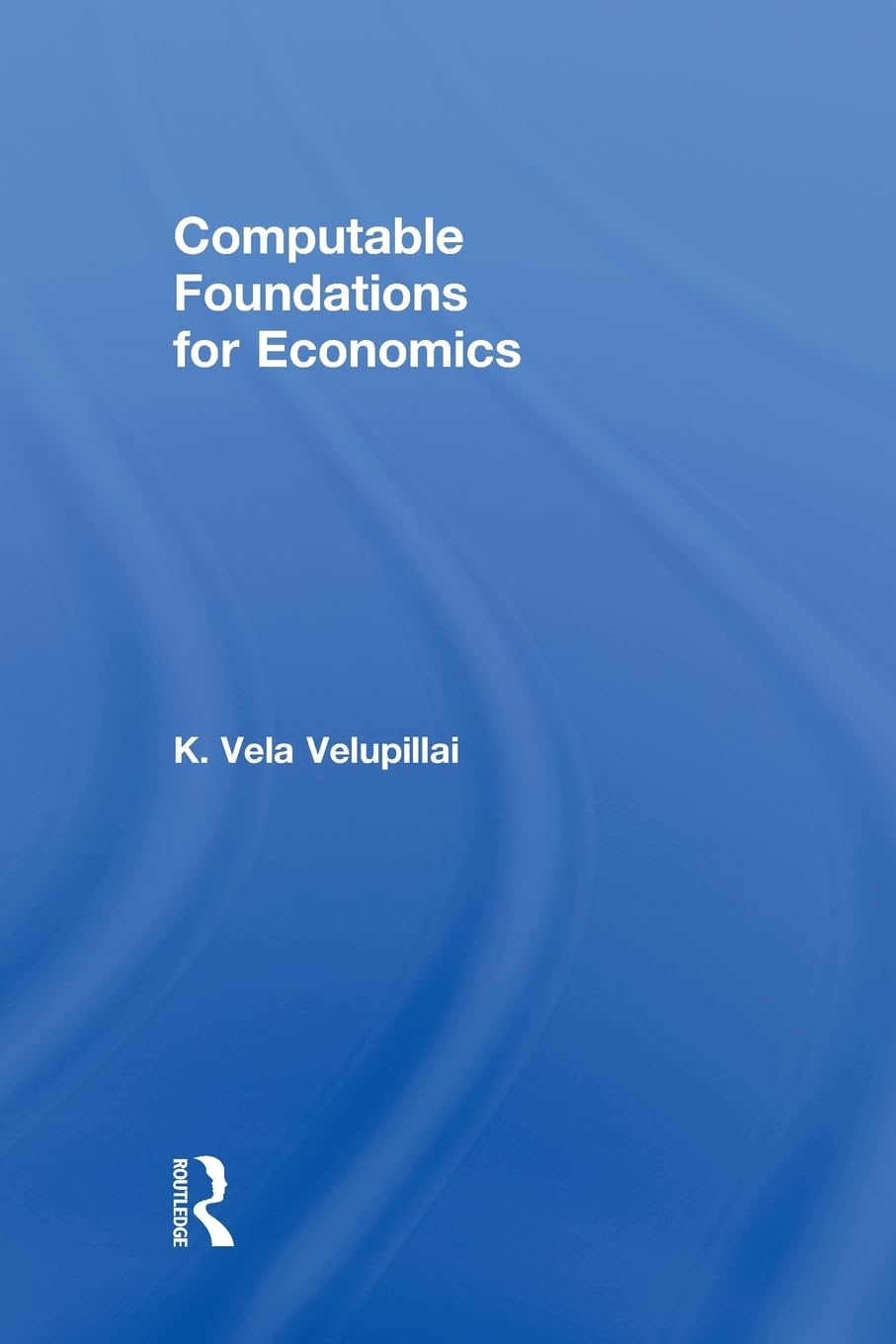
Title

Computable Foundations for Economics (Routledge Advances in Experimental and Computable Economics),Used
Sold by Ergodebooks, an authorized reseller.
Returns accepted within 30 days | support@ergodebooks.com
Shipping Information
- Free Standard Shipping — United States only
- Processing Time: 3–5 business days
- Estimated Delivery: 6–10 business days after dispatch
- Double-boxed, fully insured & discreetly packaged
- Tracking number sent via email once dispatched
Returns & Refund
Returns accepted within 30 days of delivery.
Damaged or Defective Item
Free return shipping + replacement or full refund
Wrong Item Received
Free return shipping + replacement or full refund
Change of Mind
Return shipping at customer's expense · 25% restocking fee applies
Payment Option

Computable Foundations for Economics is a unified collection of essays, some of which are published here for the first time and all of which have been updated for this book, on an approach to economic theory from the point of view of algorithmic mathematics. By algorithmic mathematics the author means computability theory and constructive mathematics. This is in contrast to orthodox mathematical economics and game theory, which are formalised with the mathematics of real analysis, underpinned by what is called the ZFC formalism, i.e., set theory with the axiom of choice. This reliance on ordinary real analysis and the ZFC system makes economic theory in its current mathematical mode completely nonalgorithmic, which means it is numerically meaningless.The book provides a systematic attempt to dissect and expose the nonalgorithmic content of orthodox mathematical economics and game theory and suggests a reformalization on the basis of a strictly rigorous algorithmic mathematics. This removes the current schizophrenia in mathematical economics and game theory, where theory is entirely divorced from algorithmic applicability for experimental and computational exercises.The chapters demonstrate the uncomputability and nonconstructivity of core areas of general equilibrium theory, game theory and recursive macroeconomics. The book also provides a fresh look at the kind of behavioural economics that lies behind Herbert Simons work, and resurrects a role for the noble classical traditions of induction and verification, viewed and formalised, now, algorithmically. It will therefore be of particular interest to postgraduate students and researchers in algorithmic economics, game theory and classical behavioural economics.
⚠️ WARNING (California Proposition 65):
This product may contain chemicals known to the State of California to cause cancer, birth defects, or other reproductive harm.
For more information, please visit www.P65Warnings.ca.gov.