
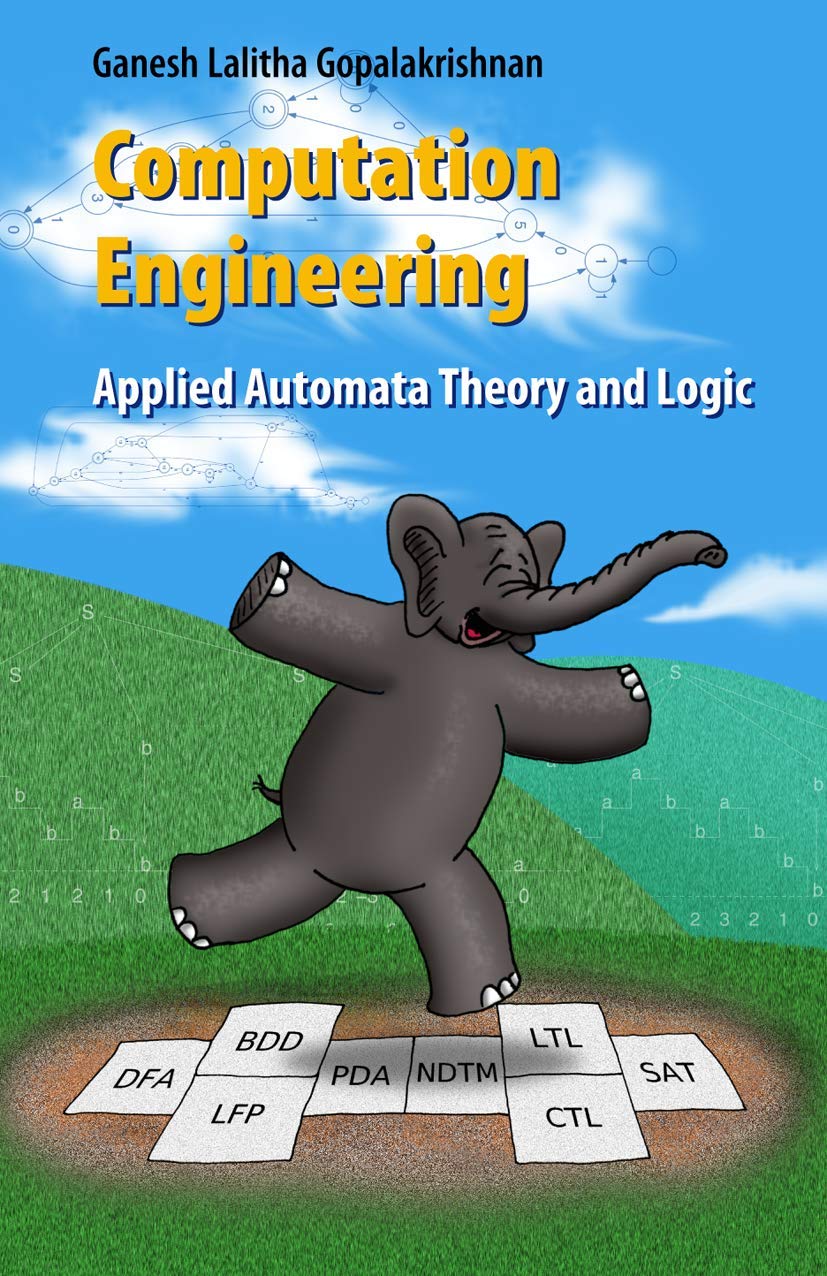
Title
Computation Engineering: Applied Automata Theory and Logic,Used
Sold by Ergodebooks, an authorized reseller.
Returns accepted within 30 days | support@ergodebooks.com
Shipping Information
- Free Standard Shipping — United States only
- Processing Time: 3–5 business days
- Estimated Delivery: 6–10 business days after dispatch
- Double-boxed, fully insured & discreetly packaged
- Tracking number sent via email once dispatched
Returns & Refund
Returns accepted within 30 days of delivery.
Damaged or Defective Item
Free return shipping + replacement or full refund
Wrong Item Received
Free return shipping + replacement or full refund
Change of Mind
Return shipping at customer's expense · 25% restocking fee applies
Payment Option

It takes more e?ort to verify that digital system designs are correct than it does to design them, and as systems get more complex the proportion of cost spent on veri?cation is increasing (one estimate is that veri?cation complexity rises as the square of design complexity). Although this veri?cation crisis was predicted decades ago, it is only recently that powerful methods based on mathematical logic and automata theory have come to the designers rescue. The ?rst such method was equivalence checking, which automates Boolean algebra calculations.Nextcamemodelchecking,whichcanautomatically verify that designs have or dont have behaviours of interest speci?ed in temporal logic. Both these methods are available today in tools sold by all the major design automation vendors. It is an amazing fact that ideas like Boolean algebra and modal logic, originating frommathematicians andphilosophersbeforemodern computers were invented, have come to underlie computer aided tools for creating hardware designs. The recent success of formal approaches to hardware veri?cation has lead to the creation of a new methodology: assertion based design, in which formal properties are incorporated into designs and are then validated by a combination of dynamic simulation and static model checking. Two industrial strength property languages based on tem ral logic are undergoing IEEE standardisation. It is not only hardwaredesignand veri?cation that is changing: new mathematical approaches to software veri?cation are starting to be ployed. Microsoft provides windows driver developers with veri?cation tools based on symbolic methods.
⚠️ WARNING (California Proposition 65):
This product may contain chemicals known to the State of California to cause cancer, birth defects, or other reproductive harm.
For more information, please visit www.P65Warnings.ca.gov.