
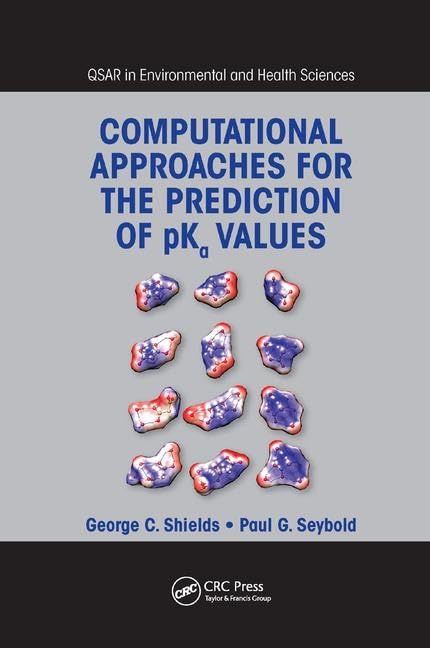
Title
Computational Approaches for the Prediction of pKa Values (QSAR in Environmental and Health Sciences),Used
Sold by Ergodebooks, an authorized reseller.
Returns accepted within 30 days | support@ergodebooks.com
Shipping Information
- Free Standard Shipping — United States only
- Processing Time: 3–5 business days
- Estimated Delivery: 6–10 business days after dispatch
- Double-boxed, fully insured & discreetly packaged
- Tracking number sent via email once dispatched
Returns & Refund
Returns accepted within 30 days of delivery.
Damaged or Defective Item
Free return shipping + replacement or full refund
Wrong Item Received
Free return shipping + replacement or full refund
Change of Mind
Return shipping at customer's expense · 25% restocking fee applies
Payment Option

The pKa of a compound describes its acidity or basicity and, therefore, is one of its most important properties. Its value determines what form of the compoundpositive ion, negative ion, or neutral specieswill be present under different circumstances. This is crucial to the action and detection of the compound as a drug, pollutant, or other active chemical agent. In many cases it is desirable to predict pKa values prior to synthesizing a compound, and enough is now known about the salient features that influence a molecules acidity to make these predictions.Computational Approaches for the Prediction of pKa Values describes the insights that have been gained on the intrinsic and extrinsic features that influence a molecules acidity and discusses the computational methods developed to estimate acidity from a compounds molecular structure. The authors examine the strengths and weaknesses of the theoretical techniques and show how they have been used to obtain information about the acidities of different classes of chemical compounds.The book presents theoretical methods for both general and more specific applications, covering methods for various acids in aqueous solutionsincluding oxyacids and related compounds, nitrogen acids, inorganic acids, and excitedstate acidsas well as acids in nonaqueous solvents. It also considers temperature effects, isotope effects, and other important factors that influence pKa. This book provides a resource for predicting pKa values and understanding the bases for these determinations, which can be helpful in designing better chemicals for future uses.
⚠️ WARNING (California Proposition 65):
This product may contain chemicals known to the State of California to cause cancer, birth defects, or other reproductive harm.
For more information, please visit www.P65Warnings.ca.gov.