If you have any questions, you are always welcome to contact us. We'll get back to you as soon as possible, withing 24 hours on weekdays.
Customer service
All questions about your order, return and delivery must be sent to our customer service team by e-mail at yourstore@yourdomain.com
Sale & Press
If you are interested in selling our products, need more information about our brand or wish to make a collaboration, please contact us at press@yourdomain.com
Help
If you have any questions, you are always welcome to contact us. We'll get back to you as soon as possible, withing 24 hours on weekdays.
Customer service
All questions about your order, return and delivery must be sent to our customer service team by e-mail at yourstore@yourdomain.com
Sale & Press
If you are interested in selling our products, need more information about our brand or wish to make a collaboration, please contact us at press@yourdomain.com
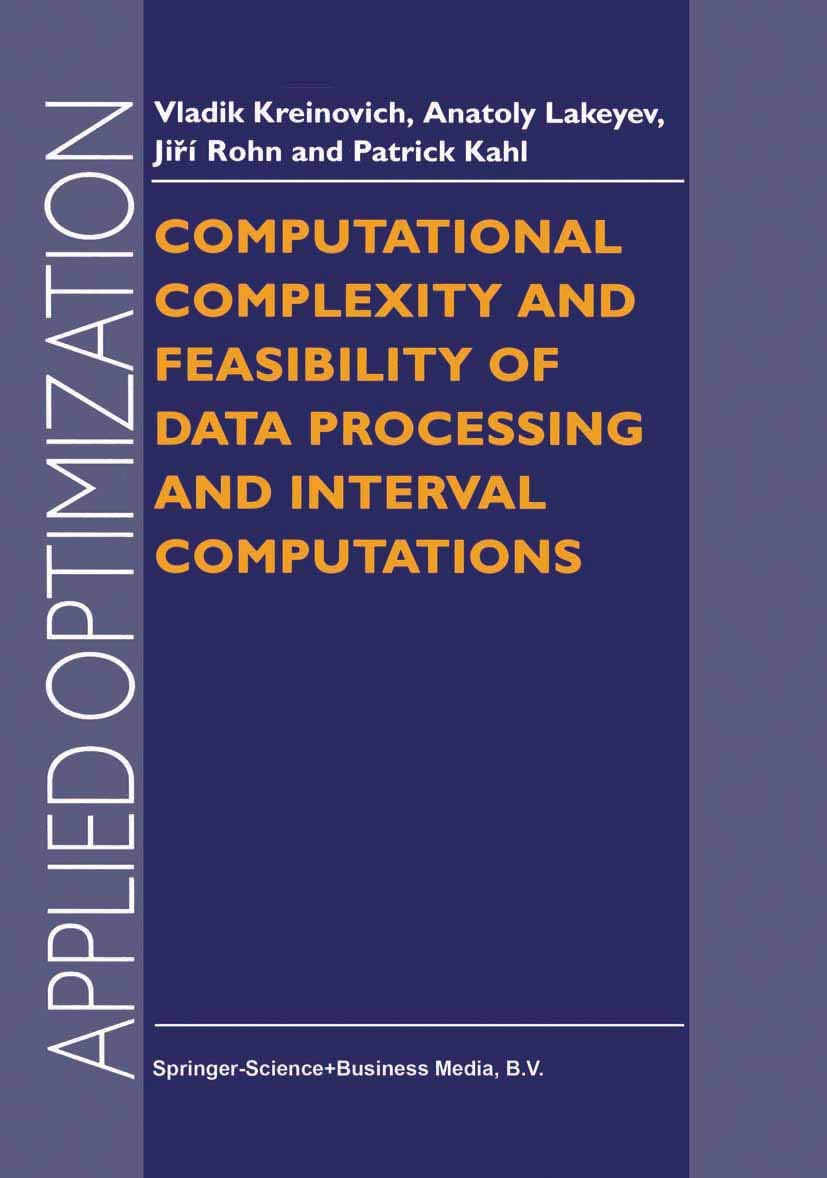
Targeted audience Specialists in numerical computations, especially in numerical optimiza tion, who are interested in designing algorithms with automatie result ver ification, and who would therefore be interested in knowing how general their algorithms caIi in principle be. Mathematicians and computer scientists who are interested in the theory 0/ computing and computational complexity, especially computational com plexity of numerical computations. Students in applied mathematics and computer science who are interested in computational complexity of different numerical methods and in learning general techniques for estimating this computational complexity. The book is written with all explanations and definitions added, so that it can be used as a graduate level textbook. What this book .is about Data processing. In many reallife situations, we are interested in the value of a physical quantity y that is diflicult (or even impossible) to measure directly. For example, it is impossible to directly measure the amount of oil in an oil field or a distance to a star. Since we cannot measure such quantities directly, we measure them indirectly, by measuring some other quantities Xi and using the known relation between y and Xi'S to reconstruct y. The algorithm that transforms the results Xi of measuring Xi into an estimate fj for y is called data processing.
⚠️ WARNING (California Proposition 65):
This product may contain chemicals known to the State of California to cause cancer,
birth defects, or other reproductive harm.
For MAP (Minimum Advertised Price) violations and Intellectual Property (IP) or Trademark concerns, please contact:
support@ergodebooks.com
⚠️ California Proposition 65 Warning: Some products sold on this website may expose you to chemicals known to the State of California to cause cancer, birth defects, or other reproductive harm. For more information, visit www.P65Warnings.ca.gov.