If you have any questions, you are always welcome to contact us. We'll get back to you as soon as possible, withing 24 hours on weekdays.
Customer service
All questions about your order, return and delivery must be sent to our customer service team by e-mail at yourstore@yourdomain.com
Sale & Press
If you are interested in selling our products, need more information about our brand or wish to make a collaboration, please contact us at press@yourdomain.com
Help
If you have any questions, you are always welcome to contact us. We'll get back to you as soon as possible, withing 24 hours on weekdays.
Customer service
All questions about your order, return and delivery must be sent to our customer service team by e-mail at yourstore@yourdomain.com
Sale & Press
If you are interested in selling our products, need more information about our brand or wish to make a collaboration, please contact us at press@yourdomain.com
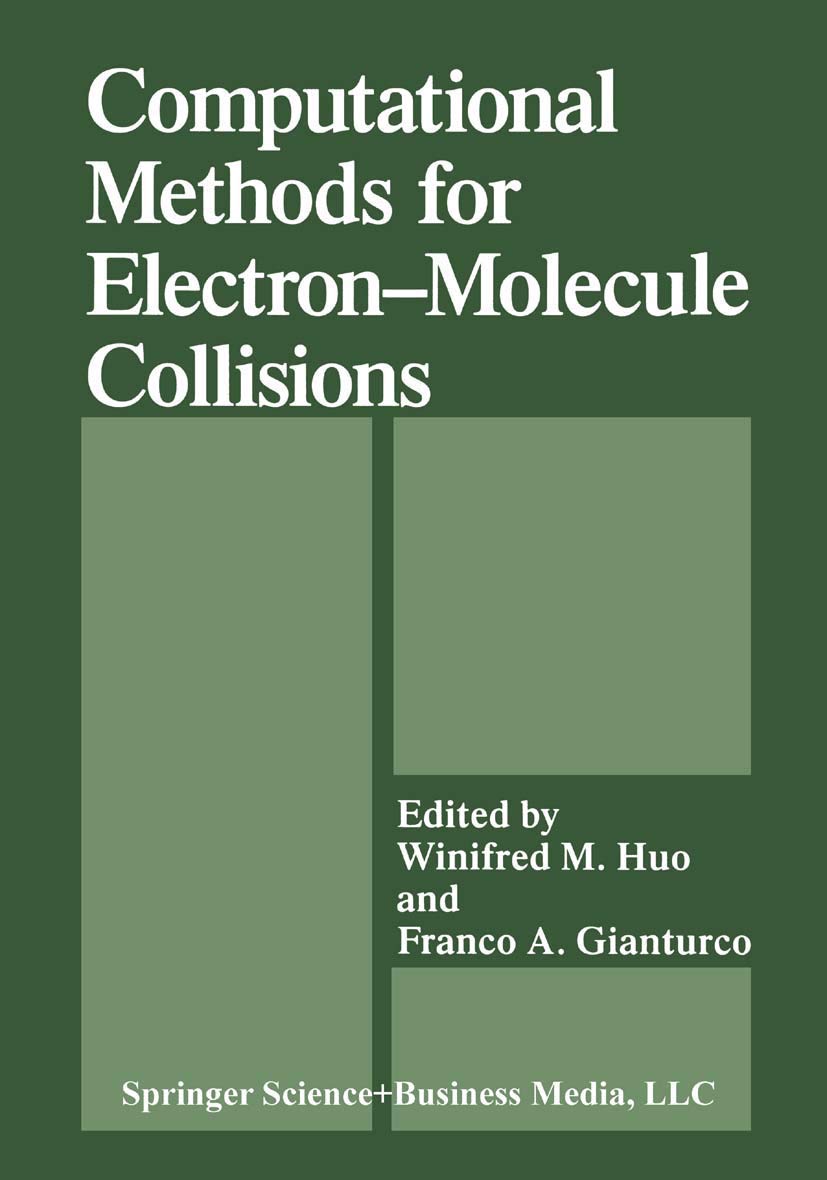
The collision of electrons with molecules and molecular ions is a fundamental pro cess in atomic and molecular physics and in chemistry. At high incident electron en ergies, electronmolecule collisions are used to deduce molecular geometries, oscillator strengths for optically allowed transitions, and in the case of electronimpact ionization, to probe the momentum distribution of the molecule itself. When the incident electron energy is comparable to or below those of the molecular valence electrons, the physics involved is particularly rich. Correlation and exchange effects necessary to describe such collision processes bear a close resemblance to similar efft:cts in the theory of electronic structure in molecules. Compound state formations, in the form of resonances and vir tual states, manifest themselves in experimental observables which provide details of the electronmolecule interactions. Rovibrational excitations by lowenergy electron collisions exemplify energy transfer between the electronic and nuclear motion. The role of nonadiabatic interaction is raised here. When the final vibrational state is in the continuum, molecular dissociation occurs. Dissociative recombination and dissociative attachment are examples of such fragmentation processes. In addition to its fundamental nature, the study of electronmolecule collisions is also motivated by its relation to other fields of study and by its technological appli cations. The study of planetary atmospheres and the interstellar medium necessarily involve collision processes of electrons with molecules and molecular ions.
⚠️ WARNING (California Proposition 65):
This product may contain chemicals known to the State of California to cause cancer,
birth defects, or other reproductive harm.
For MAP (Minimum Advertised Price) violations and Intellectual Property (IP) or Trademark concerns, please contact:
support@ergodebooks.com
⚠️ California Proposition 65 Warning: Some products sold on this website may expose you to chemicals known to the State of California to cause cancer, birth defects, or other reproductive harm. For more information, visit www.P65Warnings.ca.gov.