
Title
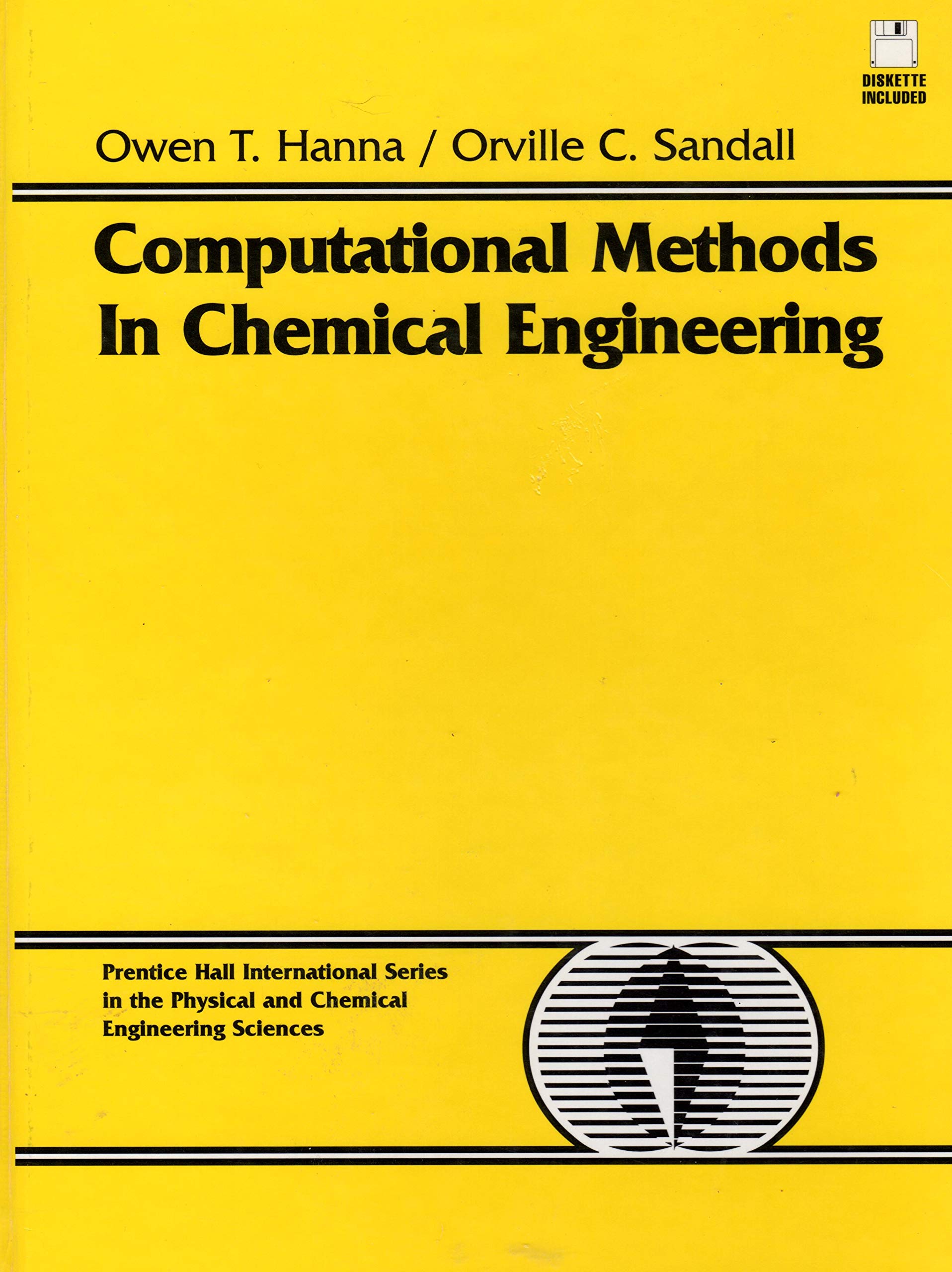
Computational Methods In Chemical Engineering (Prentice Hall International Series In The Physical And Chemical Engineering Scien,Used
Sold by Ergodebooks, an authorized reseller.
Returns accepted within 30 days | support@ergodebooks.com
Shipping Information
- Free Standard Shipping — United States only
- Processing Time: 3–5 business days
- Estimated Delivery: 6–10 business days after dispatch
- Double-boxed, fully insured & discreetly packaged
- Tracking number sent via email once dispatched
Returns & Refund
Returns accepted within 30 days of delivery.
Damaged or Defective Item
Free return shipping + replacement or full refund
Wrong Item Received
Free return shipping + replacement or full refund
Change of Mind
Return shipping at customer's expense · 25% restocking fee applies
Payment Option

Presenting A Clear, Concise Exposition Of Practical Computational Methods In Chemical Engineering, This Book Provides A Bridge Between Introductory Applications And More Advanced Levels Of Mathematics. Authors Owen Hanna And Orville Sandall Include Broad Use Of Convergence Acceleration Techniques Such As Pade Approximation For Series; Shanks Transformation For Series; Linear And Nonlinear Systems Of Algebraic Equations; Systematic Use Of Global Richardson Extrapolation For Integrals And Ode Systems To Monitor The Overall Error; And Discussion Of Methods For The Solution Of Stiff Ode.In Addition, Some 25 Userfriendly Microcomputer Programs Which Are Demonstrated And Used For Many Of The Problems Are Available In Ibm Format On The Accompanying Diskette In Fortran 77 And True Basic.
⚠️ WARNING (California Proposition 65):
This product may contain chemicals known to the State of California to cause cancer, birth defects, or other reproductive harm.
For more information, please visit www.P65Warnings.ca.gov.
- Q: How many pages does the book have? A: The book has four hundred eighty pages. It offers a comprehensive overview of computational methods in chemical engineering.
- Q: What is the binding type of this book? A: The binding type is hardcover. This ensures durability and a professional appearance for your collection.
- Q: What are the dimensions of the book? A: The book measures seven point twenty-five inches in length, one inch in width, and nine point five inches in height. This size makes it easy to handle.
- Q: Who is the author of this book? A: The authors are Owen Hanna and Orville Sandall. They are recognized experts in the field of chemical engineering.
- Q: What topics does this book cover? A: The book covers practical computational methods in chemical engineering. It bridges introductory applications with advanced mathematics concepts.
- Q: Is this book suitable for beginners? A: Yes, this book is suitable for beginners. It provides clear explanations and practical applications that build foundational knowledge.
- Q: What type of programs does this book include? A: The book includes twenty-five user-friendly microcomputer programs. These programs are in IBM format and demonstrate various problems.
- Q: How can I use the microcomputer programs from the book? A: You can run the programs on a compatible microcomputer. They are designed to assist with the problems presented in the book.
- Q: Is this book intended for a specific audience? A: Yes, the book is intended for students and professionals in chemical engineering. It caters to those looking to deepen their computational skills.
- Q: How should I store this book to keep it in good condition? A: Store the book upright in a cool, dry place. Keep it away from direct sunlight to prevent fading and damage.
- Q: Can this book be cleaned if it gets dirty? A: Yes, you can wipe the cover gently with a damp cloth. Avoid using harsh chemicals to protect the binding and pages.
- Q: What if my book arrives damaged? A: If your book arrives damaged, you should contact the seller for a return or exchange. Most sellers have a customer service policy for such issues.
- Q: Does this book have any user reviews? A: Yes, the book has received positive reviews from readers. Many appreciate its clarity and practical applications.
- Q: Is this book relevant for current chemical engineering practices? A: Yes, the book is relevant and includes modern computational techniques used in chemical engineering today.
- Q: Are there any additional resources included with the book? A: Yes, there is an accompanying diskette with microcomputer programs. These programs enhance the learning experience.
- Q: What is the publication year of this book? A: The book was published in the Prentice Hall International Series. It is a well-regarded series in the field of physical and chemical engineering sciences.