
Title

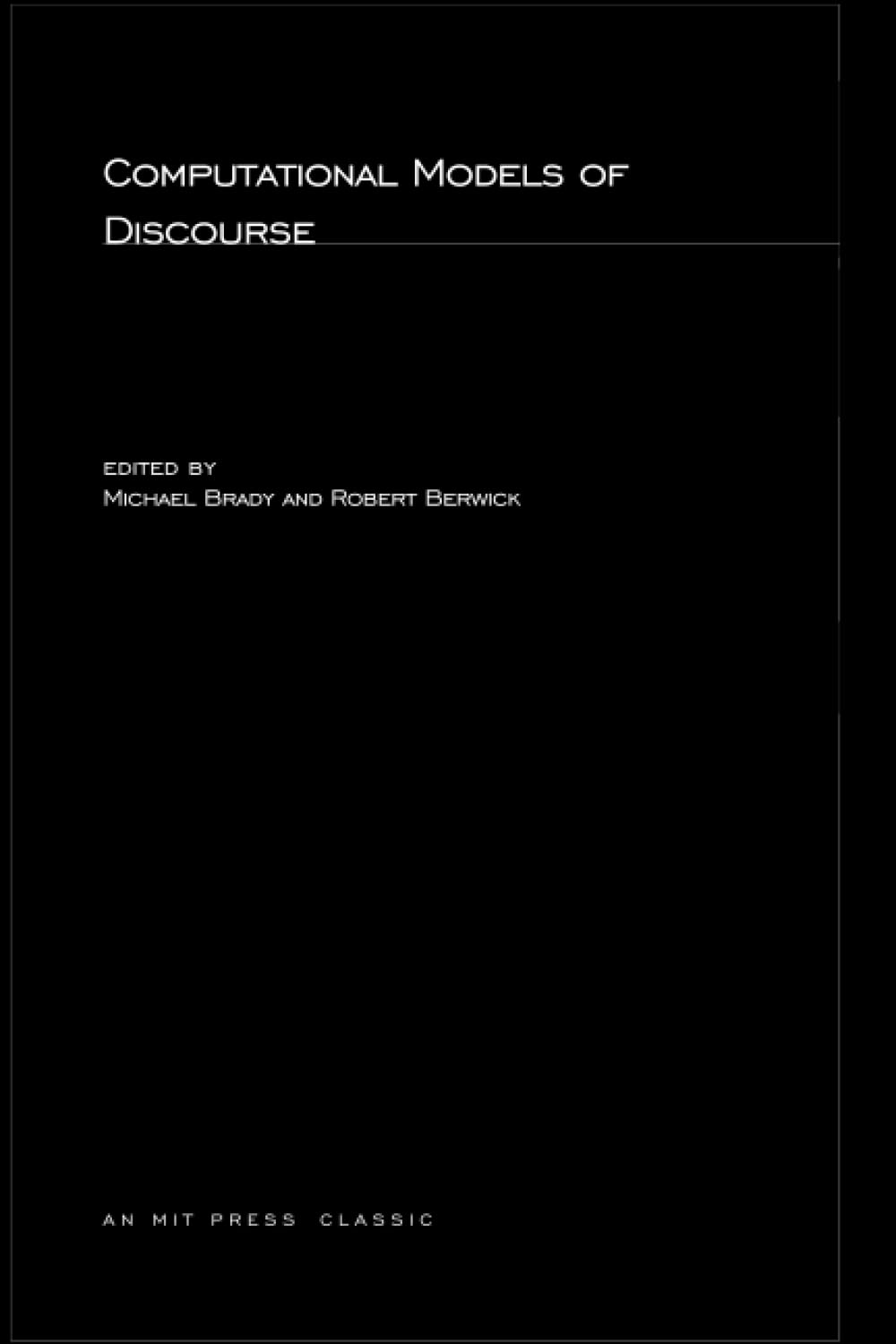
Computational Models of Discourse (Artificial Intelligence),Used
Sold by Ergodebooks, an authorized reseller.
Returns accepted within 30 days | support@ergodebooks.com
Shipping Information
- Free Standard Shipping — United States only
- Processing Time: 3–5 business days
- Estimated Delivery: 6–10 business days after dispatch
- Double-boxed, fully insured & discreetly packaged
- Tracking number sent via email once dispatched
Returns & Refund
Returns accepted within 30 days of delivery.
Damaged or Defective Item
Free return shipping + replacement or full refund
Wrong Item Received
Free return shipping + replacement or full refund
Change of Mind
Return shipping at customer's expense · 25% restocking fee applies
Payment Option

About the Author Michael Brady is Senior Research Scientist at MIT's Artifical Intelligence Laboratory.Robert C. Berwick is Professor of Computational Linguistics and Computer Science and Engineering, in the Laboratory for Information and Decision Systems and the Institute for Data, Systems, and Society at MIT and the author of Computational Complexity and Natural Language and The Acquisition of Syntactic Knowledge, both published by the MIT Press. Product Description As the contributions to this book make clear, a fundamental change is taking place in the study of computational linguistics analogous to that which has taken place in the study of computer vision over the past few years and indicative of trends that are likely to affect future work in artificial intelligence generally. The first wave of efforts on machine translation and the formal mathematical study of parsing yielded little real insight into how natural language could be understood by computers or how computers could lead to an understanding of natural language. The current wave of research seeks both to include a wider and more realistic range of features found in human languages and to limit the dimensions of program goals. Some of the new programs embody for the first time constraints on human parsing which Chomsky has uncovered, for example. The isolation of constraints and the representations for their expression, rather than the design of mechanisms and ideas about process organization, is central to the work reported in this volume. And if present goals are somewhat less ambitious, they are also more realistic and more realizable. ContentsComputational Aspects of Discourse, Robert Berwick Recognizing Intentions from Natural Language Utterances, James Allen Cooperative Responses from a Portable Natural Language Data Base Query System, Jerrold Kaplan Natural Language Generation as a Computational Problem: An Introduction, David McDonald Focusing in the Comprehension of Definite Anaphor, Candace Sidner So What Can We Talk About Now? Bonnie Webber A Preface by David Israel relates these chapters to the general considerations of philosophers and psycholinguists
⚠️ WARNING (California Proposition 65):
This product may contain chemicals known to the State of California to cause cancer, birth defects, or other reproductive harm.
For more information, please visit www.P65Warnings.ca.gov.