
Title
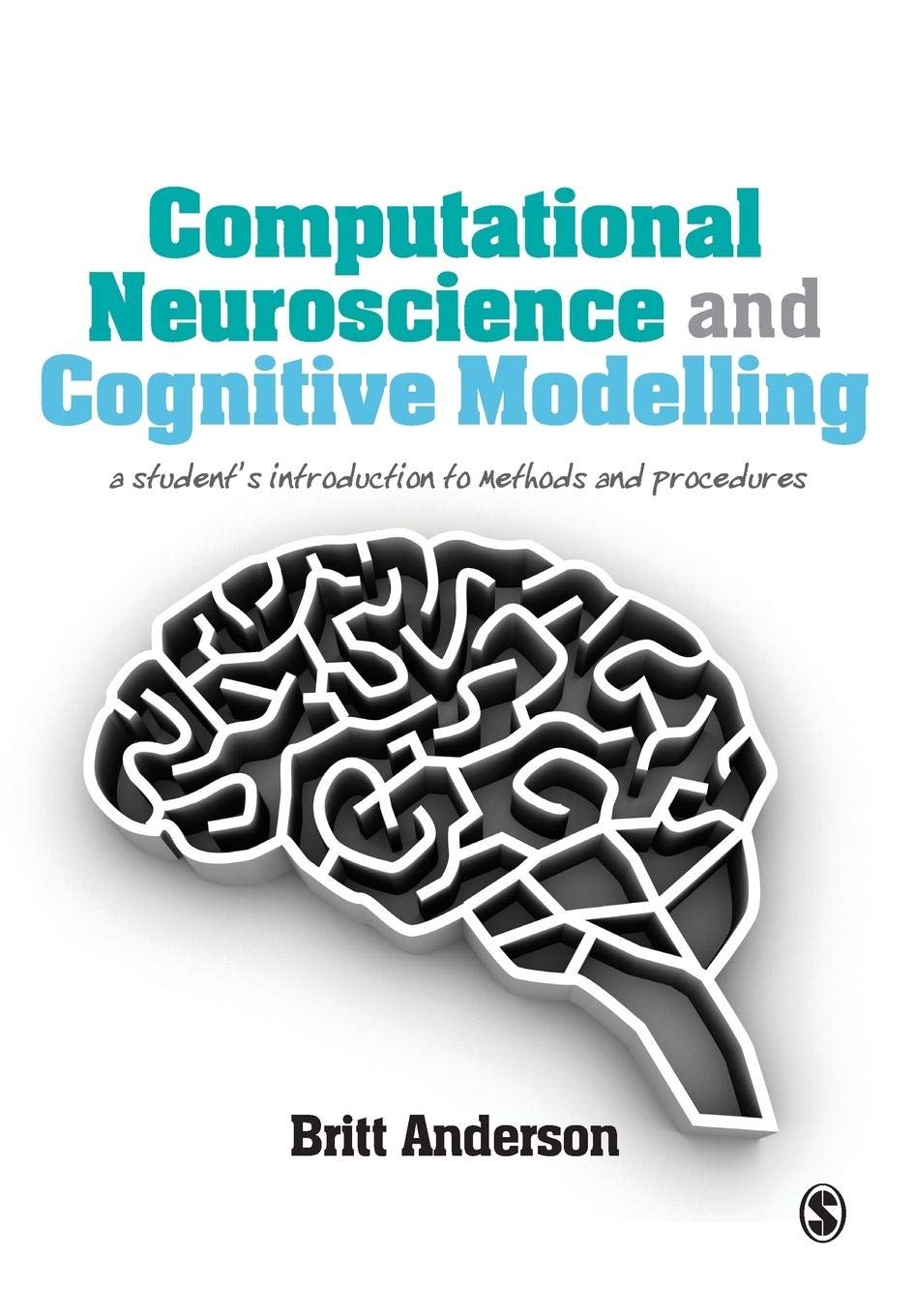
Computational Neuroscience and Cognitive Modelling: A Student's Introduction to Methods and Procedures,Used
Sold by Ergodebooks, an authorized reseller.
Returns accepted within 30 days | support@ergodebooks.com
Shipping Information
- Free Standard Shipping — United States only
- Processing Time: 3–5 business days
- Estimated Delivery: 6–10 business days after dispatch
- Double-boxed, fully insured & discreetly packaged
- Tracking number sent via email once dispatched
Returns & Refund
Returns accepted within 30 days of delivery.
Damaged or Defective Item
Free return shipping + replacement or full refund
Wrong Item Received
Free return shipping + replacement or full refund
Change of Mind
Return shipping at customer's expense · 25% restocking fee applies
Payment Option

"For the neuroscientist or psychologist who cringes at the sight of mathematical formulae and whose eyes glaze over at terms like differential equations, linear algebra, vectors, matrices, Bayes rule, and Boolean logic, this book just might be the therapy needed." Anjan Chatterjee, Professor of Neurology, University of Pennsylvania"Anderson provides a gentle introduction to computational aspects of psychological science, managing to respect the readers intelligence while also being completely unintimidating. Using carefullyselected computational demonstrations, he guides students through a wide array of important approaches and tools, with little in the way of prerequisites...I recommend it with enthusiasm." Asohan Amarasingham, The City University of New YorkThis unique, selfcontained and accessible textbook provides an introduction to computational modelling neuroscience accessible to readers with little or no background in computing or mathematics. Organized into thematic sections, the book spans from modelling integrate and firing neurons to playing the game Rock, Paper, Scissors in ACTR. This nontechnical guide shows how basic knowledge and modern computers can be combined for interesting simulations, progressing from early exercises utilizing spreadsheets, to simple programs in Python. Key Features include: Interleaved chapters that show how traditional computing constructs are simply disguised versions of the spread sheet methods. Mathematical facts and notation needed to understand the modelling methods are presented at their most basic and are interleaved with biographical and historical notes for contex. Numerous worked examples to demonstrate the themes and procedures of cognitive modelling.An excellent text for postgraduate students taking courses in research methods, computational neuroscience, computational modelling, cognitive science and neuroscience. It will be especially valuable to psychology students.
⚠️ WARNING (California Proposition 65):
This product may contain chemicals known to the State of California to cause cancer, birth defects, or other reproductive harm.
For more information, please visit www.P65Warnings.ca.gov.