If you have any questions, you are always welcome to contact us. We'll get back to you as soon as possible, withing 24 hours on weekdays.
Customer service
All questions about your order, return and delivery must be sent to our customer service team by e-mail at yourstore@yourdomain.com
Sale & Press
If you are interested in selling our products, need more information about our brand or wish to make a collaboration, please contact us at press@yourdomain.com
Help
If you have any questions, you are always welcome to contact us. We'll get back to you as soon as possible, withing 24 hours on weekdays.
Customer service
All questions about your order, return and delivery must be sent to our customer service team by e-mail at yourstore@yourdomain.com
Sale & Press
If you are interested in selling our products, need more information about our brand or wish to make a collaboration, please contact us at press@yourdomain.com
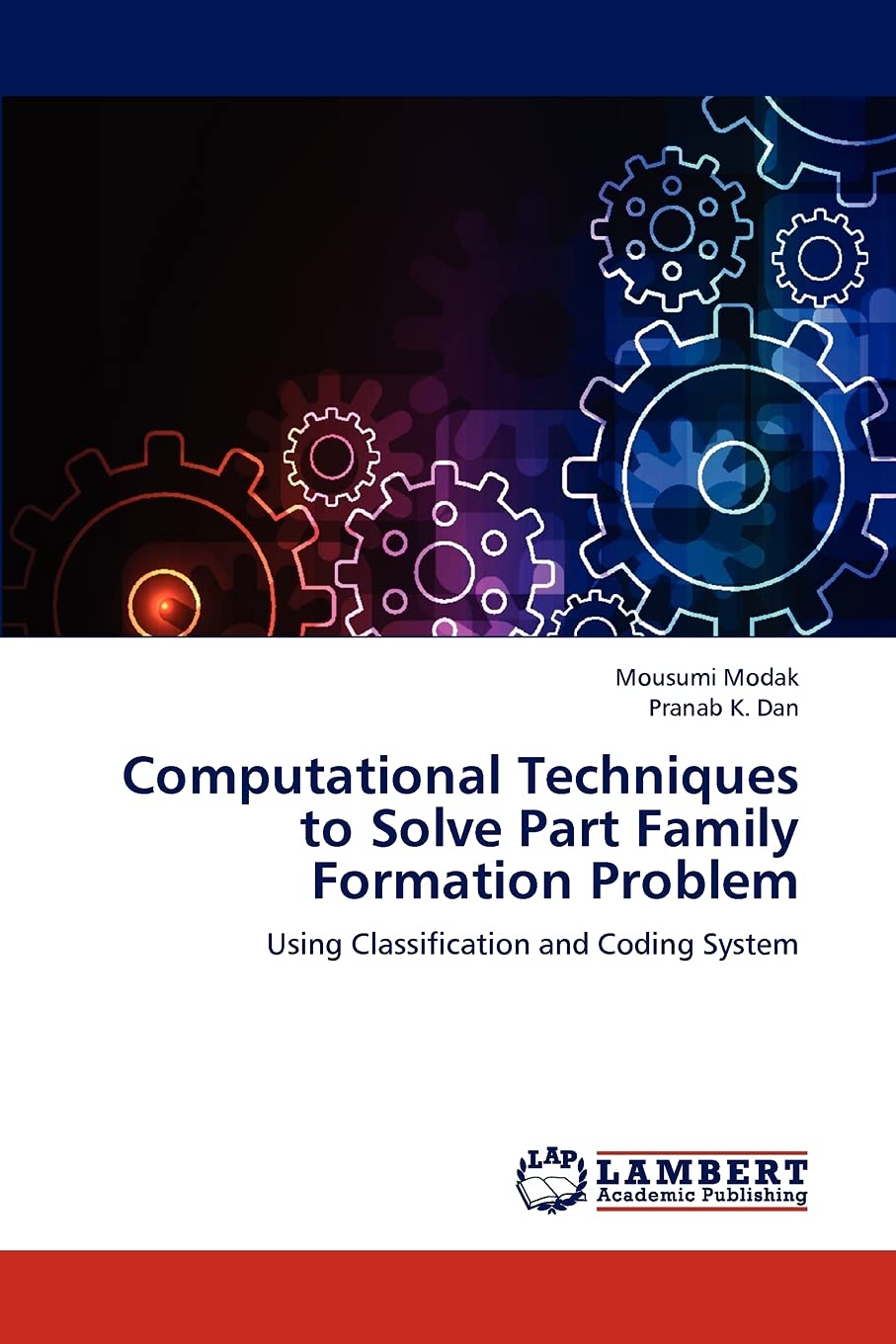
Group Technology (GT) and Cellular Manufacturing System (CMS) portray a significant role in improving productivity for manufacturing organisations. GT is a technique that identifies homogeneous parts and further clusters them into part families based on their manufacturing designs, attributes and geometric shapes. A successful implementation of GT can eventually shrink the engineering costs, facilitate cellular manufacturing, quicken product development, enhance costing accuracy, etc. A major prerequisite in implementing GT is the recognition of part families. Part Coding Analysis proved to be an evolutionary technique in establishing such part similarities. Clustering analysis is practiced in CMS as a competent methodology to facilitate the machinepart grouping problems. In this research, different clustering techniques such as Single Linkage Clustering, Complete Linkage Clustering and Kmeans Clustering Algorithms have been adopted to investigate the nature of similarities and to describe the effectiveness of the techniques in solving the part family problem. Besides, Principal Component Analysis and Particle Swarm Optimization were used to form competent part families.
⚠️ WARNING (California Proposition 65):
This product may contain chemicals known to the State of California to cause cancer,
birth defects, or other reproductive harm.
For MAP (Minimum Advertised Price) violations and Intellectual Property (IP) or Trademark concerns, please contact:
support@ergodebooks.com
⚠️ California Proposition 65 Warning: Some products sold on this website may expose you to chemicals known to the State of California to cause cancer, birth defects, or other reproductive harm. For more information, visit www.P65Warnings.ca.gov.