If you have any questions, you are always welcome to contact us. We'll get back to you as soon as possible, withing 24 hours on weekdays.
Customer service
All questions about your order, return and delivery must be sent to our customer service team by e-mail at yourstore@yourdomain.com
Sale & Press
If you are interested in selling our products, need more information about our brand or wish to make a collaboration, please contact us at press@yourdomain.com
Help
If you have any questions, you are always welcome to contact us. We'll get back to you as soon as possible, withing 24 hours on weekdays.
Customer service
All questions about your order, return and delivery must be sent to our customer service team by e-mail at yourstore@yourdomain.com
Sale & Press
If you are interested in selling our products, need more information about our brand or wish to make a collaboration, please contact us at press@yourdomain.com
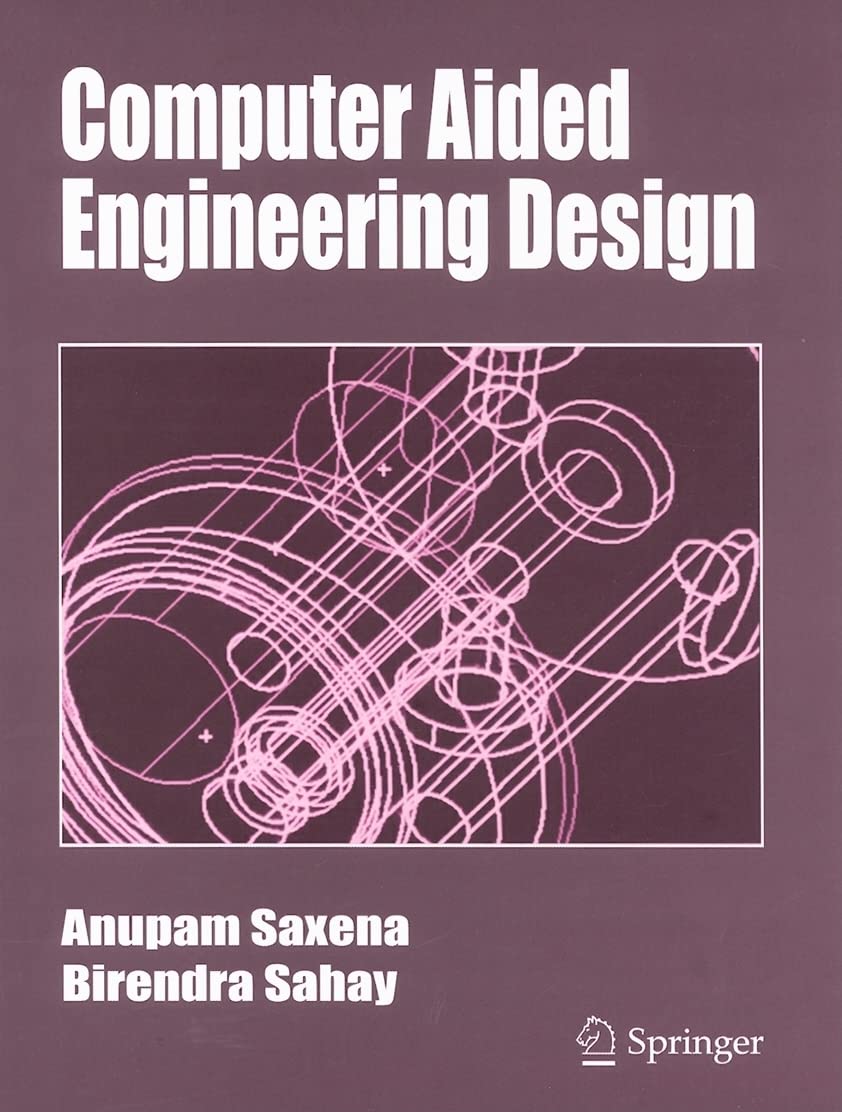
A new discipline is said to attain maturity when the subject matter takes the shape of a textbook. Several textbooks later, the discipline tends to acquire a firm place in the curriculum for teaching and learning. Computer Aided Engineering Design (CAED), barely three decades old, is interdisciplinary in nature whose boundaries are still expanding. However, it draws its core strength from several acknowledged and diverse areas such as computer graphics, differential geometry, Boolean algebra, computational geometry, topological spaces, numerical analysis, mechanics of solids, engineering design and a few others. CAED also needs to show its strong linkages with Computer Aided Manufacturing (CAM). As is true with any growing discipline, the literature is widespread in research journals, edited books, and conference proceedings. Various textbooks have appeared with different biases, like geometric modeling, computer graphics, and CAD/CAM over the last decade. This book goes into mathematical foundations and the core subjects of CAED without allowing itself to be overshadowed by computer graphics. It is written in a logical and thorough manner for use mainly by senior and graduate level students as well as users and developers of CAD software. The book covers (a) The fundamental concepts of geometric modeling so that a real understanding of designing synthetic surfaces and solid modeling can be achieved. (b) A wide spectrum of CAED topics such as CAD of linkages and machine elements, finite element analysis, optimization. (c) Application of these methods to real world problems.
⚠️ WARNING (California Proposition 65):
This product may contain chemicals known to the State of California to cause cancer,
birth defects, or other reproductive harm.
For MAP (Minimum Advertised Price) violations and Intellectual Property (IP) or Trademark concerns, please contact:
support@ergodebooks.com
⚠️ California Proposition 65 Warning: Some products sold on this website may expose you to chemicals known to the State of California to cause cancer, birth defects, or other reproductive harm. For more information, visit www.P65Warnings.ca.gov.