
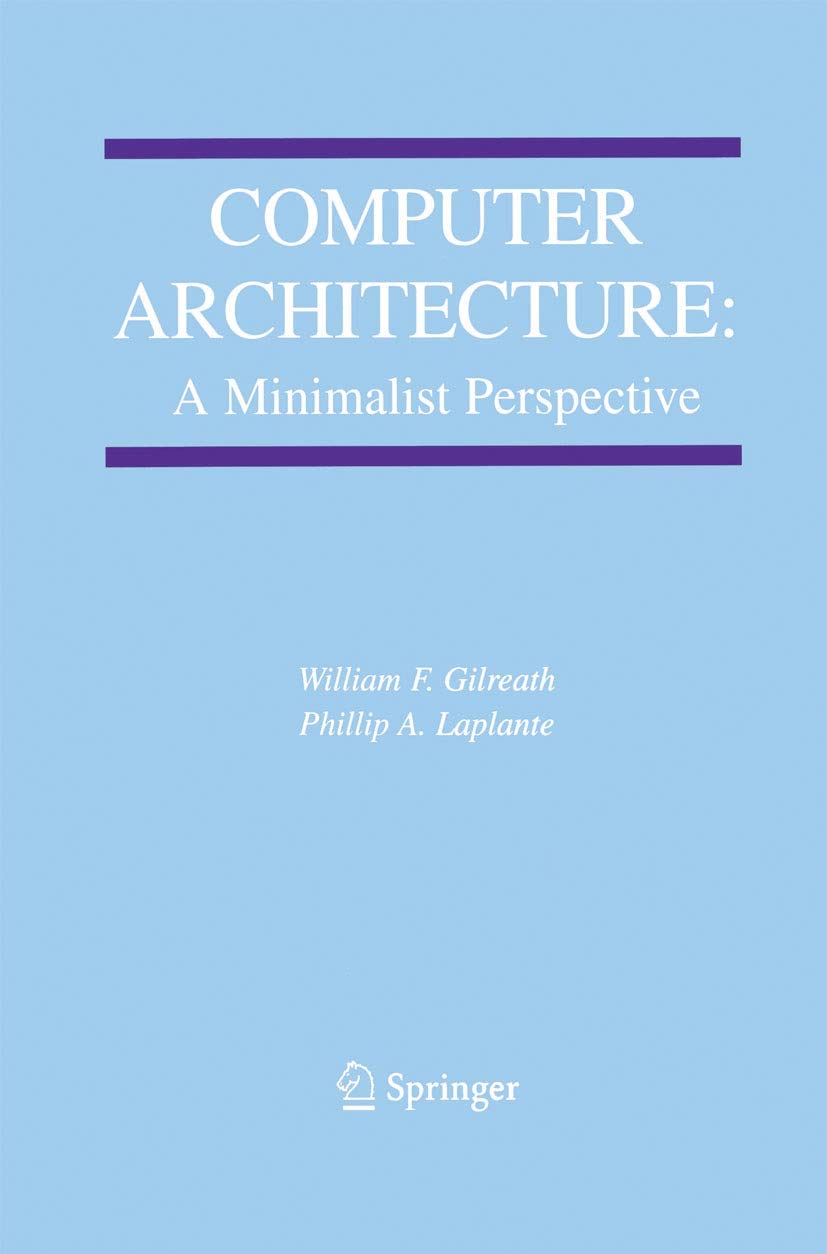
Title
Computer Architecture: A Minimalist Perspective (The Springer International Series in Engineering and Computer Science, 730),New
Sold by Ergodebooks, an authorized reseller.
Returns accepted within 30 days | support@ergodebooks.com
Shipping Information
- Free Standard Shipping — United States only
- Processing Time: 3–5 business days
- Estimated Delivery: 6–10 business days after dispatch
- Double-boxed, fully insured & discreetly packaged
- Tracking number sent via email once dispatched
Returns & Refund
Returns accepted within 30 days of delivery.
Damaged or Defective Item
Free return shipping + replacement or full refund
Wrong Item Received
Free return shipping + replacement or full refund
Change of Mind
Return shipping at customer's expense · 25% restocking fee applies
Payment Option

This book examines computer architecture, computability theory, and the history of computers from the perspective of minimalist computing a framework in which the instruction set consists of a single instruction. This approach is different than that taken in any other computer architecture text, and it is a bold step. The audience for this book is researchers, computer hardware engineers, software engineers, and systems engineers who are looking for a fresh, unique perspective on computer architecture. Upper division undergraduate students and early graduate students studying computer architecture, computer organization, or embedded systems will also find this book useful. A typical course title might be 'Special Topics in Computer Architecture.' The organization ofthe book is as follows. First, the reasons for studying such an 'esoteric' subject are given. Then, the history and evolution of instruction sets is studied with an emphasis on how modern computing has features ofone instruction computing. Also, previous computer systems are reviewed to show how their features relate to one instruction computers. Next, the primary forms of one instruction set computing are examined. The theories of computation and of Turing machines are also reviewed to examine the theoretical nature of one instruction computers. Other processor architectures and instruction sets are then mapped into single instructions to illustrate the features of both types of one instruction computers. In doing so, the features of the processor being mapped are highlighted.
⚠️ WARNING (California Proposition 65):
This product may contain chemicals known to the State of California to cause cancer, birth defects, or other reproductive harm.
For more information, please visit www.P65Warnings.ca.gov.