
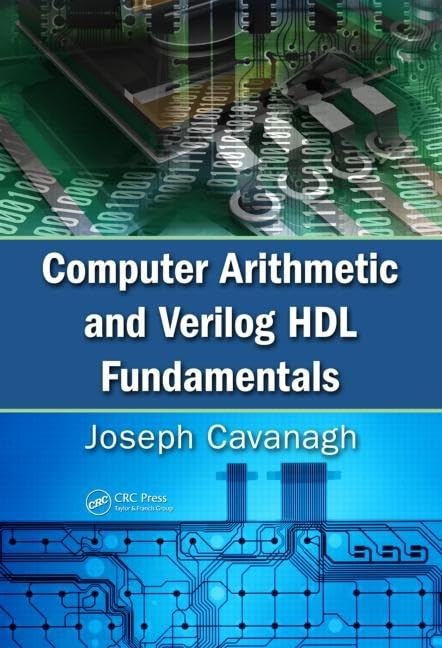
Title
Computer Arithmetic and Verilog HDL Fundamentals,Used
Sold by Ergodebooks, an authorized reseller.
Returns accepted within 30 days | support@ergodebooks.com
Shipping Information
- Free Standard Shipping — United States only
- Processing Time: 3–5 business days
- Estimated Delivery: 6–10 business days after dispatch
- Double-boxed, fully insured & discreetly packaged
- Tracking number sent via email once dispatched
Returns & Refund
Returns accepted within 30 days of delivery.
Damaged or Defective Item
Free return shipping + replacement or full refund
Wrong Item Received
Free return shipping + replacement or full refund
Change of Mind
Return shipping at customer's expense · 25% restocking fee applies
Payment Option

Verilog Hardware Description Language (HDL) is the stateoftheart method for designing digital and computer systems. Ideally suited to describe both combinational and clocked sequential arithmetic circuits, Verilog facilitates a clear relationship between the language syntax and the physical hardware. It provides a very easytolearn and practical means to model a digital system at many levels of abstraction.Computer Arithmetic and Verilog HDL Fundamentals details the steps needed to master computer arithmetic for fixedpoint, decimal, and floatingpoint number representations for all primary operations. Silvaco Internationals SILOS, the Verilog simulator used in these pages, is simple to understand, yet powerful enough for any application. It encourages users to quickly prototype and debug any logic function and enables singlestepping through the Verilog source code. It also presents draganddrop abilities.Introducing the three main modeling methodsdataflow, behavioral, and structuralthis selfcontained tutorialCovers the number systems of different radices, such as octal, decimal, hexadecimal, and binarycoded variationsReviews logic design fundamentals, including Boolean algebra and minimization techniques for switching functionsPresents basic methods for fixedpoint addition, subtraction, multiplication, and division, including the use of decimals in all four operationsAddresses floatingpoint addition and subtraction with several numerical examples and flowcharts that graphically illustrate steps required for true addition and subtraction for floatingpoint operandsDemonstrates floatingpoint division, including the generation of a zerobiased exponentDesigned for electrical and computer engineers and computer scientists, this book leaves nothing unfinished, carrying design examples through to completion. The goal is practical proficiency. To this end, each chapter includes problems of varying complexity to be designed by the reader.
⚠️ WARNING (California Proposition 65):
This product may contain chemicals known to the State of California to cause cancer, birth defects, or other reproductive harm.
For more information, please visit www.P65Warnings.ca.gov.