
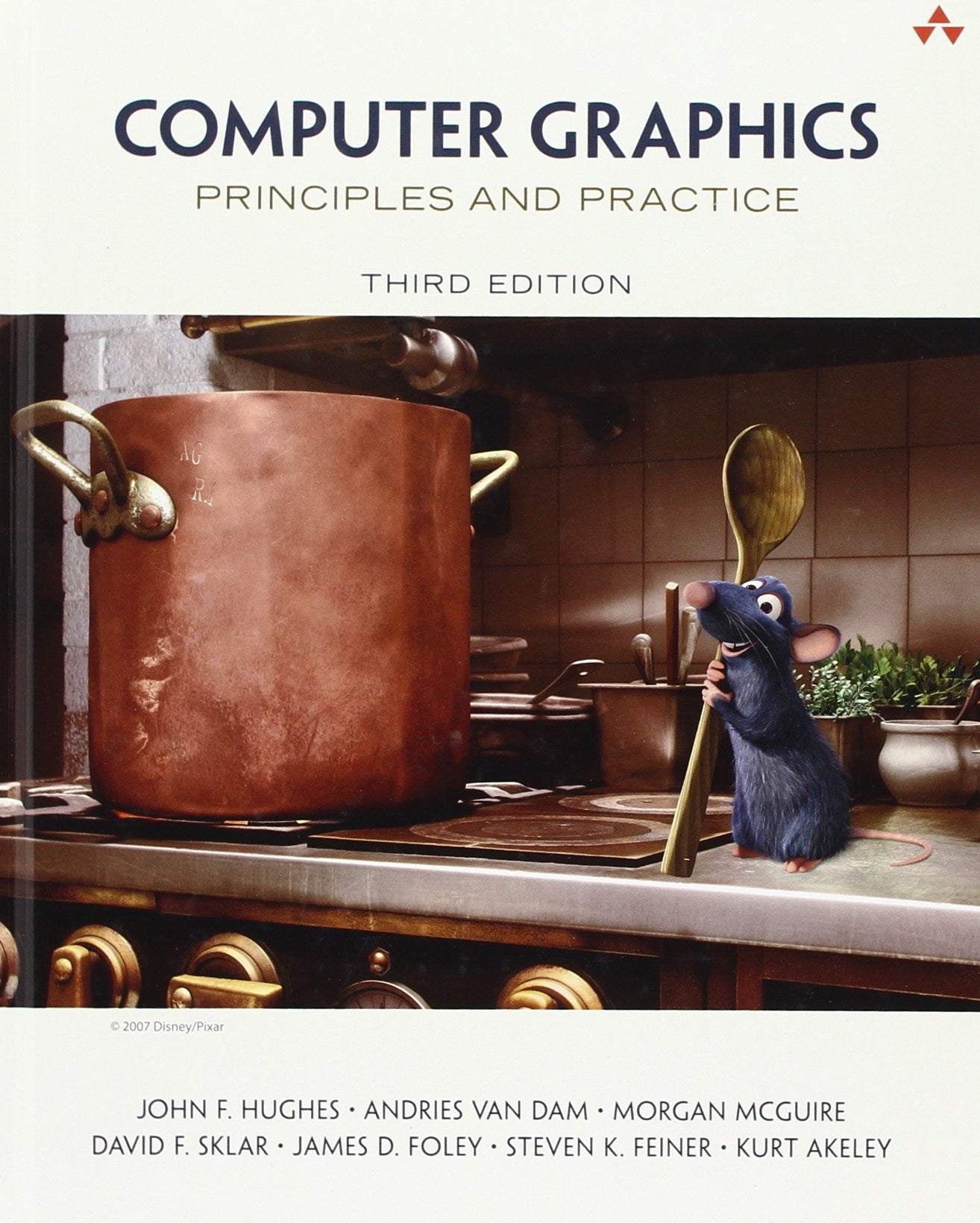
Title
Computer Graphics: Principles and Practice,Used
Sold by Ergodebooks, an authorized reseller.
Returns accepted within 30 days | support@ergodebooks.com
Shipping Information
- Free Standard Shipping — United States only
- Processing Time: 3–5 business days
- Estimated Delivery: 6–10 business days after dispatch
- Double-boxed, fully insured & discreetly packaged
- Tracking number sent via email once dispatched
Returns & Refund
Returns accepted within 30 days of delivery.
Damaged or Defective Item
Free return shipping + replacement or full refund
Wrong Item Received
Free return shipping + replacement or full refund
Change of Mind
Return shipping at customer's expense · 25% restocking fee applies
Payment Option

Computer Graphics: Principles and Practice, Third Edition, remains the most authoritative introduction to the field. The first edition, the original Foley and van Dam, helped to define computer graphics and how it could be taught. The second edition became an even more comprehensive resource for practitioners and students alike. This third edition has been completely rewritten to provide detailed and uptodate coverage of key concepts, algorithms, technologies, and applications.The authors explain the principles, as well as the mathematics, underlying computer graphicsknowledge that is essential for successful work both now and in the future. Early chapters show how to create 2D and 3D pictures right away, supporting experimentation. Later chapters, covering a broad range of topics, demonstrate more sophisticated approaches. Sections on current computer graphics practice show how to apply given principles in common situations, such as how to approximate an ideal solution on available hardware, or how to represent a data structure more efficiently. Topics are reinforced by exercises, programming problems, and handson projects.This revised edition features New coverage of the rendering equation, GPU architecture considerations, and importance sampling in physically based rendering An emphasis on modern approaches, as in a new chapter on probability theory for use in MonteCarlo rendering Implementations of GPU shaders, software rendering, and graphicsintensive 3D interfaces 3D realtime graphics platformstheir design goals and tradeoffsincluding new mobile and browser platforms Programming and debugging approaches unique to graphics developmentThe text and hundreds of figures are presented in full color throughout the book. Programs are written in C++, C#, WPF, or pseudocodewhichever language is most effective for a given example. Source code and figures from the book, testbed programs, and additional content will be available from the authors' website (cgpp.net) or the publisher's website (informit.com/title/9780321399526). Instructor resources will be available from the publisher. The wealth of information in this book makes it the essential resource for anyone working in or studying any aspect of computer graphics.
⚠️ WARNING (California Proposition 65):
This product may contain chemicals known to the State of California to cause cancer, birth defects, or other reproductive harm.
For more information, please visit www.P65Warnings.ca.gov.