
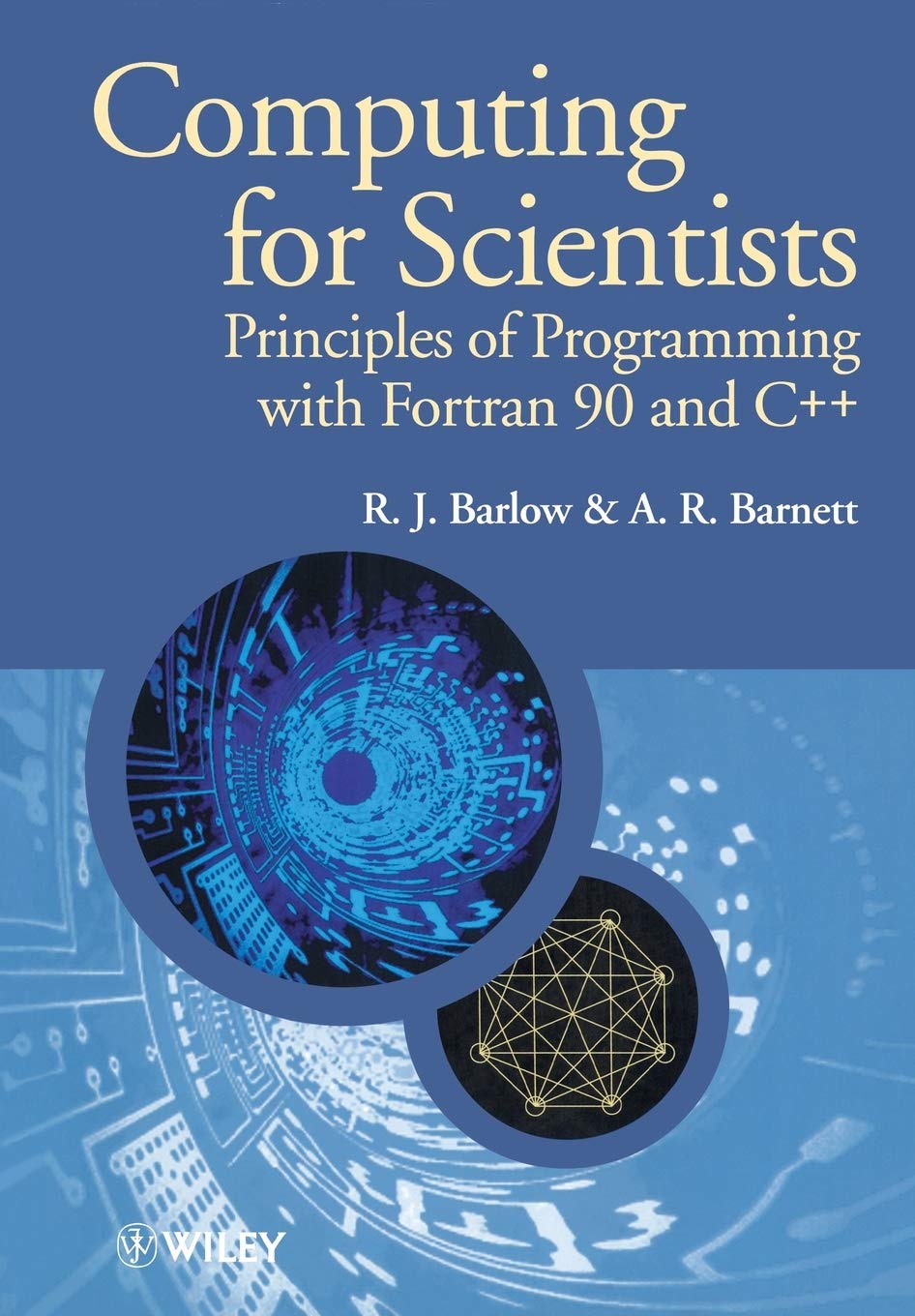
Title
Computing For Scientists: Principles Of Programming With Fortran 90 And C++,New
Sold by Ergodebooks, an authorized reseller.
Returns accepted within 30 days | support@ergodebooks.com
Shipping Information
- Free Standard Shipping — United States only
- Processing Time: 3–5 business days
- Estimated Delivery: 6–10 business days after dispatch
- Double-boxed, fully insured & discreetly packaged
- Tracking number sent via email once dispatched
Returns & Refund
Returns accepted within 30 days of delivery.
Damaged or Defective Item
Free return shipping + replacement or full refund
Wrong Item Received
Free return shipping + replacement or full refund
Change of Mind
Return shipping at customer's expense · 25% restocking fee applies
Payment Option

The Manchester Physics Series General Editors: D. J. Sandiford; F. Mandl; A. C. Phillips Department Of Physics And Astronomy, University Of Manchester Properties Of Matter B. H. Flowers And E. Mendoza Optics Second Edition F. G. Smith And J. H. Thomson Statistical Physics Second Edition F. Mandl Electromagnetism Second Edition I. S. Grant And W. R. Phillips Statistics R. J. Barlow Solid State Physics Second Edition J. R. Hook And H. E. Hall Quantum Mechanics F. Mandl Particle Physics Second Edition B. R. Martin And G. Shaw The Physics Of Stars A. C. Phillips Computing For Scientists R. J. Barlow And A. R. Barnett Computing For Scientists Focuses On The Principles Involved In Scientific Programming. Topics Of Importance And Interest To Scientists Are Presented In A Thoughtful And Thoughtprovoking Way, With Coverage Ranging From Highlevel Objectoriented Software To Lowlevel Machinecode Operations. Taking A Problemsolving Approach, This Book Gives The Reader An Insight Into The Ways Programs Are Implemented And What Actually Happens When They Run. Throughout, The Importance Of Good Programming Style Is Emphasised And Illustrated. Two Languages, Fortran 90 And C++, Are Used To Provide Contrasting Examples, And Explain How Various Techniques Are Used And When They Are Appropriate Or Inappropriate. For Scientists And Engineers Needing To Write Programs Of Their Own Or Understand Those Written By Others, Computing For Scientists:* Is A Carefully Written Introduction To Programming, Taking The Reader From The Basics To A Considerable Level Of Sophistication.* Emphasises An Understanding Of The Principles And The Development Of Good Programming Skills.* Includes Optional 'Starred' Sections Containing More Specialised And Advanced Material For The More Ambitious Reader.* Assumes No Prior Knowledge, And Has Many Examples And Exercises With Solutions Included At The Back Of The Book.
⚠️ WARNING (California Proposition 65):
This product may contain chemicals known to the State of California to cause cancer, birth defects, or other reproductive harm.
For more information, please visit www.P65Warnings.ca.gov.
- Q: How many pages does this book have? A: This book has two hundred ninety-two pages. It provides in-depth coverage of programming principles specifically for scientists.
- Q: What is the binding type of this book? A: The binding type is paperback. This makes it lightweight and easy to carry for study or reference.
- Q: What are the dimensions of this book? A: The dimensions are six point six one inches in length, zero point six seven inches in width, and nine point five three inches in height. These measurements make it a convenient size for reading.
- Q: How do I use this book for learning programming? A: You can use this book to learn programming by following its structured approach. It starts with basic concepts and progresses to more advanced topics suitable for scientists.
- Q: Is this book suitable for beginners? A: Yes, this book is suitable for beginners. It assumes no prior knowledge of programming and includes numerous examples and exercises.
- Q: What programming languages are covered in this book? A: This book covers Fortran ninety and C++. It provides contrasting examples to illustrate different programming techniques.
- Q: How should I store this book to keep it in good condition? A: Store this book in a cool, dry place away from direct sunlight. Keeping it on a shelf will help prevent bending or damage.
- Q: Are there any special care instructions for this book? A: There are no special care instructions needed for this book. Just handle it gently and avoid exposing it to moisture.
- Q: What if my book arrives damaged? A: If your book arrives damaged, you can contact customer support for a return or exchange. Ensure to have your order details handy.
- Q: Can I find solutions to exercises in this book? A: Yes, solutions to many exercises are included at the back of the book. This helps reinforce learning and understanding.
- Q: Is this book appropriate for advanced programmers? A: Yes, it includes optional 'starred' sections with more specialized material. Advanced programmers can benefit from these sections.
- Q: Does this book emphasize good programming practices? A: Yes, the book emphasizes the importance of good programming style. It provides insights into best practices throughout the content.
- Q: What topics are covered in this book? A: The book covers a range of topics from high-level object-oriented software to low-level machine-code operations. It's comprehensive for scientific programming.
- Q: Who is the author of this book? A: The author is R. J. Barlow. He is known for his expertise in programming for scientists.
- Q: What is the target audience for this book? A: The target audience includes scientists and engineers who need to write or understand programs. It’s designed for learners at various levels.
- Q: What makes this book unique compared to others? A: This book uniquely combines scientific principles with programming techniques, making it particularly relevant for scientists and engineers.