
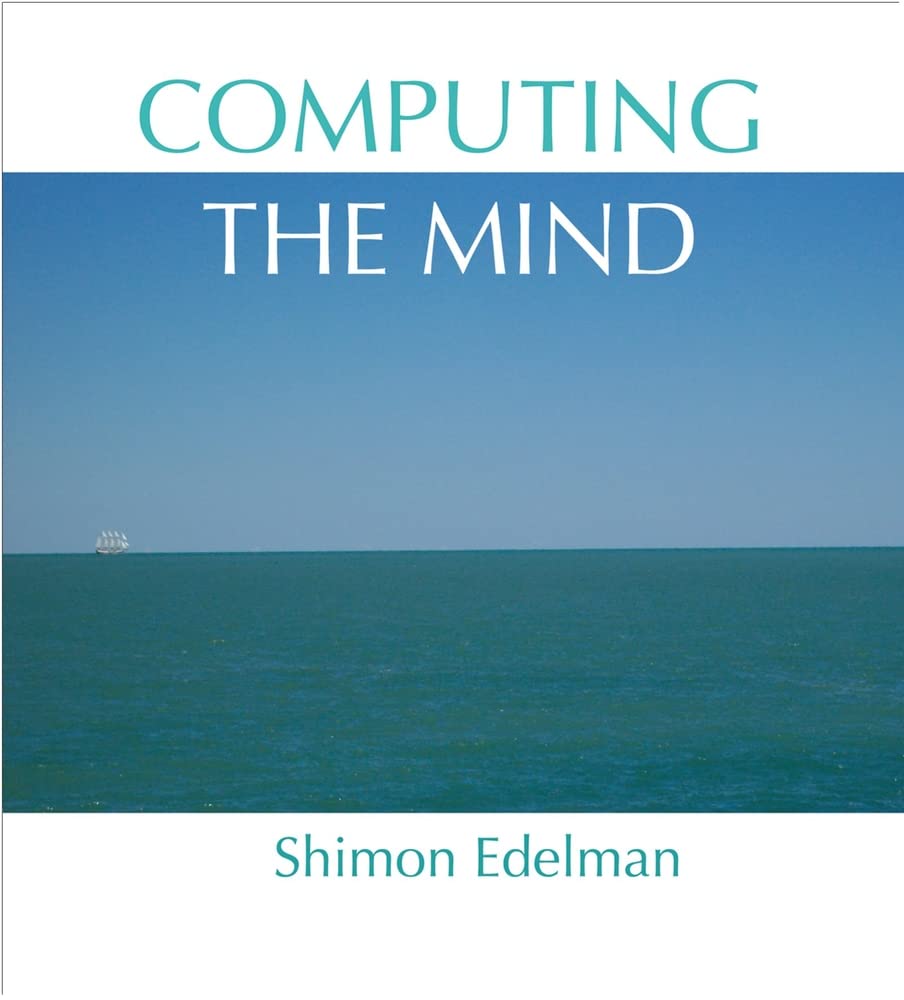
Title
Computing the Mind: How the Mind Really Works,Used
Sold by Ergodebooks, an authorized reseller.
Returns accepted within 30 days | support@ergodebooks.com
Shipping Information
- Free Standard Shipping — United States only
- Processing Time: 3–5 business days
- Estimated Delivery: 6–10 business days after dispatch
- Double-boxed, fully insured & discreetly packaged
- Tracking number sent via email once dispatched
Returns & Refund
Returns accepted within 30 days of delivery.
Damaged or Defective Item
Free return shipping + replacement or full refund
Wrong Item Received
Free return shipping + replacement or full refund
Change of Mind
Return shipping at customer's expense · 25% restocking fee applies
Payment Option

In a culmination of humanity's millennialong quest for self knowledge, the sciences of the mind are now in a position to offer concrete, empirically validated answers to the most fundamental questions about human nature. What does it mean to be a mind? How is the mind related to the brain? How are minds shaped by their embodiment and environment? What are the principles behind cognitive functions such as perception, memory, language, thought, and consciousness?By analyzing the tasks facing any sentient being that is subject to stimulation and a pressure to act, Shimon Edelman identifies computation as the common denominator in the emerging answers to all these questions. Any system composed of elements that exchange signals with each other and occasionally with the rest of the world can be said to be engaged in computation. A brain composed of neurons is one example of a system that computes, and the computations that the neurons collectively carry out constitute the brain's mind.Edelman presents a computational account of the entire spectrum of cognitive phenomena that constitutes the mind. He begins with sentience, and uses examples from visual perception to demonstrate that it must, at its very core, be a type of computation. Throughout his account, Edelman acknowledges the human mind's biological origins. Along the way, he also demystifies traits such as creativity, language, and individual and collective consciousness, and hints at how naturally evolved minds can transcend some of their limitations by moving to computational substrates other than brains. The account that Edelman gives in this book is accessible, yet unified and rigorous, and the big picture he presents is supported by evidence ranging from neurobiology to computer science. The book should be read by anyone seeking a comprehensive and current introduction to cognitive psychology.
⚠️ WARNING (California Proposition 65):
This product may contain chemicals known to the State of California to cause cancer, birth defects, or other reproductive harm.
For more information, please visit www.P65Warnings.ca.gov.
- Q: What is the binding of this book? A: This book has a hardcover binding. Hardcover bindings are durable and ideal for long-term use.
- Q: How many pages does the book have? A: The book contains six hundred twenty-seven pages. This length allows for an in-depth exploration of cognitive psychology.
- Q: What are the dimensions of the book? A: The book measures nine point one inches in length, one point five inches in width, and eight inches in height. These dimensions make it a manageable size for reading.
- Q: Who is the author of this book? A: The author is Shimon Edelman. He is known for his significant contributions to cognitive psychology.
- Q: What topics does this book cover? A: The book covers fundamental questions about human nature, cognitive functions, and the relationship between the mind and brain. It explores concepts like perception, memory, and consciousness.
- Q: Is this book suitable for beginners in psychology? A: Yes, the book is accessible to beginners. It provides a comprehensive introduction to cognitive psychology concepts.
- Q: How should I read this book for maximum understanding? A: To maximize understanding, read the book in a quiet environment and take notes on key concepts. This will help reinforce learning.
- Q: What age group is this book appropriate for? A: This book is appropriate for adults and older teens. It deals with complex psychological concepts that require advanced comprehension.
- Q: Is there any special care needed for this hardcover book? A: No special care is needed, but it's advisable to keep it away from moisture and direct sunlight. This will help preserve its condition.
- Q: Can I return the book if I don't like it? A: Yes, the book comes with a no-quibbles return policy. You can return it if it does not meet your expectations.
- Q: What should I do if the book arrives damaged? A: If the book arrives damaged, contact customer service immediately for a replacement or refund. They will guide you through the return process.
- Q: How is this book packaged for shipping? A: The book is packaged securely to prevent damage during transit. This ensures it arrives in mint condition.
- Q: Are there any illustrations in the book? A: Yes, the book contains one hundred sixty-four line illustrations. These visuals help clarify complex concepts discussed in the text.
- Q: What makes this book unique compared to others in psychology? A: This book stands out due to its computational perspective on cognitive phenomena. It integrates insights from neurobiology and computer science.
- Q: Is this book a good resource for research purposes? A: Yes, it is an excellent resource for research. The book is well-supported by empirical evidence and provides a thorough overview of cognitive science.
- Q: Does this book include references or a bibliography? A: Yes, the book includes references throughout the text. This allows readers to explore the original research and theories discussed.