If you have any questions, you are always welcome to contact us. We'll get back to you as soon as possible, withing 24 hours on weekdays.
Customer service
All questions about your order, return and delivery must be sent to our customer service team by e-mail at yourstore@yourdomain.com
Sale & Press
If you are interested in selling our products, need more information about our brand or wish to make a collaboration, please contact us at press@yourdomain.com
Help
If you have any questions, you are always welcome to contact us. We'll get back to you as soon as possible, withing 24 hours on weekdays.
Customer service
All questions about your order, return and delivery must be sent to our customer service team by e-mail at yourstore@yourdomain.com
Sale & Press
If you are interested in selling our products, need more information about our brand or wish to make a collaboration, please contact us at press@yourdomain.com
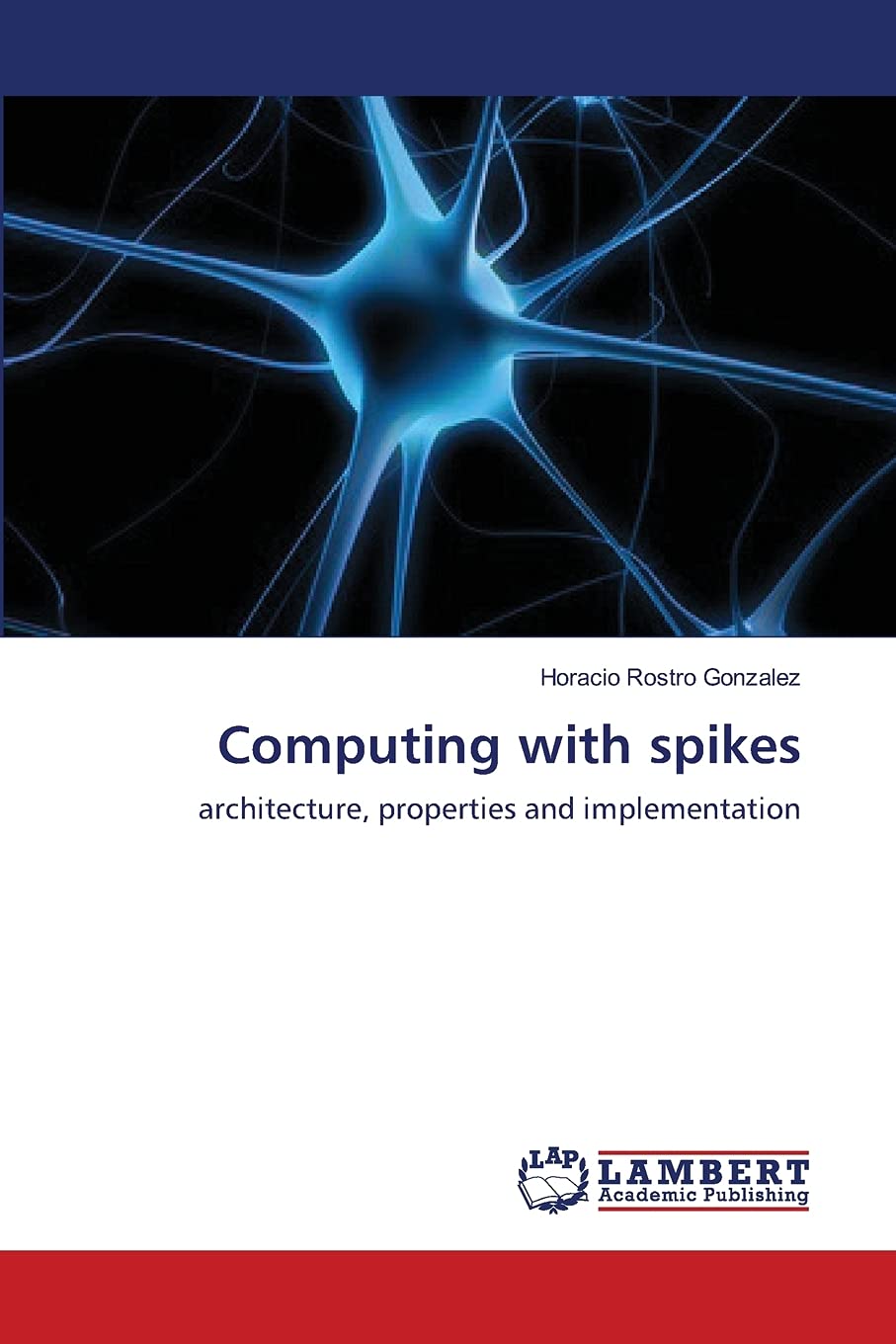
In this work we studied at a practical level how computation with action potentials (spikes) can be performed. We address the problem of programming of a dynamical system modeled as a neural network and considering both, hardware and software implementations. For this, we considered a discretetime spiking neuron model, which was introduced by Soula et al. in 2006, and called BMS. On one hand, we proposed an efficient method to properly estimate the parameters (delayed synaptic weights) of a neural network from the observation of its spiking dynamics. Thus, the idea was to avoid the underlying NPcomplete problem (when both weights and interneural transmission delays are considered in the parameters estimation). So far, our method defines a Linear Programming (LP) system to perform the parameters estimation. Another aspect considered in this work was the fact that we included a reservoir computing mechanism (hidden network) as to increase the computational power as to add robustness. Furthermore, these ideas are applied to implement inputoutput transformation for learning the implicit parameters of the corresponding transfer function.
⚠️ WARNING (California Proposition 65):
This product may contain chemicals known to the State of California to cause cancer,
birth defects, or other reproductive harm.
For MAP (Minimum Advertised Price) violations and Intellectual Property (IP) or Trademark concerns, please contact:
support@ergodebooks.com
⚠️ California Proposition 65 Warning: Some products sold on this website may expose you to chemicals known to the State of California to cause cancer, birth defects, or other reproductive harm. For more information, visit www.P65Warnings.ca.gov.