If you have any questions, you are always welcome to contact us. We'll get back to you as soon as possible, withing 24 hours on weekdays.
Customer service
All questions about your order, return and delivery must be sent to our customer service team by e-mail at yourstore@yourdomain.com
Sale & Press
If you are interested in selling our products, need more information about our brand or wish to make a collaboration, please contact us at press@yourdomain.com
Help
If you have any questions, you are always welcome to contact us. We'll get back to you as soon as possible, withing 24 hours on weekdays.
Customer service
All questions about your order, return and delivery must be sent to our customer service team by e-mail at yourstore@yourdomain.com
Sale & Press
If you are interested in selling our products, need more information about our brand or wish to make a collaboration, please contact us at press@yourdomain.com
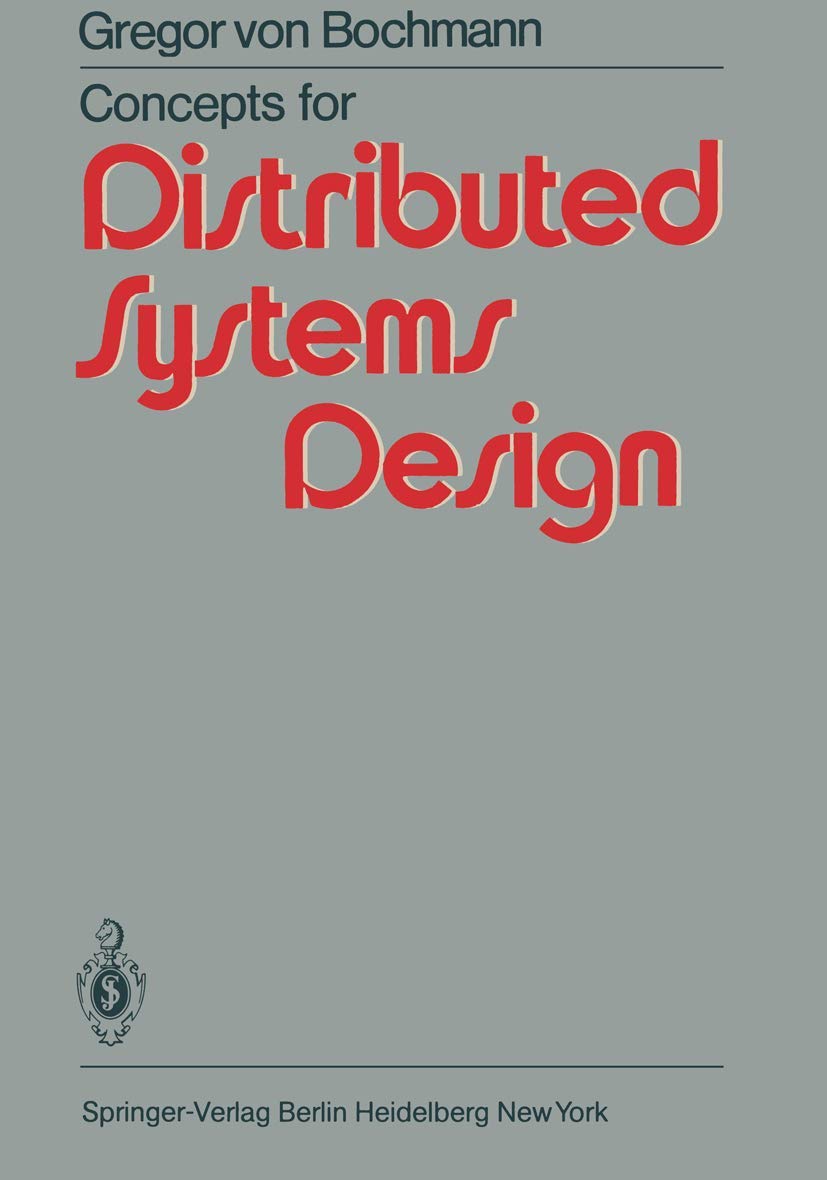
This book is written for computer programmers, analysts and scientists, as well as computer science students, as an intro duction to the principles of distributed system design. The emphasis is placed on a clear understanding of the concepts, rather than on details; and the reader will learn about the struc ture of distributed systems, their problems, and approaches to their design and development. The reader should have a basic knowledge of computer systems and be familiar with modular design principles for software development. He should also be aware of presentday remoteaccess and distributed computer applications. The book consists of three parts which deal with prin ciples of distributed systems, communications architecture and protocols, and formal description techniques. The first part serves as an introduction to the broad meaning of "distributed system". We give examples, try to define terms, and discuss the problems that arise in the context of parallel and distributed processing. The second part presents the typical layered protocol architecture of distributed systems, and discusses problems of compatibility and interworking between heterogeneous computer systems. The principles of the lower layer functions and protocols are explained in some detail, including link layer protocols and network transmission services. The third part deals with specification issues. The role of specifications in the design of distributed systems is explained in general, and formal methods for the specification, analysis and implementation of distributed systems are discussed.
⚠️ WARNING (California Proposition 65):
This product may contain chemicals known to the State of California to cause cancer,
birth defects, or other reproductive harm.
For MAP (Minimum Advertised Price) violations and Intellectual Property (IP) or Trademark concerns, please contact:
support@ergodebooks.com
⚠️ California Proposition 65 Warning: Some products sold on this website may expose you to chemicals known to the State of California to cause cancer, birth defects, or other reproductive harm. For more information, visit www.P65Warnings.ca.gov.