
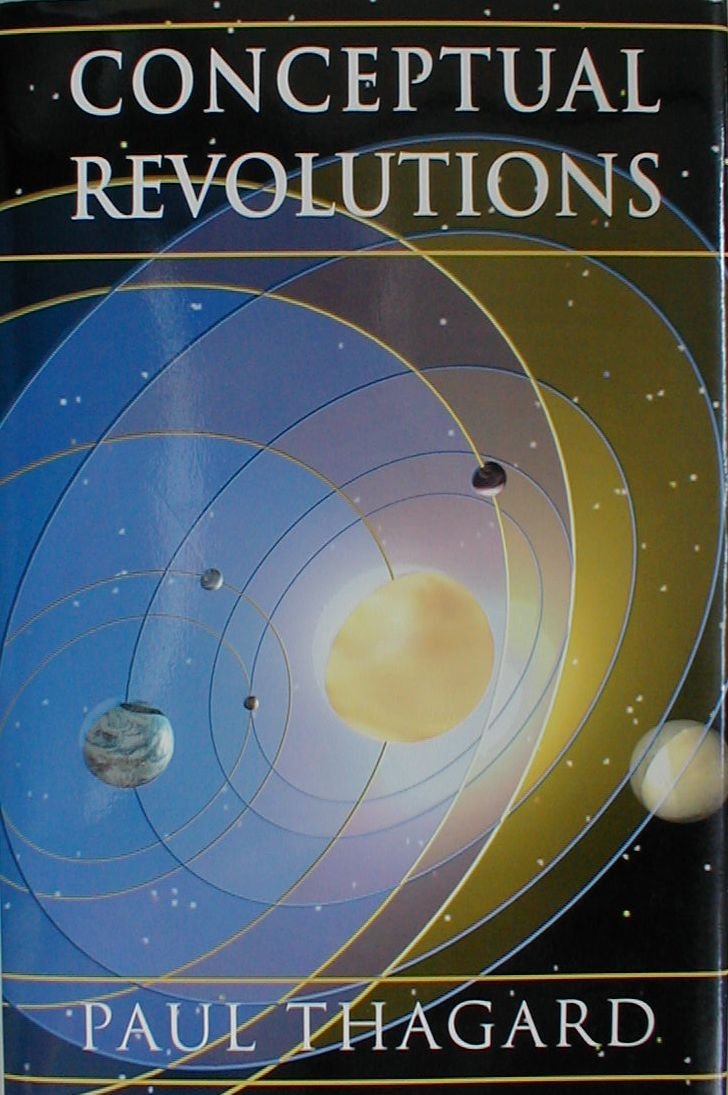
Title
Conceptual Revolutions,New
Sold by Ergodebooks, an authorized reseller.
Returns accepted within 30 days | support@ergodebooks.com
Shipping Information
- Free Standard Shipping — United States only
- Processing Time: 3–5 business days
- Estimated Delivery: 6–10 business days after dispatch
- Double-boxed, fully insured & discreetly packaged
- Tracking number sent via email once dispatched
Returns & Refund
Returns accepted within 30 days of delivery.
Damaged or Defective Item
Free return shipping + replacement or full refund
Wrong Item Received
Free return shipping + replacement or full refund
Change of Mind
Return shipping at customer's expense · 25% restocking fee applies
Payment Option

In this pathbreaking work, Paul Thagard draws on the history and philosophy of science, cognitive psychology, and the field of artificial intelligence to develop a theory of conceptual change capable of accounting for all major scientific revolutions. The history of science contains dramatic episodes of revolutionary change in which whole systems of concepts have been replaced by new systems. Thagard provides a new and comprehensive perspective on the transformation of scientific conceptual systems.Thagard examines the Copernican and the Darwinian revolutions and the emergence of Newton's mechanics, Lavoisier's oxygen theory, Einstein's theory of relativity, quantum theory, and the geological theory of plate tectonics. He discusses the psychological mechanisms by which new concepts and links between them are formed, and advances a computational theory of explanatory coherence to show how new theories can be judged to be superior to previous ones.
⚠️ WARNING (California Proposition 65):
This product may contain chemicals known to the State of California to cause cancer, birth defects, or other reproductive harm.
For more information, please visit www.P65Warnings.ca.gov.
- Q: What is the main theme of 'Conceptual Revolutions'? A: 'Conceptual Revolutions' explores the theory of conceptual change through the lens of major scientific revolutions, examining how entire systems of concepts are replaced over time.
- Q: Who is the author of 'Conceptual Revolutions'? A: The author of 'Conceptual Revolutions' is Paul Thagard, a prominent figure in the fields of philosophy of science and cognitive psychology.
- Q: What are some key scientific revolutions discussed in the book? A: The book discusses significant scientific revolutions such as the Copernican revolution, Darwinian evolution, and the development of Newton's mechanics and Einstein's theory of relativity.
- Q: What is the format of this book? A: 'Conceptual Revolutions' is available in a hardcover binding, providing durability and a professional appearance.
- Q: How many pages does 'Conceptual Revolutions' have? A: 'Conceptual Revolutions' contains a total of 310 pages, offering an in-depth exploration of its themes.
- Q: What condition is the used book in? A: The used copy of 'Conceptual Revolutions' is described as being in good condition, ensuring it is still a valuable resource for readers.
- Q: When was 'Conceptual Revolutions' first published? A: 'Conceptual Revolutions' was first published on March 10, 1992.
- Q: Is this book suitable for someone interested in cognitive psychology? A: Yes, 'Conceptual Revolutions' integrates concepts from cognitive psychology, making it suitable for readers interested in this field.
- Q: What edition of the book is available? A: The available edition of 'Conceptual Revolutions' is the first edition, which includes the original content and insights from the author.
- Q: Are there any specific psychological mechanisms discussed in the book? A: Yes, Thagard discusses psychological mechanisms that lead to the formation of new concepts and their interconnections, emphasizing the process of conceptual change.