
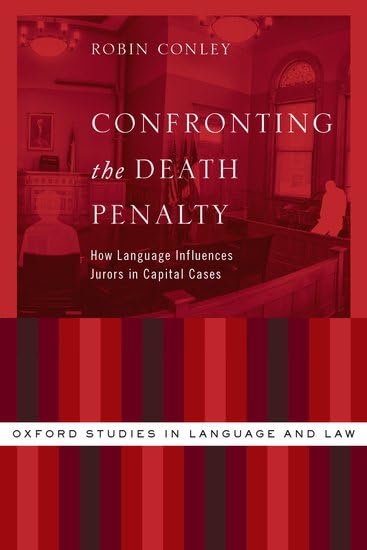
Title
Confronting the Death Penalty: How Language Influences Jurors in Capital Cases (Oxford Studies in Language and Law),Used
Sold by Ergodebooks, an authorized reseller.
Returns accepted within 30 days | support@ergodebooks.com
Shipping Information
- Free Standard Shipping — United States only
- Processing Time: 3–5 business days
- Estimated Delivery: 6–10 business days after dispatch
- Double-boxed, fully insured & discreetly packaged
- Tracking number sent via email once dispatched
Returns & Refund
Returns accepted within 30 days of delivery.
Damaged or Defective Item
Free return shipping + replacement or full refund
Wrong Item Received
Free return shipping + replacement or full refund
Change of Mind
Return shipping at customer's expense · 25% restocking fee applies
Payment Option

Confronting the Death Penalty: How Language Influences Jurors in Capital Cases probes how jurors make the ultimate decision about whether another human being should live or die. Drawing on ethnographic and qualitative linguistic methods, this book explores the means through which language helps to make death penalty decisions possible how specific linguistic choices mediate and restrict jurors', attorneys', and judges' actions and experiences while serving and reflecting on capital trials.The analysis draws on fifteen months of ethnographic fieldwork in diverse counties across Texas, including participant observation in four capital trials and postverdict interviews with the jurors who decided those cases. Given the impossibility of access to actual capital jury deliberations, this integration of methods aims to provide the clearest possible window into jurors' decisionmaking. Using methods from linguistic anthropology, conversation analysis, and multimodal discourse analysis, Conley analyzes interviews, trial talk, and written legal language to reveal a variety of communicative practices through which jurors dehumanize defendants and thus judge them to be deserving of death.By focusing on how language can both facilitate and stymie empathic encounters, the book addresses a conflict inherent to death penalty trials: jurors literally face defendants during trial and then must distort, diminish, or negate these facetoface interactions in order to sentence those same defendants to death. The book reveals that jurors cite legal ideologies of rational, dispassionate decisionmaking conveyed in the form of authoritative legal language when negotiating these moral conflicts. By investigating the interface between experiential and linguistic aspects of legal decisionmaking, the book breaks new ground in studies of law and language, language and psychology, and the death penalty.
⚠️ WARNING (California Proposition 65):
This product may contain chemicals known to the State of California to cause cancer, birth defects, or other reproductive harm.
For more information, please visit www.P65Warnings.ca.gov.