
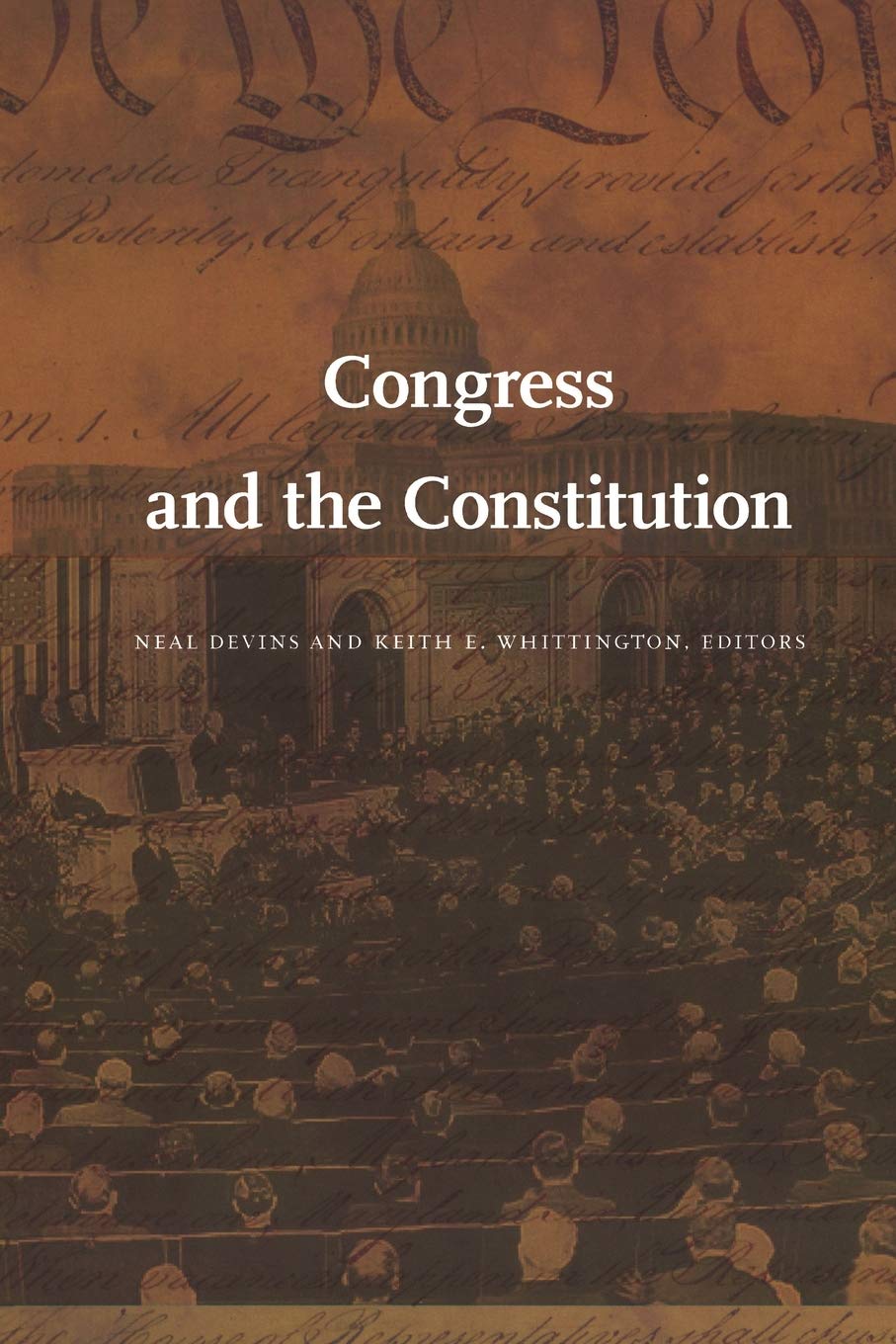
Title
Congress And The Constitution (Constitutional Conflicts),Used
Sold by Ergodebooks, an authorized reseller.
Returns accepted within 30 days | support@ergodebooks.com
Shipping Information
- Free Standard Shipping — United States only
- Processing Time: 3–5 business days
- Estimated Delivery: 6–10 business days after dispatch
- Double-boxed, fully insured & discreetly packaged
- Tracking number sent via email once dispatched
Returns & Refund
Returns accepted within 30 days of delivery.
Damaged or Defective Item
Free return shipping + replacement or full refund
Wrong Item Received
Free return shipping + replacement or full refund
Change of Mind
Return shipping at customer's expense · 25% restocking fee applies
Payment Option

For more than a decade, the U.S. Supreme Court has turned a skeptical eye toward Congress. Distrustful of Congresss capacity to respect constitutional boundaries, the Court has recently overturned federal legislation at a historically unprecedented rate. This intensified judicial scrutiny highlights the need for increased attention to how Congress approaches constitutional issues. In this important collection, leading scholars in law and political science examine the role of Congress in constitutional interpretation, demonstrating how to better integrate the legislative branch into understandings of constitutional practice.Several contributors offer wideranging accounts of the workings of Congress. They look at lawmakers attitudes toward Congresss role as a constitutional interpreter, the offices within Congress that help lawmakers learn about constitutional issues, Congresss willingness to use its confirmation power to shape constitutional decisions by both the executive and the courts, and the frequency with which congressional committees take constitutional questions into account. Other contributors address congressional deliberation, paying particular attention to whether Congresss constitutional interpretations are sound. Still others examine how Congress and the courts should respond to one anothers decisions, suggesting how the courts should evaluate Congresss work and considering how lawmakers respond to Court decisions that strike down federal legislation. While some essayists are inclined to evaluate Congresss constitutional interpretation positively, others argue that it could be improved and suggest institutional and procedural reforms toward that end. Whatever their conclusions, all of the essays underscore the pervasive and crucial role that Congress plays in shaping the meaning of the Constitution.Contributors. David P. Currie, Neal Devins, William N. Eskridge Jr.. John Ferejohn, Louis Fisher, Elizabeth Garrett, Michael J. Gerhardt, Michael J. Klarman, Bruce G. Peabody, J. Mitchell Pickerill, Barbara Sinclair, Mark Tushnet, Adrian Vermeule, Keith E. Whittington, John C. Yoo
⚠️ WARNING (California Proposition 65):
This product may contain chemicals known to the State of California to cause cancer, birth defects, or other reproductive harm.
For more information, please visit www.P65Warnings.ca.gov.