If you have any questions, you are always welcome to contact us. We'll get back to you as soon as possible, withing 24 hours on weekdays.
Customer service
All questions about your order, return and delivery must be sent to our customer service team by e-mail at yourstore@yourdomain.com
Sale & Press
If you are interested in selling our products, need more information about our brand or wish to make a collaboration, please contact us at press@yourdomain.com
Help
If you have any questions, you are always welcome to contact us. We'll get back to you as soon as possible, withing 24 hours on weekdays.
Customer service
All questions about your order, return and delivery must be sent to our customer service team by e-mail at yourstore@yourdomain.com
Sale & Press
If you are interested in selling our products, need more information about our brand or wish to make a collaboration, please contact us at press@yourdomain.com
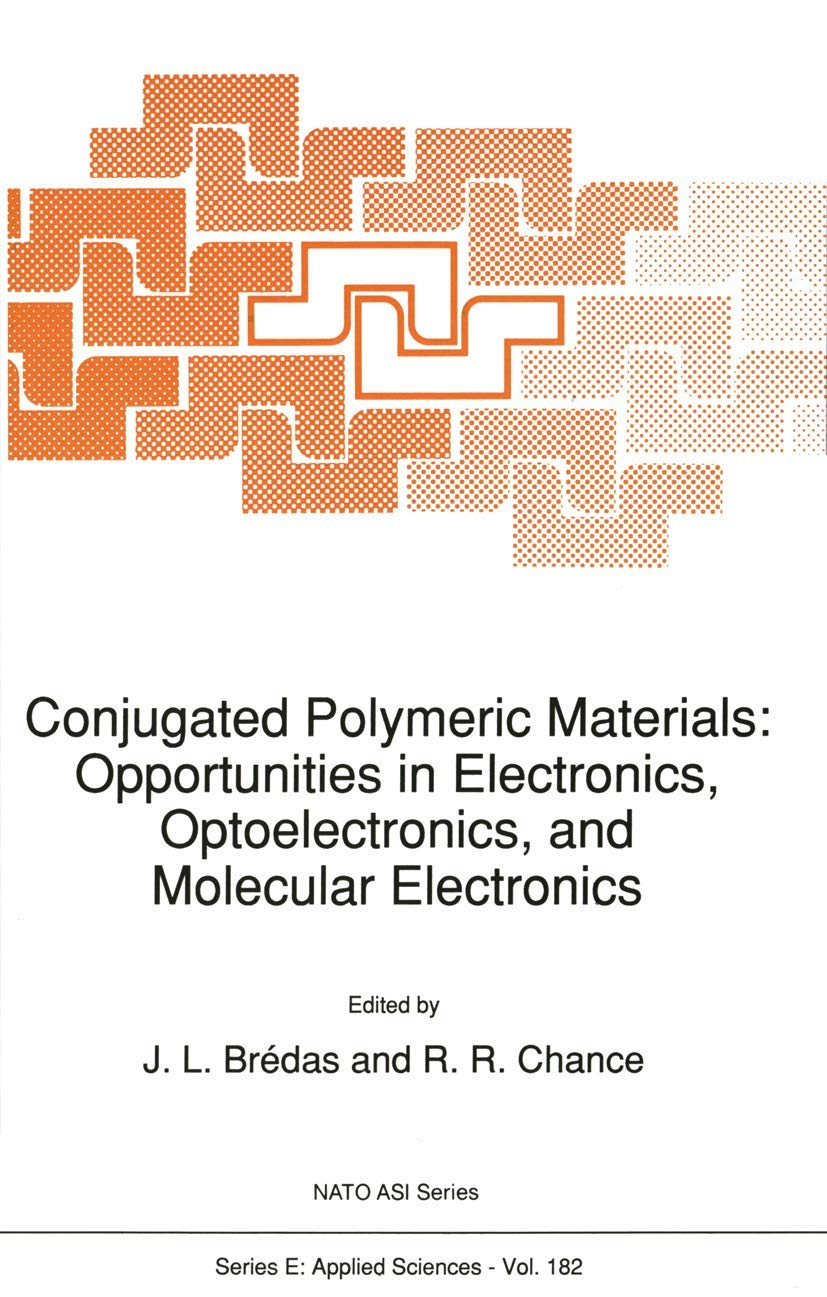
This book constitutes the Proceedings of the NATO Advanced Research Workshop on Conjugated Polymers held at the University of Mons, Belgium, during the first week of September 1989. The Workshop was attended by about fifty scientists representing most of the leading research groups within NATO countries, that have contributed to the development of conjugated polymeric materials. The program was focused on applications related to electrical conductivity and nonlinear optics. The attendance was well balanced with a blend of researchers from academic, industrial, and government labs, and including synthetic chemists, physical chemists, physicists, materials scientists, and theoreticians. The Workshop provided an especially timely opportunity to discuss the important progress that has taken place in the field of Conjugated Polymers in the late eighties as well as the enormous potential that lies in front of us. Among the recent significant developments in the field, we can cite for instance: (i) The discovery of novel synthetic routes affording conjugated polymers that are much better characterized, especially through control of the molecular weight; that can be processed from solution or the melt; the early promise that conducting polymcrs would constitute materials combining the electrical conductivities of metals with the mechanical properties of plastics is now being realized; that can reach remarkably high conductivities.
⚠️ WARNING (California Proposition 65):
This product may contain chemicals known to the State of California to cause cancer,
birth defects, or other reproductive harm.
For MAP (Minimum Advertised Price) violations and Intellectual Property (IP) or Trademark concerns, please contact:
support@ergodebooks.com
⚠️ California Proposition 65 Warning: Some products sold on this website may expose you to chemicals known to the State of California to cause cancer, birth defects, or other reproductive harm. For more information, visit www.P65Warnings.ca.gov.