If you have any questions, you are always welcome to contact us. We'll get back to you as soon as possible, withing 24 hours on weekdays.
Customer service
All questions about your order, return and delivery must be sent to our customer service team by e-mail at yourstore@yourdomain.com
Sale & Press
If you are interested in selling our products, need more information about our brand or wish to make a collaboration, please contact us at press@yourdomain.com
Help
If you have any questions, you are always welcome to contact us. We'll get back to you as soon as possible, withing 24 hours on weekdays.
Customer service
All questions about your order, return and delivery must be sent to our customer service team by e-mail at yourstore@yourdomain.com
Sale & Press
If you are interested in selling our products, need more information about our brand or wish to make a collaboration, please contact us at press@yourdomain.com
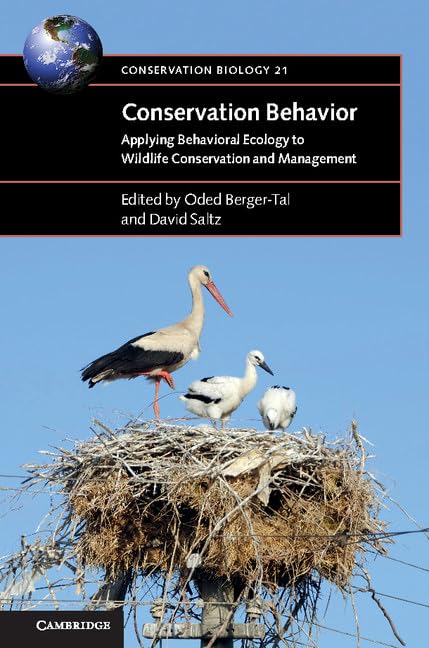
Conservation behavior assists the investigation of species endangerment associated with managing animals impacted by anthropogenic activities. It employs a theoretical framework that examines the mechanisms, development, function, and phylogeny of behavior variation in order to develop practical tools for preventing biodiversity loss and extinction. Developed from a symposium held at the International Congress on Conservation Biology in 2011, this is the first book to offer an indepth, logical framework that identifies three vital areas for understanding conservation behavior: anthropogenic threats to wildlife, conservation and management protocols, and indicators of anthropogenic threats. Bridging the gap between behavioral ecology and conservation biology, this volume ascertains key links between the fields, explores the theoretical foundations of these linkages, and connects them to practical wildlife management tools and concise applicable advice. Adopting a clear and structured approach throughout, this book is a vital resource for graduate students, academic researchers, and wildlife managers.
⚠️ WARNING (California Proposition 65):
This product may contain chemicals known to the State of California to cause cancer,
birth defects, or other reproductive harm.
For MAP (Minimum Advertised Price) violations and Intellectual Property (IP) or Trademark concerns, please contact:
support@ergodebooks.com
⚠️ California Proposition 65 Warning: Some products sold on this website may expose you to chemicals known to the State of California to cause cancer, birth defects, or other reproductive harm. For more information, visit www.P65Warnings.ca.gov.