If you have any questions, you are always welcome to contact us. We'll get back to you as soon as possible, withing 24 hours on weekdays.
Customer service
All questions about your order, return and delivery must be sent to our customer service team by e-mail at yourstore@yourdomain.com
Sale & Press
If you are interested in selling our products, need more information about our brand or wish to make a collaboration, please contact us at press@yourdomain.com
Help
If you have any questions, you are always welcome to contact us. We'll get back to you as soon as possible, withing 24 hours on weekdays.
Customer service
All questions about your order, return and delivery must be sent to our customer service team by e-mail at yourstore@yourdomain.com
Sale & Press
If you are interested in selling our products, need more information about our brand or wish to make a collaboration, please contact us at press@yourdomain.com
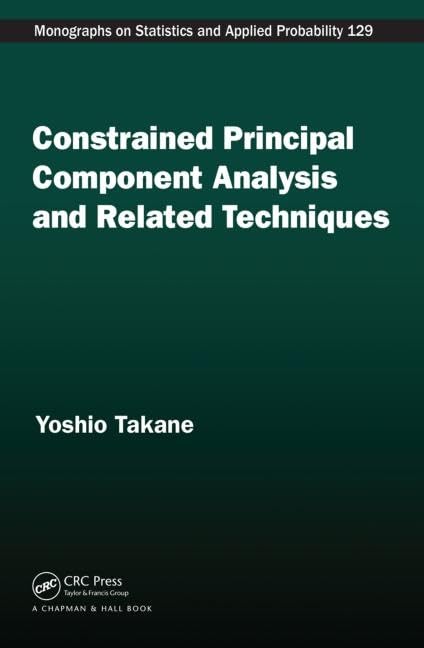
In multivariate data analysis, regression techniques predict one set of variables from another while principal component analysis (PCA) finds a subspace of minimal dimensionality that captures the largest variability in the data.How can regression analysis and PCA be combined in a beneficial way? Why and when is it a good idea to combine them? What kind of benefits are we getting from them?Addressing these questions, Constrained Principal Component Analysis and Related Techniques shows how constrained PCA (CPCA) offers a unified framework for these approaches.The book begins with four concrete examples of CPCA that provide readers with a basic understanding of the technique and its applications. It gives a detailed account of two key mathematical ideas in CPCA: projection and singular value decomposition. The author then describes the basic data requirements, models, and analytical tools for CPCA and their immediate extensions. He also introduces techniques that are special cases of or closely related to CPCA and discusses several topics relevant to practical uses of CPCA. The book concludes with a technique that imposes different constraints on different dimensions (DCDD), along with its analytical extensions. MATLAB programs for CPCA and DCDD as well as data to create the books examples are available on the authors website.
⚠️ WARNING (California Proposition 65):
This product may contain chemicals known to the State of California to cause cancer,
birth defects, or other reproductive harm.
For MAP (Minimum Advertised Price) violations and Intellectual Property (IP) or Trademark concerns, please contact:
support@ergodebooks.com
⚠️ California Proposition 65 Warning: Some products sold on this website may expose you to chemicals known to the State of California to cause cancer, birth defects, or other reproductive harm. For more information, visit www.P65Warnings.ca.gov.