
Title
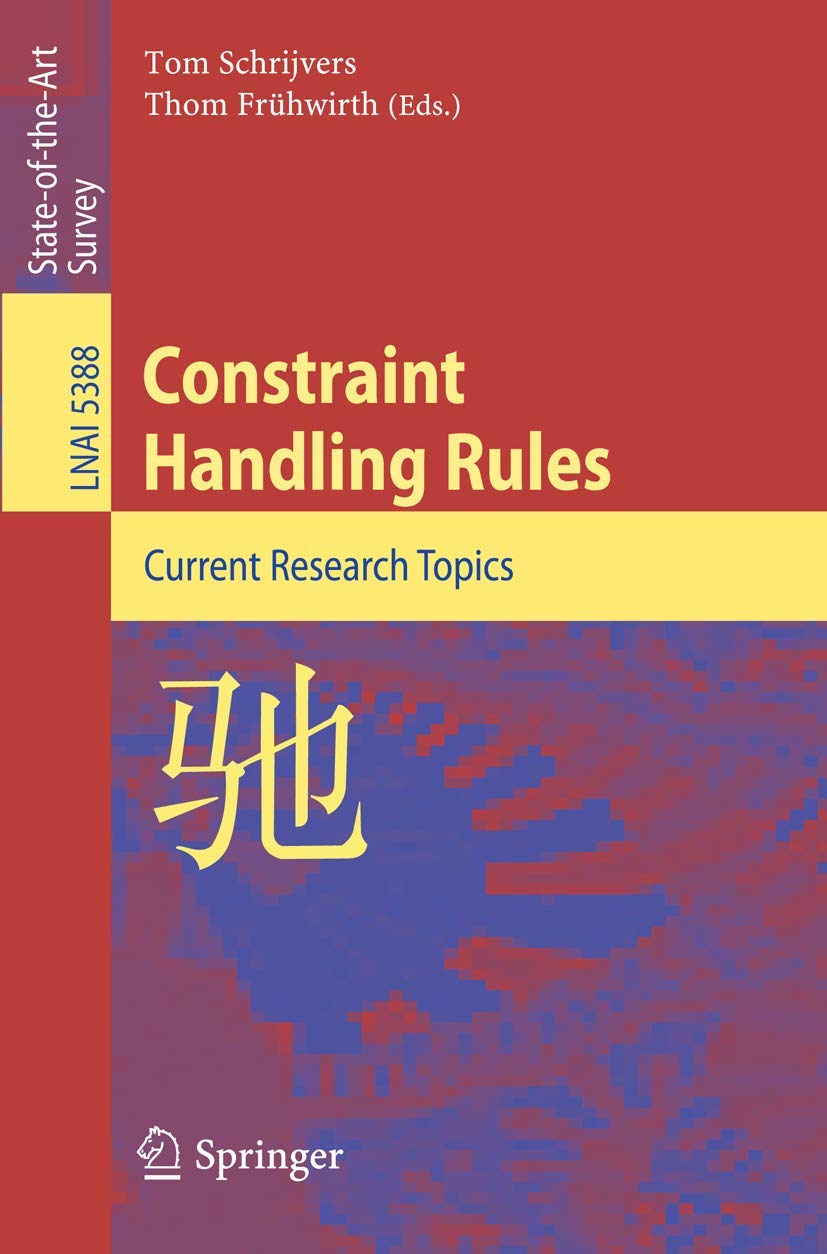
Constraint Handling Rules: Current Research Topics (Lecture Notes in Computer Science, 5388),Used
Sold by Ergodebooks, an authorized reseller.
Returns accepted within 30 days | support@ergodebooks.com
Shipping Information
- Free Standard Shipping — United States only
- Processing Time: 3–5 business days
- Estimated Delivery: 6–10 business days after dispatch
- Double-boxed, fully insured & discreetly packaged
- Tracking number sent via email once dispatched
Returns & Refund
Returns accepted within 30 days of delivery.
Damaged or Defective Item
Free return shipping + replacement or full refund
Wrong Item Received
Free return shipping + replacement or full refund
Change of Mind
Return shipping at customer's expense · 25% restocking fee applies
Payment Option

The ConstraintHandling Rules (CHR) languagecameto life morethan 15 years ago.Sincethen,ithasbecomeamajordeclarativespeci?cationandimplemen tion language for constraintbased algorithms and applications. In recent years, the ?ve Workshops on Constraint Handling Rules have spurred the exchange of ideas within the CHR community, which has led to increased international collaboration, new theoretical results and optimized implementations. The aim of this volume of Lecture Notes in Ariti?cial Intelligence was to attract highquality research papers on these recent advances in CHR. The 8 papersinthis issuewereselectedfrom11submissionsaftercarefulreviewingand subsequent revisions. Each paper was reviewd by three reviewers. The accepted papers represent some of the research teams on CHR around the world. It is not by accident that the currently most active research group is featured here with three articles. We also would have liked to see contributions from other CHR teams, but space is limited and the reviewers took their job seriously. After an introductory article that foreshadows an upcoming monograph on CHR, the accepted papers span a range of current research topics in the CHR community. It goes from extending the CHR language with search facilities and the related adaptive framework, and from generating rules from speci?cations of constraint solvers to implementing abductive probabilistic reasoning. They cover the theory that is a compositional semantics for CHR and ?nally describe e?cient implementations of CHR in traditional mainstream programming l guages and compiler optimizations in the context of the re?ned semantics of CHR. Wewouldliketothanktheauthorsofsubmittedpapersandthemanyrevi ers for their contribution in making this collection of research papers possible.
⚠️ WARNING (California Proposition 65):
This product may contain chemicals known to the State of California to cause cancer, birth defects, or other reproductive harm.
For more information, please visit www.P65Warnings.ca.gov.