
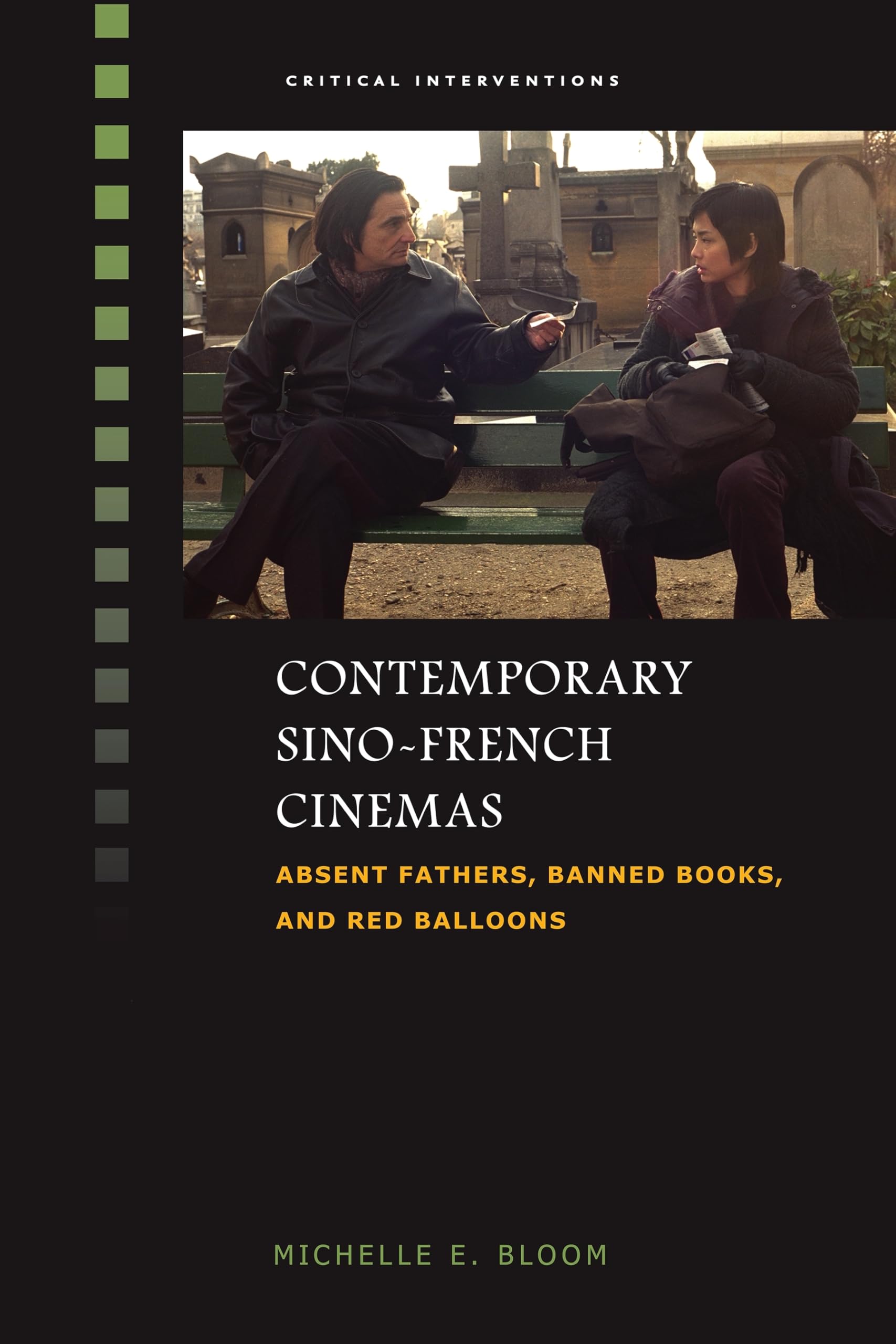
Title
Contemporary SinoFrench Cinemas: Absent Fathers, Banned Books, and Red Balloons (Critical Interventions),Used
Sold by Ergodebooks, an authorized reseller.
Returns accepted within 30 days | support@ergodebooks.com
Shipping Information
- Free Standard Shipping — United States only
- Processing Time: 3–5 business days
- Estimated Delivery: 6–10 business days after dispatch
- Double-boxed, fully insured & discreetly packaged
- Tracking number sent via email once dispatched
Returns & Refund
Returns accepted within 30 days of delivery.
Damaged or Defective Item
Free return shipping + replacement or full refund
Wrong Item Received
Free return shipping + replacement or full refund
Change of Mind
Return shipping at customer's expense · 25% restocking fee applies
Payment Option

Transnational cinemas are eclipsing national cinemas in the contemporary world, and SinoFrench films exemplify this phenomenon through the cinematic coupling of the Sinophone and the Francophone, linking France not just with the Chinese mainland but also with the rest of the Chinesespeaking world. Sinophone directors most often reach out to French cinema by referencing and adapting it. They set their films in Paris and metropolitan France, cast French actors, and sometimes use French dialogue, even when the directors themselves don't understand it. They tend to view France as mysterious, sexy, and sophisticated, just as the French see China and Taiwan as exotic.As Michelle E. Bloom makes clear, many films move past a simplistic opposition between East and West and beyond Orientalist and Occidentalist crosscultural interplay. Bloom focuses on films that have appeared since 2000 such as Tsai Mingliang's What Time Is It There? , Hou Hsiaohsien's Flight of the Red Balloon, and Dai Sijie's Balzac and the Little Chinese Seamstress. She views the work of these wellknown directors through a SinoFrench optic, applying the tropes of mtissage (or biraciality), intertextuality, adaptation and remake, translation, and imitation to shed new light on their work. She also calls attention to important, lesser studied films: Taiwanese director Cheng Yuchieh's Yang Yang, which depicts the upandcoming Taiwanese star Sandrine Pinna as a mixed race beauty; and Emily Tang Xiaobai's debut film Conjugation, which contrasts Paris and postTiananmen Square Beijing, the one an incarnation of liberty, the other a place of entrapment. Bloom's insightful analysis also probes what such films reveal about their Taiwanese and Chinese creators.Scholars have long studied SinoFrench literature, but this inaugural fulllength work on SinoFrench cinema maps uncharted territory, offering a paradigm for understanding other crosscultural interminglings and tools to study transnational cinema and world cinema. The SinoFrench, rich and multifaceted, linguistically, culturally, and ethnically, constitutes an important part of film studies, Francophone studies, Sinophone studies and myriad other fields. This is a mustread for students, scholars, and lovers of film.
⚠️ WARNING (California Proposition 65):
This product may contain chemicals known to the State of California to cause cancer, birth defects, or other reproductive harm.
For more information, please visit www.P65Warnings.ca.gov.