
Title
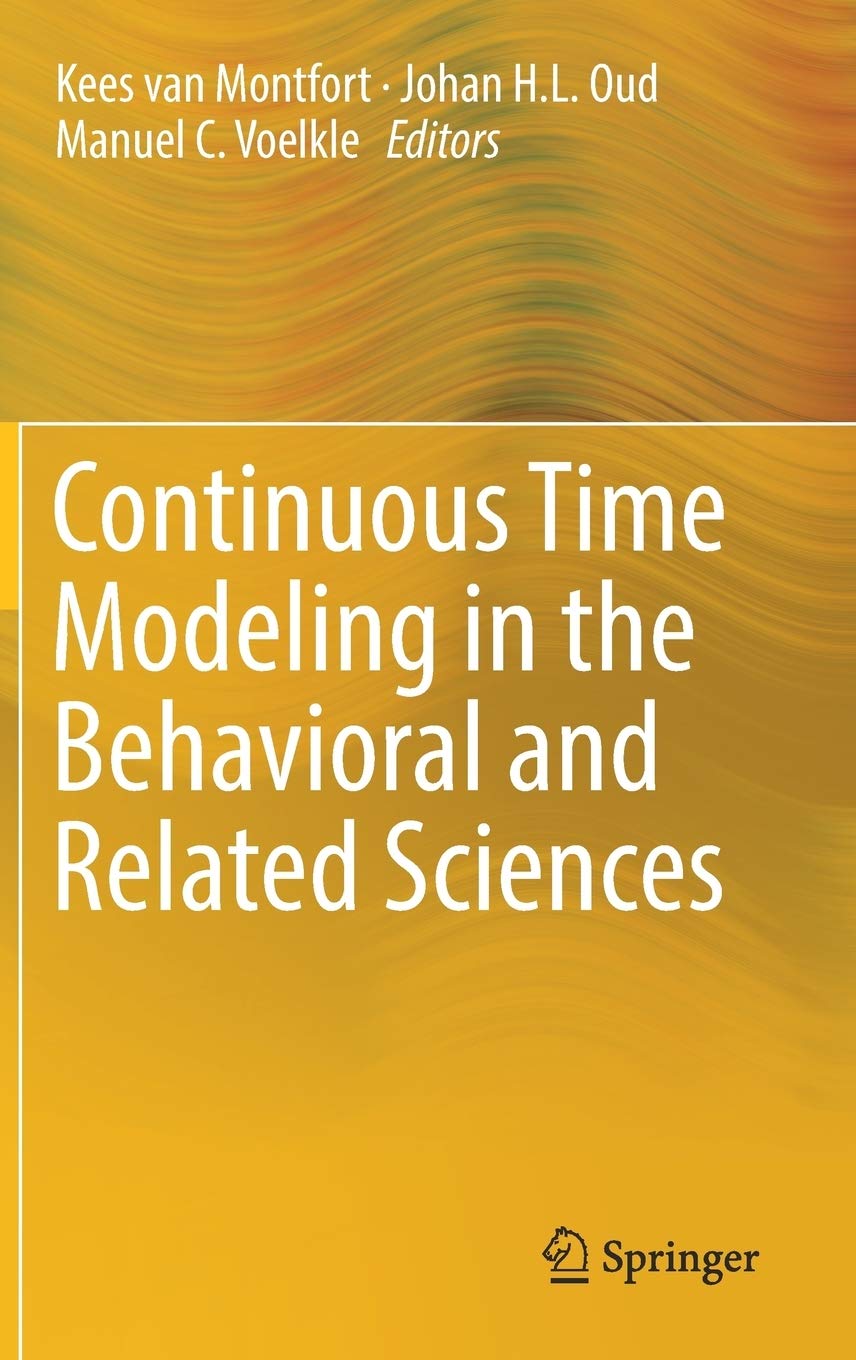
Continuous Time Modeling in the Behavioral and Related Sciences,Used
Sold by Ergodebooks, an authorized reseller.
Returns accepted within 30 days | support@ergodebooks.com
Shipping Information
- Free Standard Shipping — United States only
- Processing Time: 3–5 business days
- Estimated Delivery: 6–10 business days after dispatch
- Double-boxed, fully insured & discreetly packaged
- Tracking number sent via email once dispatched
Returns & Refund
Returns accepted within 30 days of delivery.
Damaged or Defective Item
Free return shipping + replacement or full refund
Wrong Item Received
Free return shipping + replacement or full refund
Change of Mind
Return shipping at customer's expense · 25% restocking fee applies
Payment Option

This unique book provides an overview of continuous time modeling in the behavioral and related sciences. It argues that the use of discrete time models for processes that are in fact evolving in continuous time produces problems that make their application in practice highly questionable. One main issue is the dependence of discrete time parameter estimates on the chosen time interval, which leads to incomparability of results across different observation intervals. Continuous time modeling by means of differential equations offers a powerful approach for studying dynamic phenomena, yet the use of this approach in the behavioral and related sciences such as psychology, sociology, economics and medicine, is still rare. This is unfortunate, because in these fields often only a few discrete time (sampled) observations are available for analysis (e.g., daily, weekly, yearly, etc.). However, as emphasized by Rex Bergstrom, the pioneer of continuoustime modeling in econometrics, neitherhuman beings nor the economy cease to exist in between observations.In 16 chapters, the book addresses a vast range of topics in continuous time modeling, from approaches that closely mimic traditional linear discrete time models to highly nonlinear state space modeling techniques. Each chapter describes the type of research questions and data that the approach is most suitable for, provides detailed statistical explanations of the models, and includes one or more applied examples. To allow readers to implement the various techniques directly, accompanying computer code is made available online. The book is intended as a reference work for students and scientists working with longitudinal data who have a Master's or early PhDlevel knowledge of statistics.
⚠️ WARNING (California Proposition 65):
This product may contain chemicals known to the State of California to cause cancer, birth defects, or other reproductive harm.
For more information, please visit www.P65Warnings.ca.gov.