If you have any questions, you are always welcome to contact us. We'll get back to you as soon as possible, withing 24 hours on weekdays.
Customer service
All questions about your order, return and delivery must be sent to our customer service team by e-mail at yourstore@yourdomain.com
Sale & Press
If you are interested in selling our products, need more information about our brand or wish to make a collaboration, please contact us at press@yourdomain.com
Help
If you have any questions, you are always welcome to contact us. We'll get back to you as soon as possible, withing 24 hours on weekdays.
Customer service
All questions about your order, return and delivery must be sent to our customer service team by e-mail at yourstore@yourdomain.com
Sale & Press
If you are interested in selling our products, need more information about our brand or wish to make a collaboration, please contact us at press@yourdomain.com
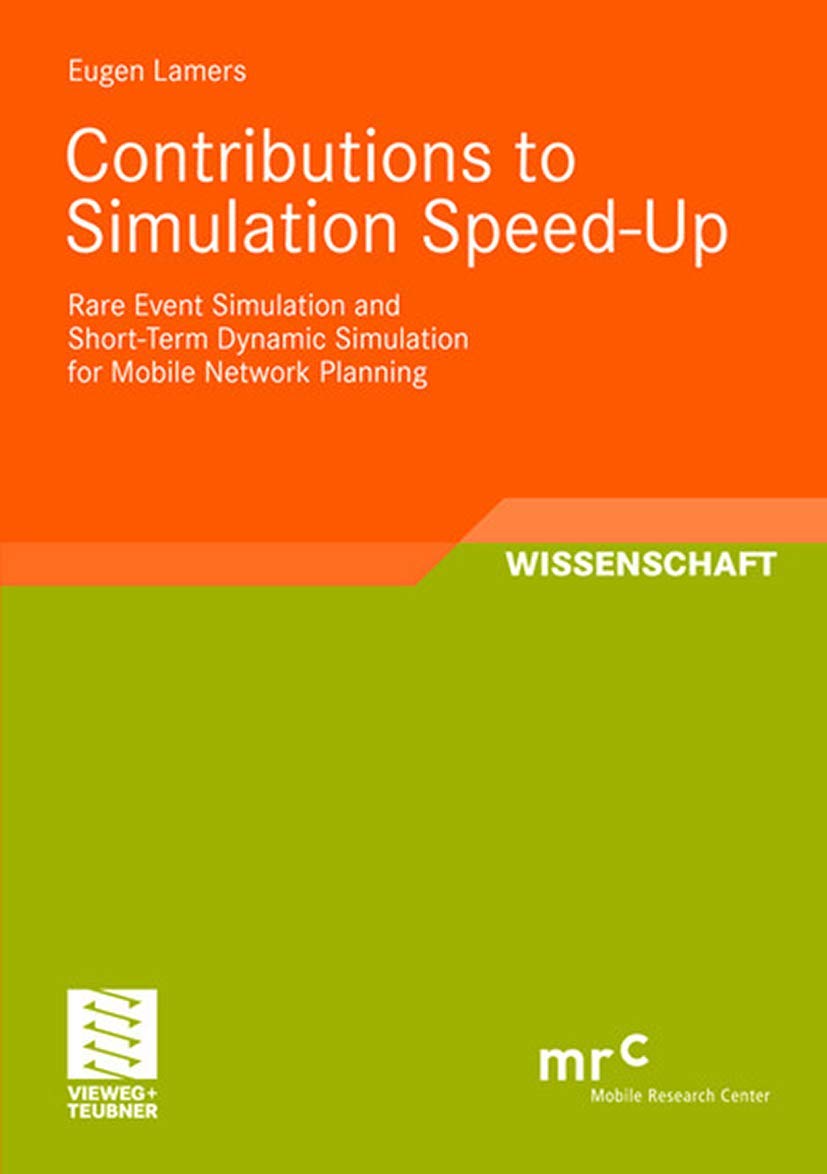
Product Description Eugen Lamers explains the principle of simulation speedup in general and shortly demonstrates the technique RESTART for the simulation of rare events. He introduces the ShortTerm Dynamic Simulation concept, developed for the planning of mobile radio networks. From the Back Cover For the simulation of stochastic systems, those techniques are essential which are able to speed up the simulation, i.e. the equivalent of increasing the accuracy that can be reached within a given runtime, especially with a focus on rare events. Eugen Lamers explains the principle of simulation speedup in general, demonstrates the technique RESTART for the simulation of rare events, and addresses its efficiency on distributed systems. Due to the character of RESTART, the efficiency is limited by the high communication overhead. The author introduces the ShortTerm Dynamic Simulation concept, developed for the planning of mobile radio networks, which enables fast state space coverage along with the consideration of dynamic aspects. He analyses the speedup potential on a theoretical basis with analytically solvable Markov models for different utilisations. With realistic models for UMTS network planning he shows that the evaluation of dynamic performance measures benefits from the ShortTerm Dynamic Simulation technique. About the Author Dr. Eugen Lamers works on quality assurance in the field of automation.
⚠️ WARNING (California Proposition 65):
This product may contain chemicals known to the State of California to cause cancer,
birth defects, or other reproductive harm.
For MAP (Minimum Advertised Price) violations and Intellectual Property (IP) or Trademark concerns, please contact:
support@ergodebooks.com
⚠️ California Proposition 65 Warning: Some products sold on this website may expose you to chemicals known to the State of California to cause cancer, birth defects, or other reproductive harm. For more information, visit www.P65Warnings.ca.gov.