If you have any questions, you are always welcome to contact us. We'll get back to you as soon as possible, withing 24 hours on weekdays.
Customer service
All questions about your order, return and delivery must be sent to our customer service team by e-mail at yourstore@yourdomain.com
Sale & Press
If you are interested in selling our products, need more information about our brand or wish to make a collaboration, please contact us at press@yourdomain.com
Help
If you have any questions, you are always welcome to contact us. We'll get back to you as soon as possible, withing 24 hours on weekdays.
Customer service
All questions about your order, return and delivery must be sent to our customer service team by e-mail at yourstore@yourdomain.com
Sale & Press
If you are interested in selling our products, need more information about our brand or wish to make a collaboration, please contact us at press@yourdomain.com
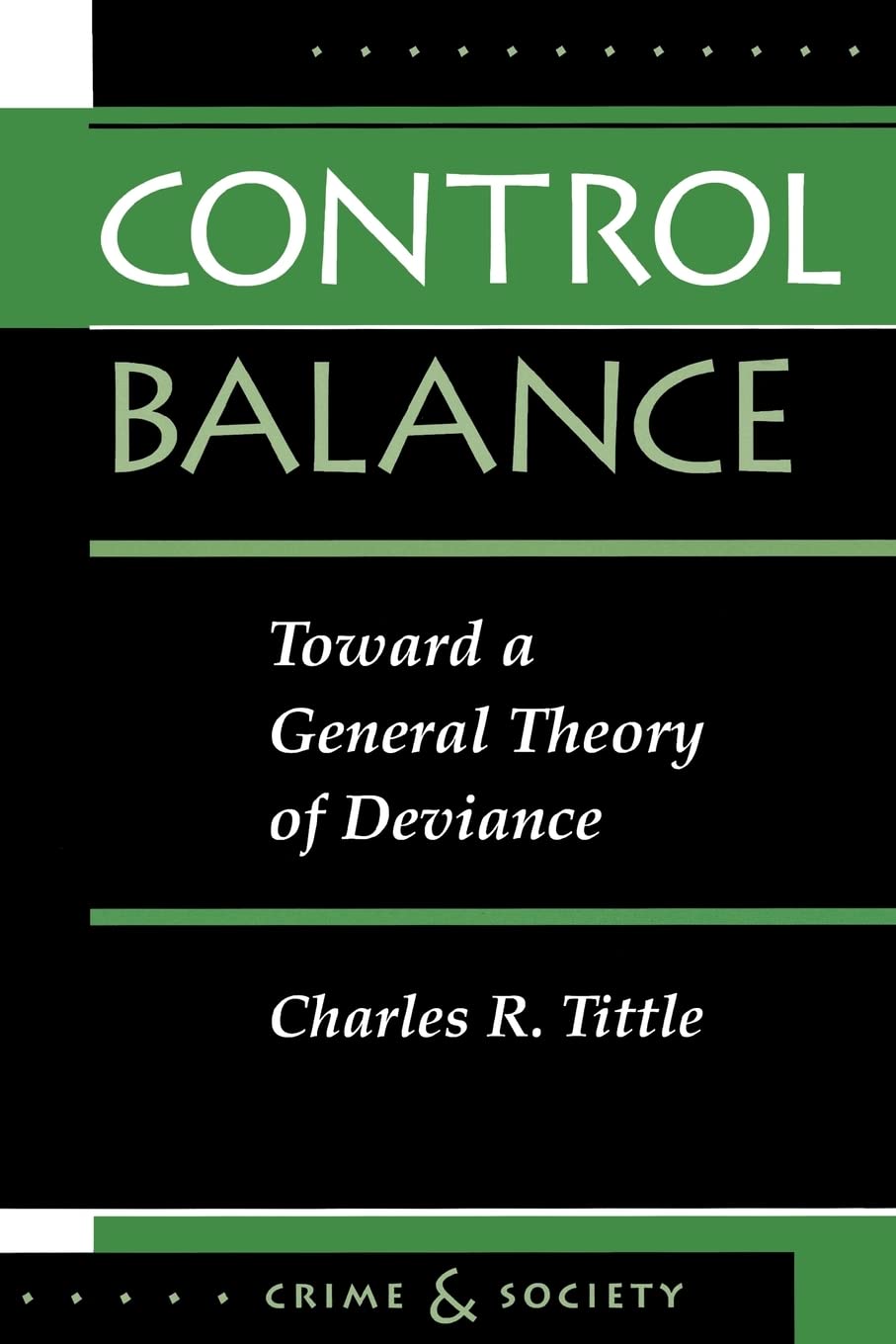
A major contribution to the field of crime/deviance, this volume by noted criminologist Charles R. Tittle puts forth an integrated theory of deviancecontrol balance. Its central premise is that the total amount of control people are subjected to, relative to the control they can exercise, will affect the probability and type of their deviant behavior. In developing control balance, Tittle critically reviews other general theories such as anomie, Marxian conflict, social control, differential association/social learning, labelling, and routine activities and offers reasons why those theories are insufficient. Using realworld examples to illustrate his argument, he contends that deviance results from the convergence of four variables, each of which represents an interactive nexus of several inputs, including most prominently a control imbalance. The variables are predisposition, motivation, opportunity, and constraint. Control balance theory also explains six basic types of deviance, ranging from predation, defiance, and submissiveness on one end of a control ratio continuum to exploitation, plunder, and decadence on the other. Tittle conceives of control balance as a continuation, or temporary culmination, of the collective efforts of crime/deviance scholars who have gone before, presenting it as a vehicle for trying to achieve a fully adequate general theory of deviance.
⚠️ WARNING (California Proposition 65):
This product may contain chemicals known to the State of California to cause cancer,
birth defects, or other reproductive harm.
For MAP (Minimum Advertised Price) violations and Intellectual Property (IP) or Trademark concerns, please contact:
support@ergodebooks.com
⚠️ California Proposition 65 Warning: Some products sold on this website may expose you to chemicals known to the State of California to cause cancer, birth defects, or other reproductive harm. For more information, visit www.P65Warnings.ca.gov.