
Title
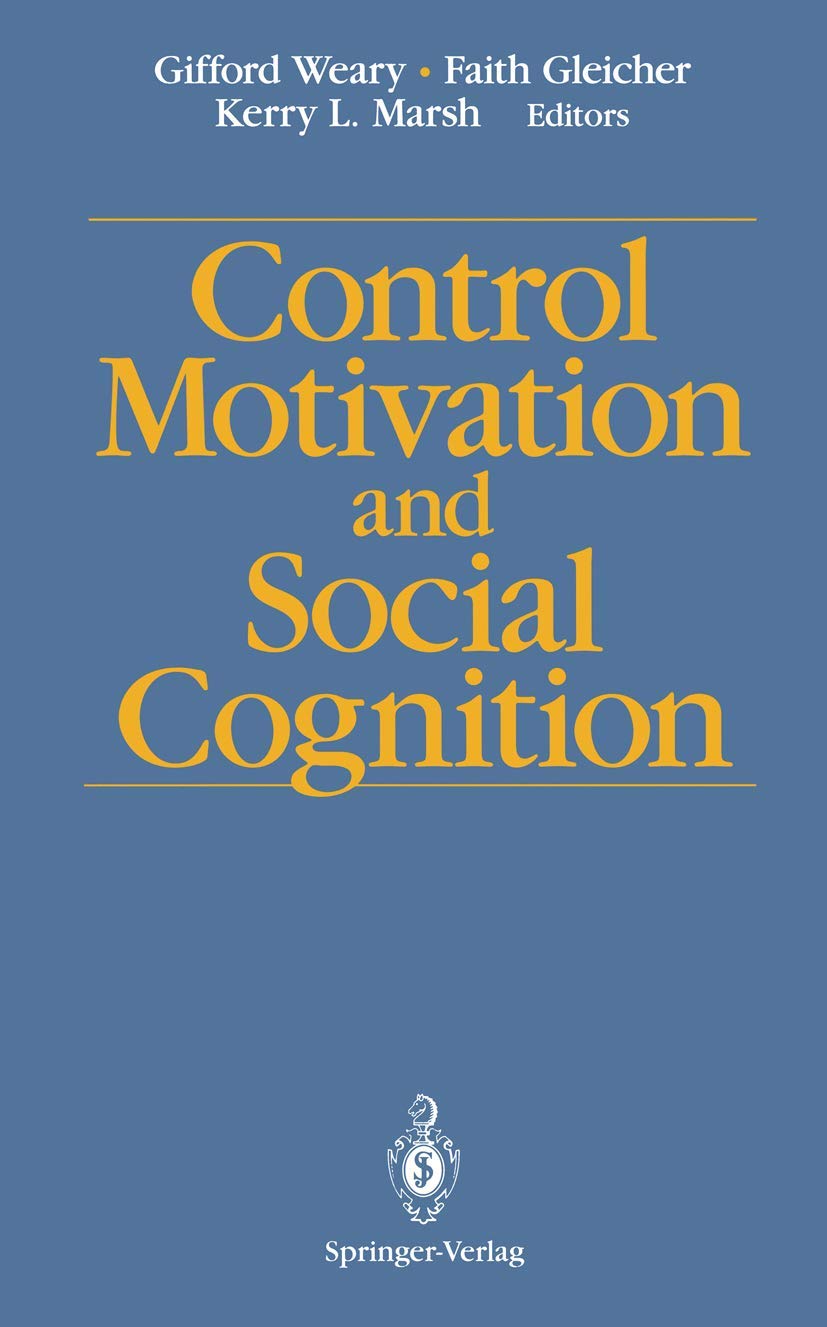
Control Motivation And Social Cognition,Used
Sold by Ergodebooks, an authorized reseller.
Returns accepted within 30 days | support@ergodebooks.com
Shipping Information
- Free Standard Shipping — United States only
- Processing Time: 3–5 business days
- Estimated Delivery: 6–10 business days after dispatch
- Double-boxed, fully insured & discreetly packaged
- Tracking number sent via email once dispatched
Returns & Refund
Returns accepted within 30 days of delivery.
Damaged or Defective Item
Free return shipping + replacement or full refund
Wrong Item Received
Free return shipping + replacement or full refund
Change of Mind
Return shipping at customer's expense · 25% restocking fee applies
Payment Option

Over the past two decades theorists and researchers have given increasing attention to the effects, both beneficial and harmful, of various control related motivations and beliefs. People's notions of how much personal control they have or desire to have over important events in their lives have been used to explain a host of performance and adaptational outcomes, including motivational and performance deficits associated with learned helplessness (Abramson, Seligman, & Teasdale, 1978) and depression (Abramson, Metalsky, & Alloy, 1989), adaptation to aging (Baltes & Baltes, 1986; Rodin, 1986), cardiovascular disease (Matthews, 1982), cancer (Sklar & Anisman, 1979), increased reports of physical symptoms (Pennebaker, 1982), enhanced learning (Savage, Perlmutter, & Monty, 1979), achievementrelated behaviors (Dweck & Licht, 1980; Ryckman, 1979), and post abortion adjustment (Mueller & Major, 1989). The notion that control motivation plays a fundamental role in a variety of basic, social psychological processes also has a long historical tradition. A number of theorists (Heider, 1958; Jones & Davis, 1965; Kelley, 1967), for example, have suggested that causal inferences arise from a desire to render the social world predictable and controllable. Similarly, control has been implicated as an important mediator of cognitive dissonance (Wicklund & Brehm, 1976) and attitude phenomena (Brehm & Brehm, 1981; Kiesler, Collins, & Miller, 1969). Despite the apparent centrality of control motivation to a variety of social psychological phenomena, until recently there has been relatively little research explicitly concerned with the effects of control motivation on the cognitive processes underlying such phenomena (cf.
⚠️ WARNING (California Proposition 65):
This product may contain chemicals known to the State of California to cause cancer, birth defects, or other reproductive harm.
For more information, please visit www.P65Warnings.ca.gov.