If you have any questions, you are always welcome to contact us. We'll get back to you as soon as possible, withing 24 hours on weekdays.
Customer service
All questions about your order, return and delivery must be sent to our customer service team by e-mail at yourstore@yourdomain.com
Sale & Press
If you are interested in selling our products, need more information about our brand or wish to make a collaboration, please contact us at press@yourdomain.com
Help
If you have any questions, you are always welcome to contact us. We'll get back to you as soon as possible, withing 24 hours on weekdays.
Customer service
All questions about your order, return and delivery must be sent to our customer service team by e-mail at yourstore@yourdomain.com
Sale & Press
If you are interested in selling our products, need more information about our brand or wish to make a collaboration, please contact us at press@yourdomain.com
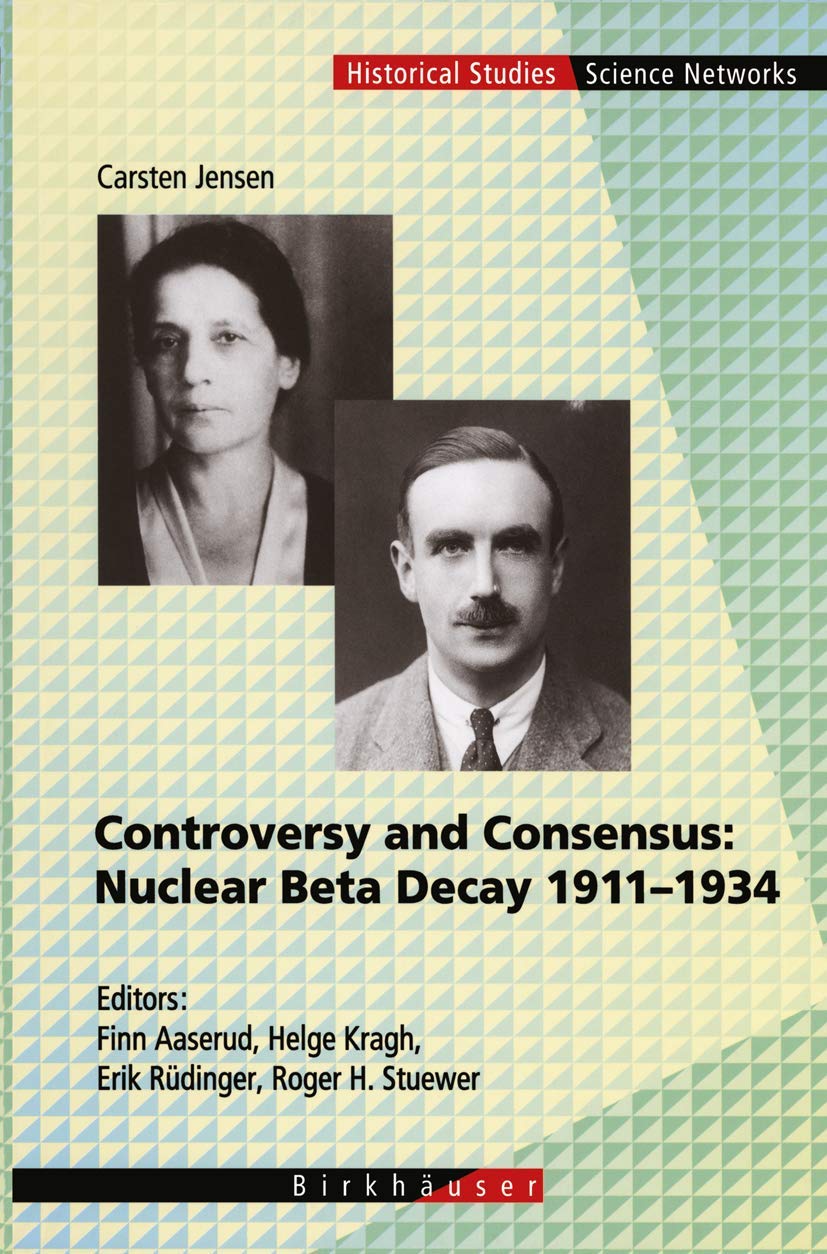
In 1920s, a longlasting controversy on the interpretation of nuclear beta spectrum arose between Lise Meitner and Charles Drummond Ellis. This controversy, and the reactions from the contending parties when it was settled, reflect clearly the difference between the scientific communities in Berlin and Cambridge at that time. The MeitnerEllis controversy ended in 1929, and it left an anomaly that attracted leading theoretical physicists. A new dispute, this time between Niels Bohr and Wolfgang Pauli, broke out. It concerned the explanation of the continuity of the primary beta particles and dominated the discussions for the next five years. Pauli argued for a new particle, and Bohr for a new theory; both suggestions were radical steps, but they reflected two different ways of doing physics.
⚠️ WARNING (California Proposition 65):
This product may contain chemicals known to the State of California to cause cancer,
birth defects, or other reproductive harm.
For MAP (Minimum Advertised Price) violations and Intellectual Property (IP) or Trademark concerns, please contact:
support@ergodebooks.com
⚠️ California Proposition 65 Warning: Some products sold on this website may expose you to chemicals known to the State of California to cause cancer, birth defects, or other reproductive harm. For more information, visit www.P65Warnings.ca.gov.