If you have any questions, you are always welcome to contact us. We'll get back to you as soon as possible, withing 24 hours on weekdays.
Customer service
All questions about your order, return and delivery must be sent to our customer service team by e-mail at yourstore@yourdomain.com
Sale & Press
If you are interested in selling our products, need more information about our brand or wish to make a collaboration, please contact us at press@yourdomain.com
Help
If you have any questions, you are always welcome to contact us. We'll get back to you as soon as possible, withing 24 hours on weekdays.
Customer service
All questions about your order, return and delivery must be sent to our customer service team by e-mail at yourstore@yourdomain.com
Sale & Press
If you are interested in selling our products, need more information about our brand or wish to make a collaboration, please contact us at press@yourdomain.com
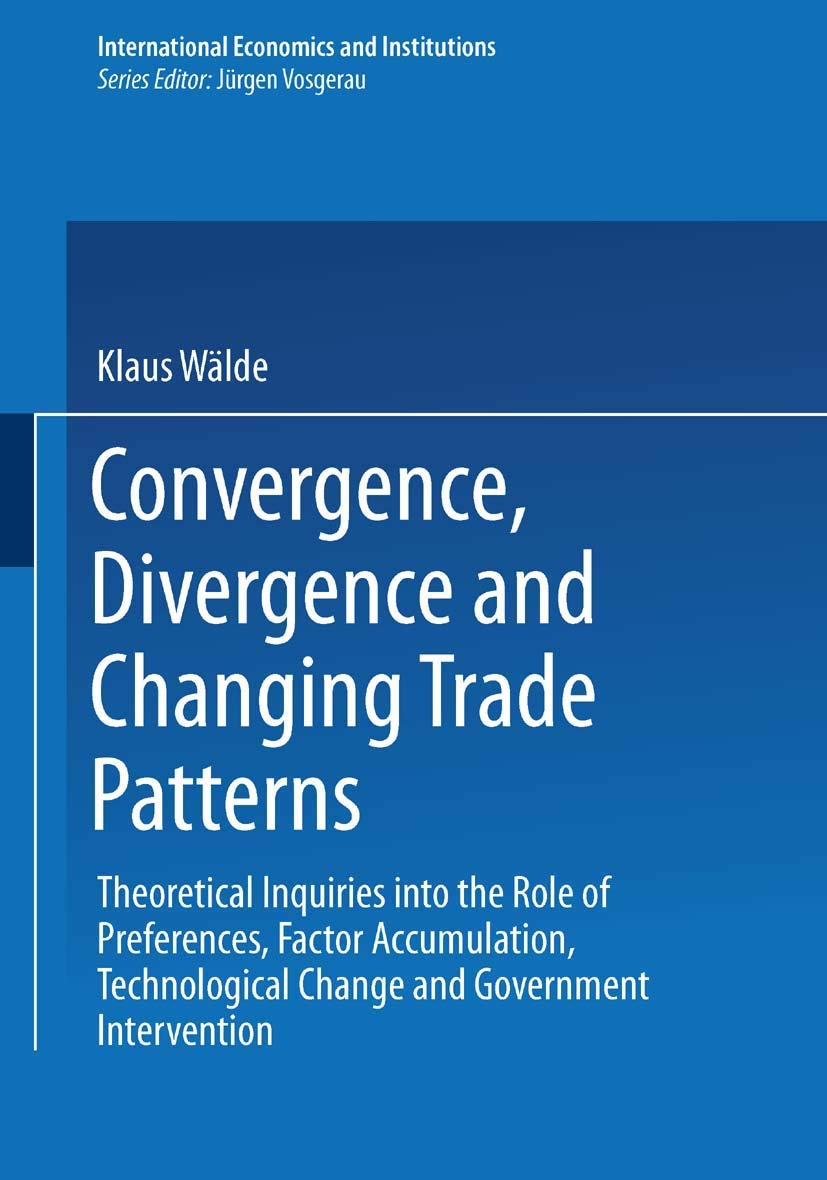
1. Introduction and overview Until still few years ago, economic growth theory (going back to Solow, 1956; for an introduction cf. Burmeister and Dobell, 1970) predicted convergence of both growth rates and level of per capita income of economies which share identical preferences, technologies and same population growth rates, independently of initial conditions. Countries with a low capital stock grow faster than those with a higher capital stock, until, in the longrun, they all converge to a common constant growth rate. This prediction is due to the way how growth is "explained" in models of this kind. Growth of output per capita resulted, in the simplest model, from an exogenous growth oflabour productivity (see e. g. SalaiMartin, 1990; Grossman and Helpman, 1991a, ch. 2). Si!1ce this increase of productivity is exogenously given, the model itselfdoes not give any explanation ofits source. The prediction ofconvergence ofgrowth rates, itself, is very doubtful and observations show, that on an international level either convergence is not given at all, or that it takes a very long time. The literature of the "new" theory of growth provides a rich variety of models whose theoretical implications range from divergence to convergence and thus offers much better working tools in order to analyze real world observations. These models (starting with Romer, 1986 and Lucas, 1988) explain growth of GNP or per capita income from within the model by includingexternal effects such as a public stock ofknowledge capital (e. g.
⚠️ WARNING (California Proposition 65):
This product may contain chemicals known to the State of California to cause cancer,
birth defects, or other reproductive harm.
For MAP (Minimum Advertised Price) violations and Intellectual Property (IP) or Trademark concerns, please contact:
support@ergodebooks.com
⚠️ California Proposition 65 Warning: Some products sold on this website may expose you to chemicals known to the State of California to cause cancer, birth defects, or other reproductive harm. For more information, visit www.P65Warnings.ca.gov.