If you have any questions, you are always welcome to contact us. We'll get back to you as soon as possible, withing 24 hours on weekdays.
Customer service
All questions about your order, return and delivery must be sent to our customer service team by e-mail at yourstore@yourdomain.com
Sale & Press
If you are interested in selling our products, need more information about our brand or wish to make a collaboration, please contact us at press@yourdomain.com
Help
If you have any questions, you are always welcome to contact us. We'll get back to you as soon as possible, withing 24 hours on weekdays.
Customer service
All questions about your order, return and delivery must be sent to our customer service team by e-mail at yourstore@yourdomain.com
Sale & Press
If you are interested in selling our products, need more information about our brand or wish to make a collaboration, please contact us at press@yourdomain.com
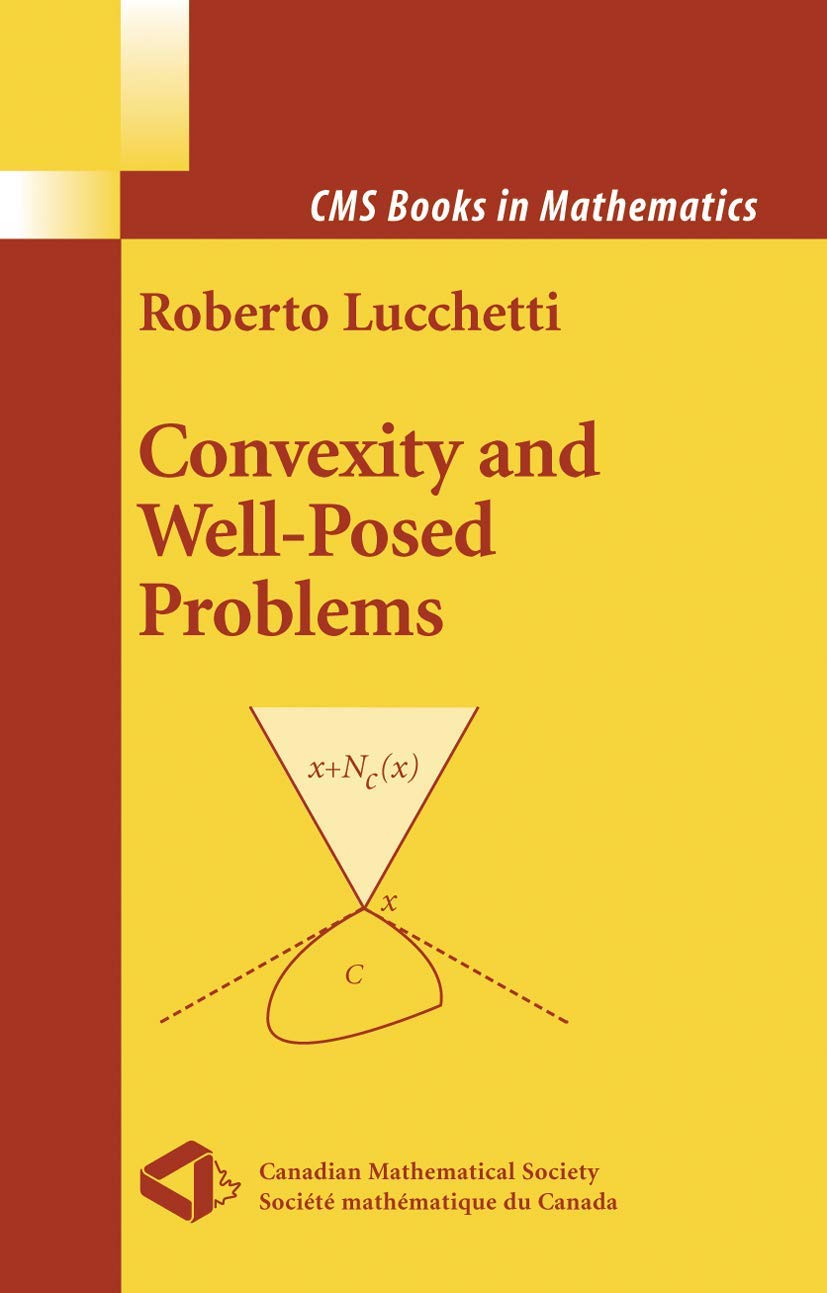
This book deals mainly with the study of convex functions and their behavior from the point of view of stability with respect to perturbations. We shall consider convex functions from the most modern point of view: a function is de?ned to be convex whenever its epigraph, the set of the points lying above the graph, is a convex set. Thus many of its properties can be seen also as properties of a certain convex set related to it. Moreover, we shall consider extended real valued functions, i. e. , functions taking possibly the values?? and +?. The reason for considering the value +? is the powerful device of including the constraint set of a constrained minimum problem into the objective function itself (by rede?ning it as +? outside the constraint set). Except for trivial cases, the minimum value must be taken at a point where the function is not +?, hence at a point in the constraint set. And the value ?? is allowed because useful operations, such as the infconvolution, can give rise to functions valued?? even when the primitive objects are real valued. Observe that de?ning the objective function to be +? outside the closed constraint set preserves lower semicontinuity, which is the pivotal and mi mal continuity assumption one needs when dealing with minimum problems. Variational calculus is usually based on derivatives.
⚠️ WARNING (California Proposition 65):
This product may contain chemicals known to the State of California to cause cancer,
birth defects, or other reproductive harm.
For MAP (Minimum Advertised Price) violations and Intellectual Property (IP) or Trademark concerns, please contact:
support@ergodebooks.com
⚠️ California Proposition 65 Warning: Some products sold on this website may expose you to chemicals known to the State of California to cause cancer, birth defects, or other reproductive harm. For more information, visit www.P65Warnings.ca.gov.