
Title
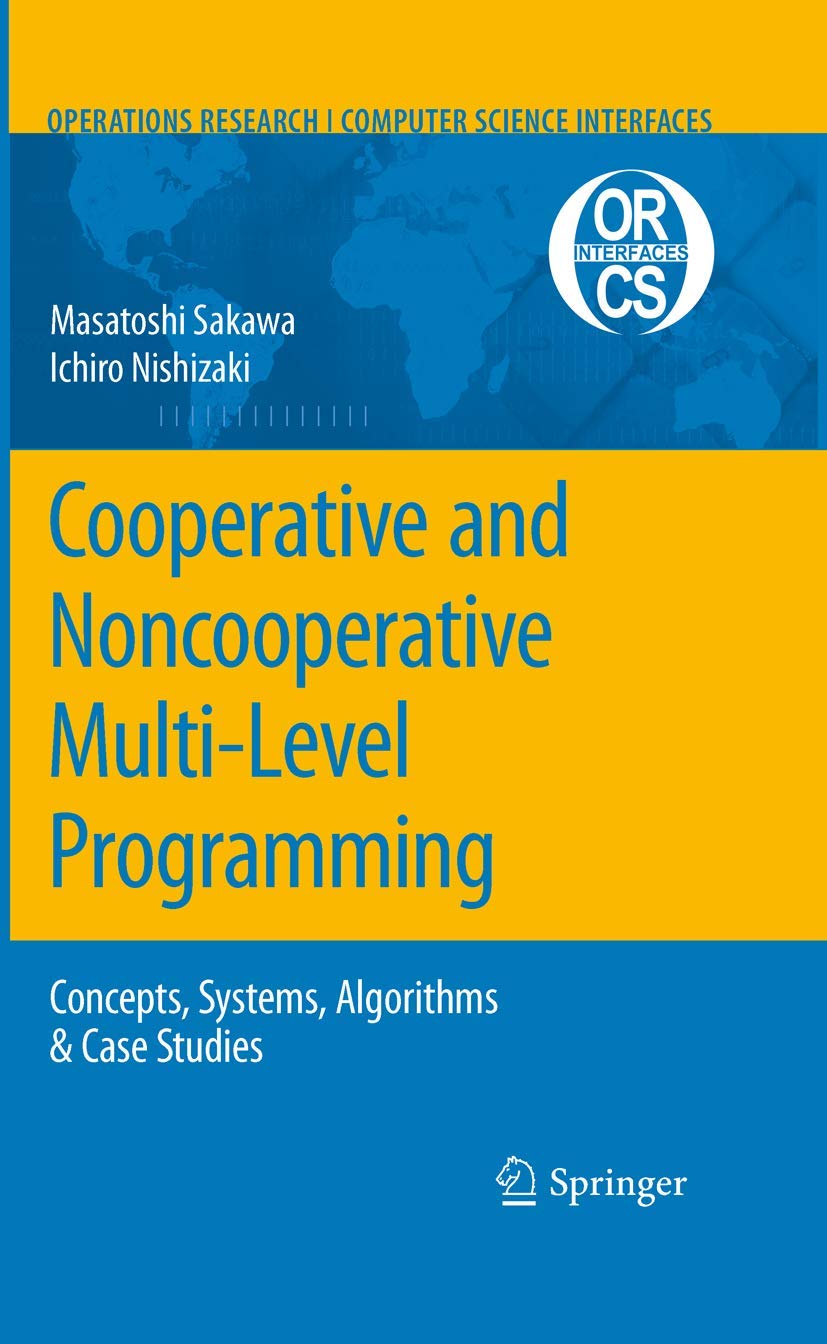
Cooperative and Noncooperative MultiLevel Programming (Operations Research/Computer Science Interfaces Series, 48),Used
Sold by Ergodebooks, an authorized reseller.
Returns accepted within 30 days | support@ergodebooks.com
Shipping Information
- Free Standard Shipping — United States only
- Processing Time: 3–5 business days
- Estimated Delivery: 6–10 business days after dispatch
- Double-boxed, fully insured & discreetly packaged
- Tracking number sent via email once dispatched
Returns & Refund
Returns accepted within 30 days of delivery.
Damaged or Defective Item
Free return shipping + replacement or full refund
Wrong Item Received
Free return shipping + replacement or full refund
Change of Mind
Return shipping at customer's expense · 25% restocking fee applies
Payment Option

To derive rational and convincible solutions to practical decision making problems in complex and hierarchical human organizations, the decision making problems are formulated as relevant mathematical programming problems which are solved by developing optimization techniques so as to exploit characteristics or structural features of the formulated problems. In particular, for resolving con?ict in decision making in hierarchical managerial or public organizations, the multi level formula tion of the mathematical programming problems has been often employed together with the solution concept of Stackelberg equilibrium. However,weconceivethatapairoftheconventionalformulationandthesolution concept is not always suf?cient to cope with a large variety of decision making situations in actual hierarchical organizations. The following issues should be taken into consideration in expression and formulation of decision making problems. Informulationofmathematicalprogrammingproblems,itistacitlysupposedthat decisions are made by a single person while game theory deals with economic be havior of multiple decision makers with fully rational judgment. Because two level mathematical programming problems are interpreted as static Stackelberg games, multi level mathematical programming is relevant to noncooperative game theory; in conventional multi level mathematical programming models employing the so lution concept of Stackelberg equilibrium, it is assumed that there is no communi cation among decision makers, or they do not make any binding agreement even if there exists such communication. However, for decision making problems in such as decentralized large ?rms with divisional independence, it is quite natural to sup pose that there exists communication and some cooperativerelationship among the decision makers.
⚠️ WARNING (California Proposition 65):
This product may contain chemicals known to the State of California to cause cancer, birth defects, or other reproductive harm.
For more information, please visit www.P65Warnings.ca.gov.