
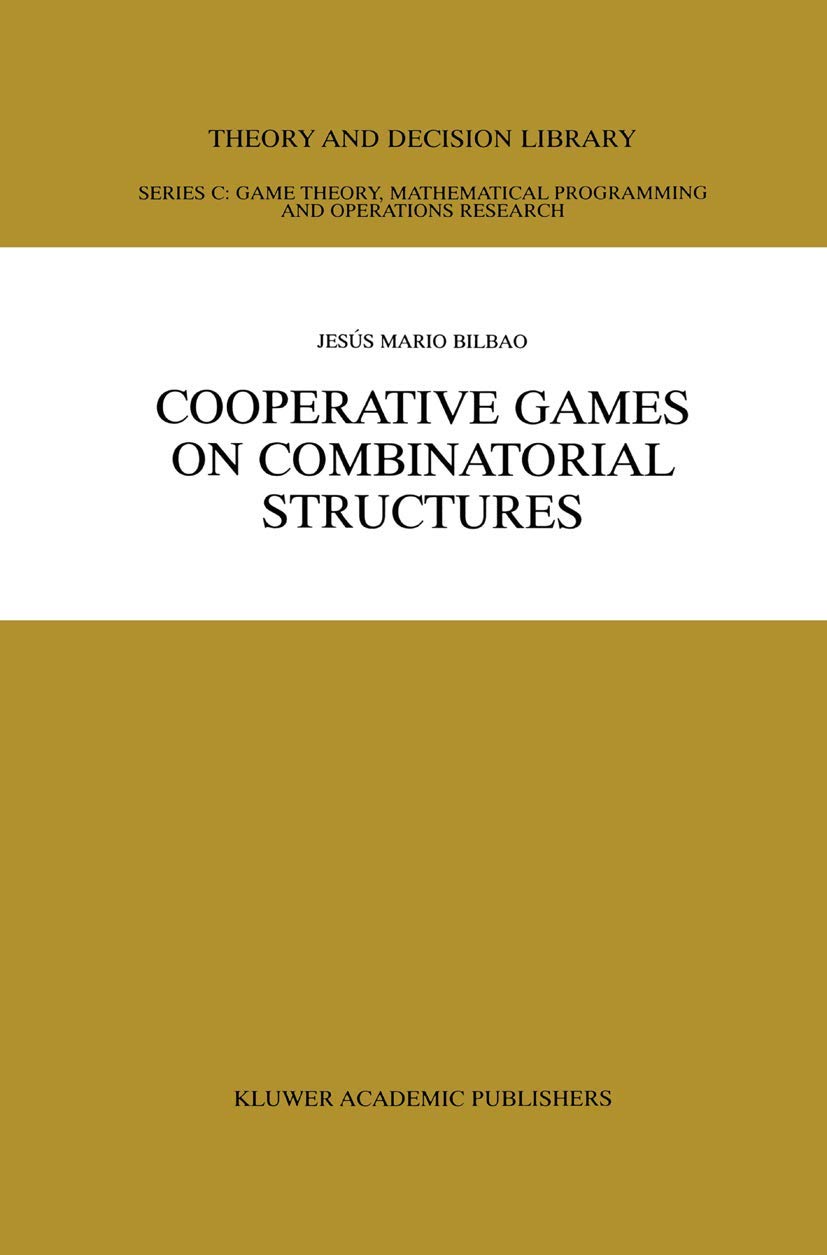
Title
Cooperative Games on Combinatorial Structures (Theory and Decision Library C, 26),New
Sold by Ergodebooks, an authorized reseller.
Returns accepted within 30 days | support@ergodebooks.com
Shipping Information
- Free Standard Shipping — United States only
- Processing Time: 3–5 business days
- Estimated Delivery: 6–10 business days after dispatch
- Double-boxed, fully insured & discreetly packaged
- Tracking number sent via email once dispatched
Returns & Refund
Returns accepted within 30 days of delivery.
Damaged or Defective Item
Free return shipping + replacement or full refund
Wrong Item Received
Free return shipping + replacement or full refund
Change of Mind
Return shipping at customer's expense · 25% restocking fee applies
Payment Option

The aim of Cooperative Games on Combinatorial Structures is to analyze conflict situations in which two or more players can make coalitions and obtain prizes and penalties. This approach to situations of competition and cooperation was given in the seminal treatise by John von Neumann and Oskar Morgenstern, Theory of Games and Economic Behavior. Cooperative game theory has succeeded in providing many applications of game theory.In this volume, games defined on combinatorial structures will be analyzed, i.e. a set system over a set of players. In many situations the author will work in a closure space. Examples of closure operators are the spanning operator of linear algebra and all convex hull operators.Chapters 14 constitute a review of mathematical concepts from Cooperative Game Theory, Graph Theory, Linear and Integer Programming, Combinatorial Optimization, Discrete Convex Analysis and Computational Complexity. The table of contents is a short guide to the topics and methods covered in this book. In Chapters 11 and 12, several notebooks are presented with the system Mathematica by Wolfram in the contexts of the packages DiscreteMath (Skiena) and Cooperative (Carter). There will also be found in the book several research projects. These are intended to offer new ideas that the reader should consider with caution.This book will be of interest to graduate students with some experience in game theory or mathematical programming and professional researchers in game theory, operational research and its applications in economic theory, and the political and social sciences. In addition, it will be especially useful for professionals who are interested in models for understanding and managing conflicts: management and operational research scientists, political and military scientists, and professional negotiators.
⚠️ WARNING (California Proposition 65):
This product may contain chemicals known to the State of California to cause cancer, birth defects, or other reproductive harm.
For more information, please visit www.P65Warnings.ca.gov.