
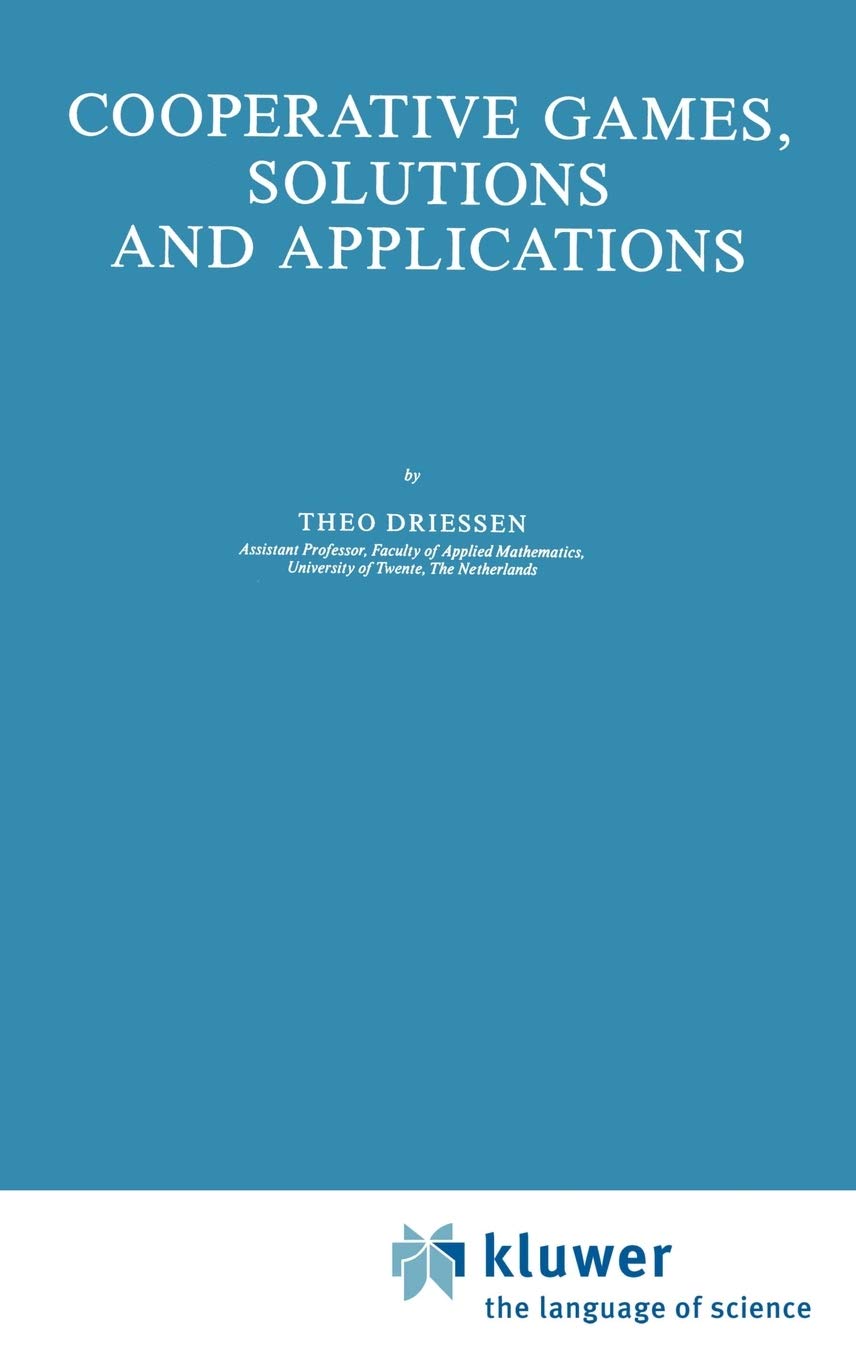
Title
Cooperative Games, Solutions and Applications (Theory and Decision Library C, 3),New
Sold by Ergodebooks, an authorized reseller.
Returns accepted within 30 days | support@ergodebooks.com
Shipping Information
- Free Standard Shipping — United States only
- Processing Time: 3–5 business days
- Estimated Delivery: 6–10 business days after dispatch
- Double-boxed, fully insured & discreetly packaged
- Tracking number sent via email once dispatched
Returns & Refund
Returns accepted within 30 days of delivery.
Damaged or Defective Item
Free return shipping + replacement or full refund
Wrong Item Received
Free return shipping + replacement or full refund
Change of Mind
Return shipping at customer's expense · 25% restocking fee applies
Payment Option

The study of the theory of games was started in Von Neumann (1928), but the development of the theory of games was accelerated after the publication of the classical book 'Theory of games and economic behavior' by Von Neumann and Morgenstern (1944). As an initial step, the theory of games aims to put situations of conflict and cooperation into mathematical models. In the second and final step, the resulting models are analysed on the basis of equitable and mathematical reasonings. The conflict and/or cooperative situation in question is generally due to the interaction between two or more individuals (players). Their interaction may lead up to several potential payoffs over which each player has his own preferences. Any player attempts to achieve his largest possible payoff, but the other players may also exert their influence on the realization of some potential payoff. As already mentioned, the theory of games consists of two parts, a modelling part and a solution part. Concerning the modelling part, the mathematical models of conflict and cooperative situations are described. The description of the models includes the rules, the strategy space of any player, potential payoffs to the players, the preferences of each player over the set of all potential payoffs, etc. According to the rules, it is either permitted or forbidden that the players communicate with one another in order to make binding agreements regarding their mutual actions.
⚠️ WARNING (California Proposition 65):
This product may contain chemicals known to the State of California to cause cancer, birth defects, or other reproductive harm.
For more information, please visit www.P65Warnings.ca.gov.