If you have any questions, you are always welcome to contact us. We'll get back to you as soon as possible, withing 24 hours on weekdays.
Customer service
All questions about your order, return and delivery must be sent to our customer service team by e-mail at yourstore@yourdomain.com
Sale & Press
If you are interested in selling our products, need more information about our brand or wish to make a collaboration, please contact us at press@yourdomain.com
Help
If you have any questions, you are always welcome to contact us. We'll get back to you as soon as possible, withing 24 hours on weekdays.
Customer service
All questions about your order, return and delivery must be sent to our customer service team by e-mail at yourstore@yourdomain.com
Sale & Press
If you are interested in selling our products, need more information about our brand or wish to make a collaboration, please contact us at press@yourdomain.com
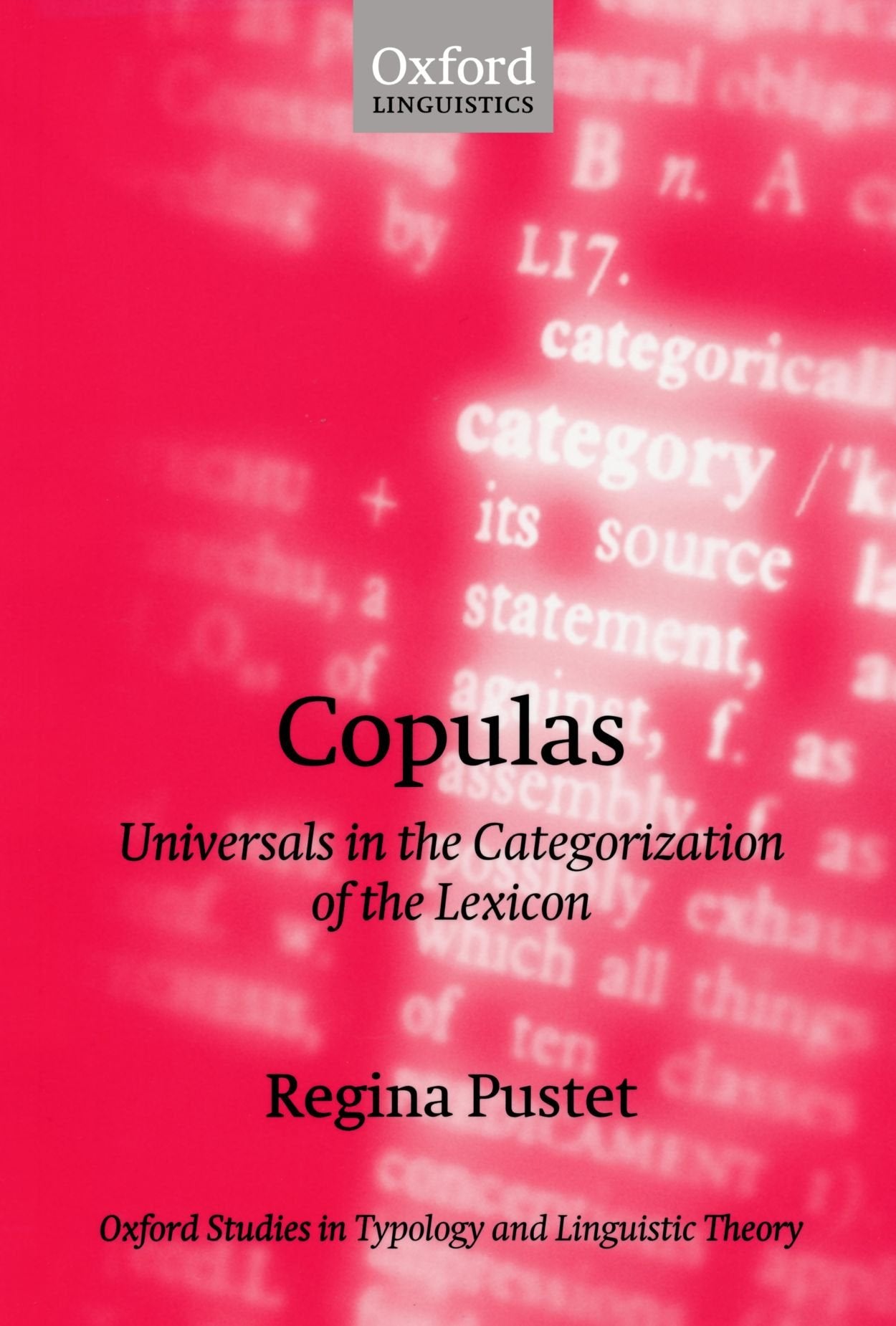
About the Author Regina Pustet, born in 1963, PhD in General Linguistics in 1991 (University of Cologne) is currently teaching at the University of Munich. Her previous research activities focus on various aspects of functionaltypological language theory, such as case marking and lexical categorization, and also include descriptive work especially on Native American languages. Product Description Copulas (in English, the verb to be) are conventionally defined functionally as a means of relating elements of clause structure, especially subject and complement, and considered to be semantically empty or meaningless. Pustet presents an analysis of grammatical descriptions of over 160 languages drawn from the language families of the world. She shows that some languages have a single copula, others several, and some none at all. She links the distribution of copulas to variations in lexical categorization and syntactic structure. She advances a comprehensive theory of copularization which she relates to language classification and to theories of language change, notably grammaticalization.
⚠️ WARNING (California Proposition 65):
This product may contain chemicals known to the State of California to cause cancer,
birth defects, or other reproductive harm.
For MAP (Minimum Advertised Price) violations and Intellectual Property (IP) or Trademark concerns, please contact:
support@ergodebooks.com
⚠️ California Proposition 65 Warning: Some products sold on this website may expose you to chemicals known to the State of California to cause cancer, birth defects, or other reproductive harm. For more information, visit www.P65Warnings.ca.gov.