
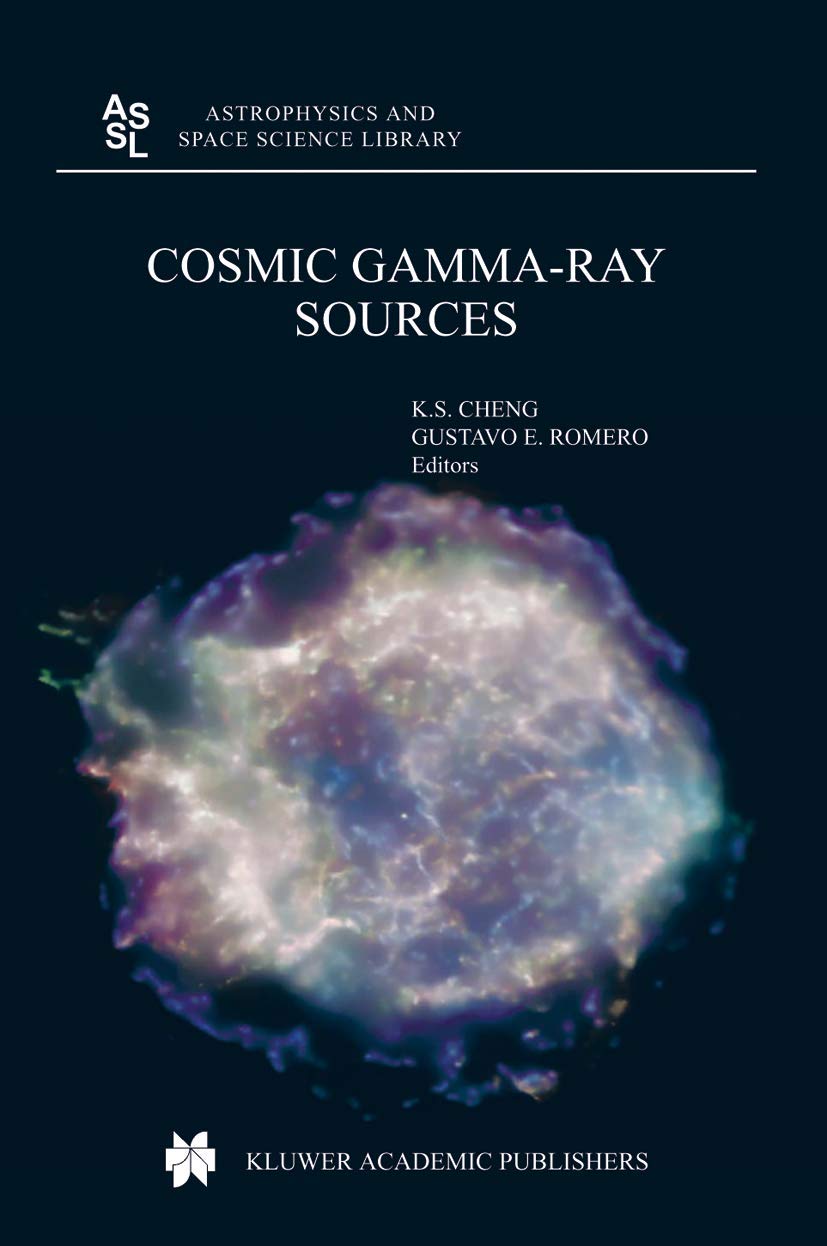
Title
Cosmic GammaRay Sources (Astrophysics and Space Science Library, 304),New
Sold by Ergodebooks, an authorized reseller.
Returns accepted within 30 days | support@ergodebooks.com
Shipping Information
- Free Standard Shipping — United States only
- Processing Time: 3–5 business days
- Estimated Delivery: 6–10 business days after dispatch
- Double-boxed, fully insured & discreetly packaged
- Tracking number sent via email once dispatched
Returns & Refund
Returns accepted within 30 days of delivery.
Damaged or Defective Item
Free return shipping + replacement or full refund
Wrong Item Received
Free return shipping + replacement or full refund
Change of Mind
Return shipping at customer's expense · 25% restocking fee applies
Payment Option

Gammaray astronomy has undergone an enormous progress in the last 15 years. The success of satellite experiments like NASA's Comp ton GammaRay Observatory and ESA's INTEGRAL mission, as well as of groundbased instruments have open new views into the highenergy Universe. Different classes of cosmic gammaray sources have been now detected at different energies, in addition to young radio pulsars and gammaray bursts, the classical ones. The new sources include radio quiet pulsars, microquasars, supernova remnants, starburst galaxies, ra dio galaxies, flatspectrum radio quasars, and BL Lacertae objects. A large number of unidentified sources strongly suggests that this brief enumeration is far from complete. Gammaray bursts are now estab lished as extragalactic sources with tremendous energy output. There is accumulating evidence supporting the idea that massive stars and star forming regions can accelerate charged particles up to relativistic ener gies making them gammaray sources. Gammaray astronomy has also proved to be a powerful tool for cosmology imposing constraints to the background photon fields that can absorb the gammaray flux from dis tant sources. All this has profound implications for our current ideas about how particles are accelerated and transported in both the local and distant U niverse. The evolution of our knowledge on the gammaray sky has been so fast that is not easy for the nonspecialist scientist and the graduate student to be aware of the full potential of this field or to grasp the fundamentals of a given topic in order to attempt some original contribution.
⚠️ WARNING (California Proposition 65):
This product may contain chemicals known to the State of California to cause cancer, birth defects, or other reproductive harm.
For more information, please visit www.P65Warnings.ca.gov.