
Title
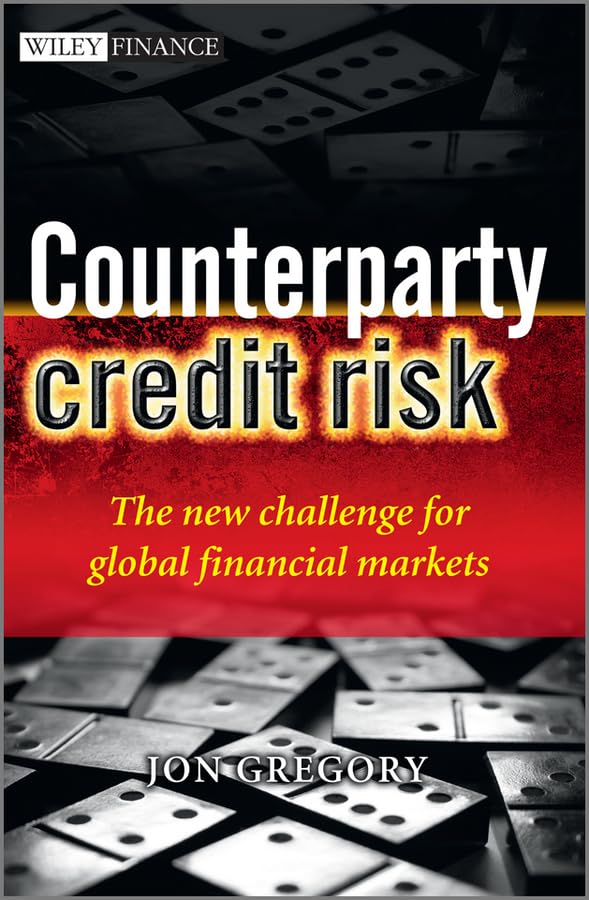
Counterparty Credit Risk: The new challenge for global financial markets (The Wiley Finance Series),Used
Sold by Ergodebooks, an authorized reseller.
Returns accepted within 30 days | support@ergodebooks.com
Shipping Information
- Free Standard Shipping — United States only
- Processing Time: 3–5 business days
- Estimated Delivery: 6–10 business days after dispatch
- Double-boxed, fully insured & discreetly packaged
- Tracking number sent via email once dispatched
Returns & Refund
Returns accepted within 30 days of delivery.
Damaged or Defective Item
Free return shipping + replacement or full refund
Wrong Item Received
Free return shipping + replacement or full refund
Change of Mind
Return shipping at customer's expense · 25% restocking fee applies
Payment Option

The first decade of the 21st Century has been disastrous for financial institutions, derivatives and risk management. Counterparty credit risk has become the key element of financial risk management, highlighted by the bankruptcy of the investment bank Lehman Brothers and failure of other high profile institutions such as Bear Sterns, AIG, Fannie Mae and Freddie Mac. The sudden realisation of extensive counterparty risks has severely compromised the health of global financial markets. Counterparty risk is now a key problem for all financial institutions.This book explains the emergence of counterparty risk during the recent credit crisis. The quantification of firmwide credit exposure for trading desks and businesses is discussed alongside risk mitigation methods such as netting and collateral management (margining). Banks and other financial institutions have been recently developing their capabilities for pricing counterparty risk and these elements are considered in detail via a characterisation of credit value adjustment (CVA). The implications of an institution valuing their own default via debt value adjustment (DVA) are also considered at length. Hedging aspects, together with the associated instruments such as credit defaults swaps (CDSs) and contingent CDS (CCDS) are described in full.A key feature of the credit crisis has been the realisation of wrongway risks illustrated by the failure of monoline insurance companies. Wrongway counterparty risks are addressed in detail in relation to interest rate, foreign exchange, commodity and, in particular, credit derivative products. Portfolio counterparty risk is covered, together with the regulatory aspects as defined by the Basel II capital requirements. The management of counterparty risk within an institution is also discussed in detail. Finally, the design and benefits of central clearing, a recent development to attempt to control the rapid growth of counterparty risk, is considered.This book is unique in being practically focused but also covering the more technical aspects. It is an invaluable complete reference guide for any market practitioner with any responsibility or interest within the area of counterparty credit risk.
⚠️ WARNING (California Proposition 65):
This product may contain chemicals known to the State of California to cause cancer, birth defects, or other reproductive harm.
For more information, please visit www.P65Warnings.ca.gov.
- Q: What is the primary focus of 'Counterparty Credit Risk'? A: 'Counterparty Credit Risk: The new challenge for global financial markets' primarily focuses on the emergence and management of counterparty credit risk, especially in the context of the financial crises of the 21st century.
- Q: Who is the author of this book? A: The book is authored by Jon Gregory, who provides insights into counterparty credit risk and its implications for financial institutions.
- Q: How many pages does this book have? A: The book consists of 448 pages, offering a comprehensive analysis of counterparty credit risk and its management.
- Q: What are some key features covered in the book? A: Key features of the book include discussions on credit value adjustment (CVA), debt value adjustment (DVA), wrong-way risks, hedging strategies, and regulatory aspects under Basel II.
- Q: What type of binding does this book have? A: This edition of the book is available in hardcover binding, providing durability for frequent use.
- Q: Is this book suitable for beginners in finance? A: While the book is practically focused, it also covers technical aspects, making it suitable for both beginners and experienced market practitioners interested in counterparty credit risk.
- Q: When was this book published? A: The book was published on January 26, 2010.
- Q: What condition is the book in? A: The book is listed as 'Used Book in Good Condition', indicating it may have some wear but is still functional for use.
- Q: Does this book discuss regulatory requirements? A: Yes, the book discusses regulatory aspects defined by Basel II capital requirements, which are crucial for managing counterparty risk.
- Q: Can this book help in understanding risk mitigation methods? A: Yes, the book explains various risk mitigation methods including netting, collateral management, and the use of credit default swaps (CDS) and contingent CDS.